SustainabilityOnline recently published its inaugural ‘Ambition Into Action’ report, featuring interviews with senior leaders about how they are turning sustainability vision into business reality at the mid-point of the decade.
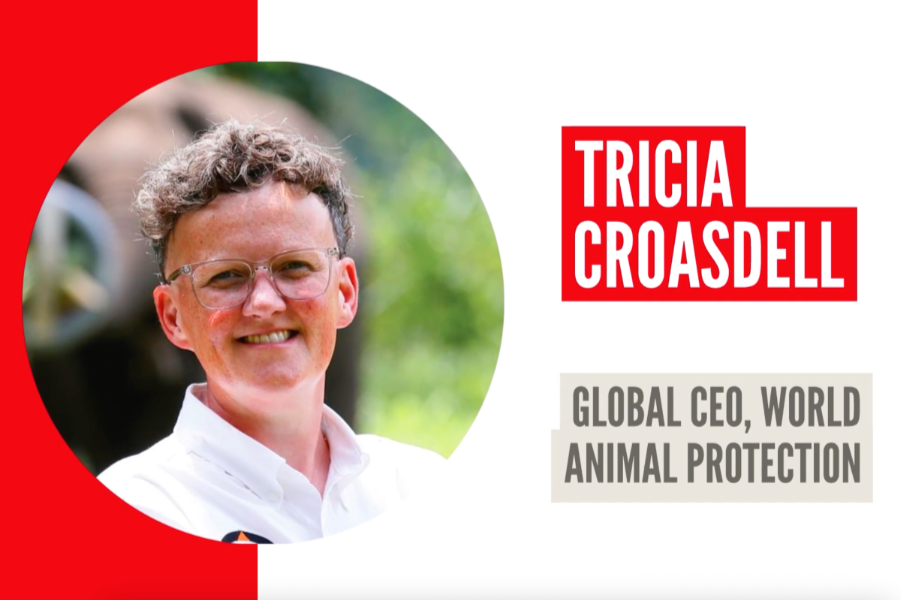
Tricia Croasdell has been the Global Chief Executive Officer of World Animal Protection since July 2024, having previously served as UK Country Director at the organisation. As CEO, she is leading efforts to address animal cruelty, transform global food systems, and reduce reliance on factory farming.
Her previous roles include positions at WWF, the UK Government, and 10 Downing Street, in areas such as communications, campaigns, and institutional funding.
How has World Animal Protection moved from ‘ambition to action’ in terms of turning sustainability into a core value driver – in other words, how have you made sustainability ‘good for business’?
For 75 years, World Animal Protection has helped and advocated for animals. A sustainable world for all is core to our mission. Industrial animal agriculture, where billions of animals live in cramped confinement, bred for profit, drives climate crisis, destruction of wild animal habitats and increases the risk to human health. Likewise, the commodification of wild animals for entertainment props up the wildlife trade and keeps millions of animals in a never-ending loop for human entertainment and profit.
Animals, people and the planet are deeply connected. Our economies, globally, are now increasingly reliant on vulnerable global supply chains. So, for us at World Animal Protection, the question is not ‘Whether the private sector should move from ambition to action?’, but rather how quickly businesses can shift will be the key not only to their survival, but all of ours.
World Animal Protection was founded to help animals in need. But in 2020, we pivoted our focus to turning off the ‘tap’ of cruelty through driving systemic change. We actively challenge the drivers of our food systems, namely industrial animal agriculture – the unrecognised climate culprit – and the wildlife trade.
Any company that wants to become truly sustainable, we want to work with you to raise your animal welfare standards, focusing on alternatives that positively promote brands as they work to meet their sustainable goals and ESG commitments.
Our resources and guidelines support companies seeking to move from ambition to action. But we won’t tolerate those seeking merely to ‘greenwash’ their brand.
We’re now at the mid point of the decade. What do you see as the single biggest barrier for businesses in moving from ambition to measurable action – and how can it be overcome?
We are facing a triple threat of climate change, biodiversity loss and increased human health risks. Our future is under threat, so any business continuing with the status quo is contributing to our collective downfall. In our work with businesses, we see companies not building sustainability into their future. This has no good long-term outcomes.
Any business owners, whose model depends on the exploitation of animals, wild habitats, or the extraction of natural resources, need to radically rethink their business model. Today’s consumers have incredible decision-making opportunities. They can gain knowledge about a company’s practices and products in an instant. They want responsible, ethical choices. They want transparency from brands, and increasingly, they expect animal welfare, along with ESG, to be acknowledged and incorporated into company guidelines and policies.
They can play a huge role in steering consumer demand, improving conditions for animals in their supply chains, and asking suppliers to end exploitative and cruel practices.
What role can (and should) leadership play in ensuring sustainability commitments actually deliver results, rather than remaining aspirational? And how can you ensure buy-in from all stakeholders?
The giants of industry should lead by example. However, in my experience, we often find that the largest companies fear change and hide behind long-term practices and convoluted supply chains. Some of the biggest organisations doing the most damage to animals and our planet are largely unknown as they hide behind multiple brands or companies.
We unmask those organisations as a way of educating consumers on where their food comes from, or which companies support wild animals being held in cruel captivity. While we openly challenge companies on their sustainability commitments, we also want to support companies who want to change.
Good leaders are responsible and accountable. As a CEO, I know how important this is. World Animal Protection is changing the way the world works to end animal cruelty.
Through my leadership, I bring our staff from across five continents, our board, our supporters, our donors, the media and the private sector on the journey to show that when we put animals at the heart of what we do, the planet will be healthier, people will be happier and healthier and I truly believe that we can create a better world for all, but especially for animals – who deserve to live free from suffering.
Learn more about World Animal Protection at www.worldanimalprotection.org.