SustainabilityOnline recently published its inaugural ‘Ambition Into Action’ report, featuring interviews with senior leaders about how they are turning sustainability vision into business reality at the mid-point of the decade.
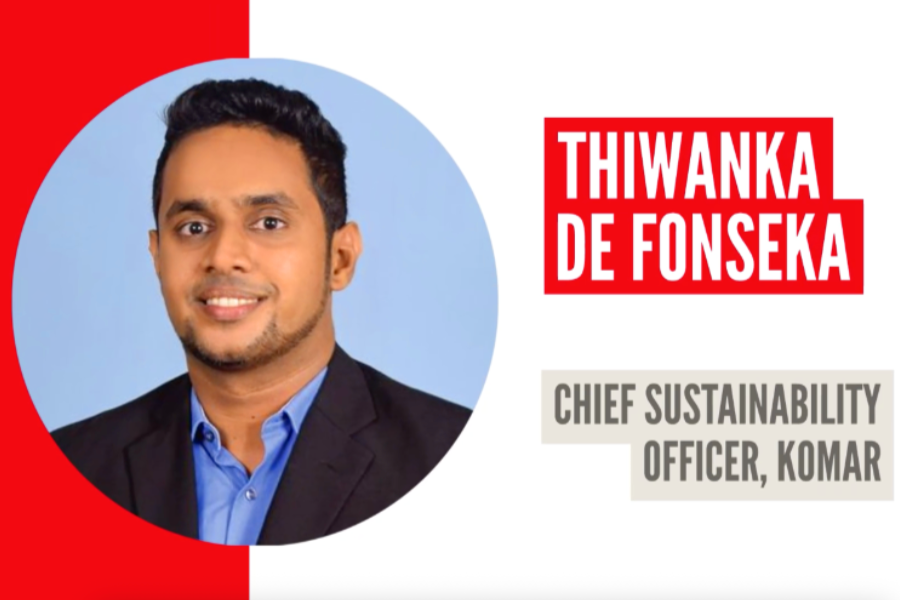
Dr Thiwanka De Fonseka is the Chief Sustainability Officer at apparel firm Komar, leading initiatives on environmental and product sustainability. He has been with Komar since November 2023, initially serving as Director of Sustainability before being promoted to CSO in March 2025. His work spans policy development, stakeholder engagement, and the implementation of environmental initiatives.
How has Komar moved from ‘ambition to action’ in terms of turning sustainability into a core value driver – in other words, how have you made sustainability ‘good for business’?
At Komar, sustainability has shifted from being just a corporate ambition to a fundamental value that drives competitiveness, efficiency, and long-term brand strength. Our philosophy is simple: doing what’s right for the planet must also make business sense, aligned with our organisational motto, ‘one reputation–real values’.
When Komar set SBTi-approved near-term targets in 2023 (46.2% reduction in Scope 1 & 2 and 27.5% reduction in Scope 3 by 2030, compared to the 2019 baseline), we didn’t treat them as standalone goals. We integrated them into our business planning, sourcing, and product development processes.
All sustainability objectives in Komar’s 2030 sustainability strategy are tied to measurable business KPIs: cost savings, operational efficiency, supplier reliability, regulatory compliance, and customer value creation.
For example, our energy transition (80% renewable electricity in owned operations by 2030) has lowered long-term utility costs, insulated operations from energy price volatility, and strengthened resilience. Also, eliminating coal from Tier 1 suppliers by 2025 and Tier 2 suppliers by 2028 reduces regulatory and reputational risk while improving relationships with global retail partners, which now demand low-carbon sourcing.
We’ve shifted from reactive compliance to proactive risk mitigation by collaborating with suppliers to phase out high-carbon processes and adopt standards, such as ZDHC, to ensure safe chemistries in our products and responsible wastewater discharge. We’ve reduced environmental risks that directly translate into financial and operational resilience by making data-driven decisions in the supply chain, using tools such as Higg FEM, ZDHC Chemical Gateway, and BHive.
Our supplier management strategies are built on shared sustainability goals, continuous capacity building, and equitable partnerships. This has resulted in improved supplier retention rates while ensuring the supply chain is better prepared for both environmental and regulatory changes.
Sustainability has also become a catalyst for innovation in product design and materials. Expanding low-impact material lines (sustainably sourced cotton, recycled polyester, MMCF from Green Shirt–certified producers) has opened new markets and strengthened partnerships with retailers focused on sustainability performance.
By integrating sustainability metrics into operational dashboards, Komar now treats environmental data as any other business performance indicator. Komar’s emphasis on traceable, ethically made, low-carbon apparel strengthens our standing with both retail partners and end consumers.
We view sustainability not as a ‘department initiative’, but as a shared responsibility and a business opportunity. Komar’s shift from ambition to action has demonstrated that sustainability is not a cost centre but a profit driver, an innovation enabler, and a long-term value creator.
We’re now at the midpoint of the decade. What do you see as the single biggest barrier for businesses in moving from ambition to measurable action – and how can it be overcome?
I think, at the midpoint of the decade, the single biggest barrier to businesses turning their sustainability ambitions into measurable action is the gap between corporate commitments and supply chain implementation capacity.
Considering the apparel industry, most apparel brands set strong sustainability goals, including net-zero targets, alignment with the SBTi, and circular product roadmaps.
However, over 80–90% of emissions (Scope 3) occur outside their direct control, deep within a fragmented, multi-tiered supply chain. While these goals are global, their implementation is local, technical, and resource-dependent. Many suppliers often lack the capital, data, and technical expertise needed for decarbonisation.
Additionally, some factories operate in regions with limited access to renewable energy, such as through PPAs, for example, in Bangladesh, Cambodia, and Sri Lanka. Most brands’ incentives often stop at Tier 1 and Tier 2, leaving Tier 3 and Tier 4 facilities out of the transformation loop due to a lack of clarity about who their Tier 3s and Tier 4s are.
However, Tier 3s and Tier 4s are generally accountable for around 37% of GHG emissions in the apparel value chain. This structural disconnect is the biggest bottleneck between aspiration and action.
To overcome this barrier, brands must go beyond mere compliance and regulatory reporting by providing direct technical and financial support to suppliers. This includes co-investing in renewable energy, efficiency upgrades, and retrofits; establishing better supply chain traceability to develop joint sustainability roadmaps with Tier 1 to Tier 4 suppliers; and helping suppliers access climate finance and affordable transition capital.
Additionally, the reporting burden on suppliers should be reduced by using common industry-wide tools rather than individual tools. This approach ensures that when suppliers report once, and all brands use that data, progress accelerates and duplication decreases.
The next half of this decade isn’t about setting more goals. It is about empowering people, supply chain partners, and systems to turn those goals into measurable, realistic actions that close the gap between corporate commitments and supply chain implementation capacity.
What role can (and should) leadership play in ensuring sustainability commitments actually deliver results, rather than remaining aspirational? And how can you ensure buy-in from all stakeholders?
True sustainability leadership isn’t about making bold statements; it’s about embedding accountability, resources, and culture around measurable outcomes.
Leaders must treat sustainability as a core business function, not a communications pillar. Some of those actions could include embedding sustainability KPIs into executive scorecards and performance reviews, integrating climate risk and impact metrics into quarterly business dashboards, and discussing sustainability alongside profitability, resilience, and innovation.
Leaders must integrate sustainability into every strategic decision, from sourcing to product design to marketing. Some of those examples include considering suppliers’ sustainability credentials during onboarding as a mandatory criterion and guiding product decisions based on lifecycle impacts and carbon budgets.
Many sustainability goals fail because middle managers, who handle daily decisions, don’t see how these goals link to their performance metrics. Therefore, leadership must translate high-level commitments into departmental KPIs, not just for the sustainability team but across the entire organisation. They should also equip teams with the tools, training, and data needed to implement sustainability practices and celebrate small wins, because every emission reduction or process improvement is proof of progress.
Achieving impactful results requires buy-in from the entire ecosystem: employees, suppliers, customers, investors, and communities. Therefore, leadership could incorporate sustainability into employees’ career growth and learning paths across the organisation, and provide preferential contracts or financing to suppliers with stronger sustainability performance.
Collaboration is key to delivering sustainable ambitions, as sustainability is all about collaboration, not competition. Leaders should join coalitions to harmonise data and standards, encourage suppliers to share innovation rather than hoard best practices, and support policy advocacy that enables decarbonisation at scale. When leadership drives collective progress, systemic change follows.
Last but not least, transparent disclosure is essential for achieving greater impact. Leadership should use data-driven storytelling to show how sustainability produces tangible results (e.g., energy cost savings, GHG emissions reduction, waste reduction, water reuse/recycle, chemical compliance) and share case studies from factories, designers, or community projects that illustrate sustainability in action.
Leadership is the bridge between sustainability commitments and sustainability performance. Without leadership that funds, measures, and owns sustainability outcomes, ambition remains rhetoric. When leaders treat sustainability as a strategic investment, not a moral obligation, it becomes good business, smart governance, and a strong culture with impactful results, all at once.
Learn more about Komar’s sustainability initiatives at komarbrands.com/our-impact.