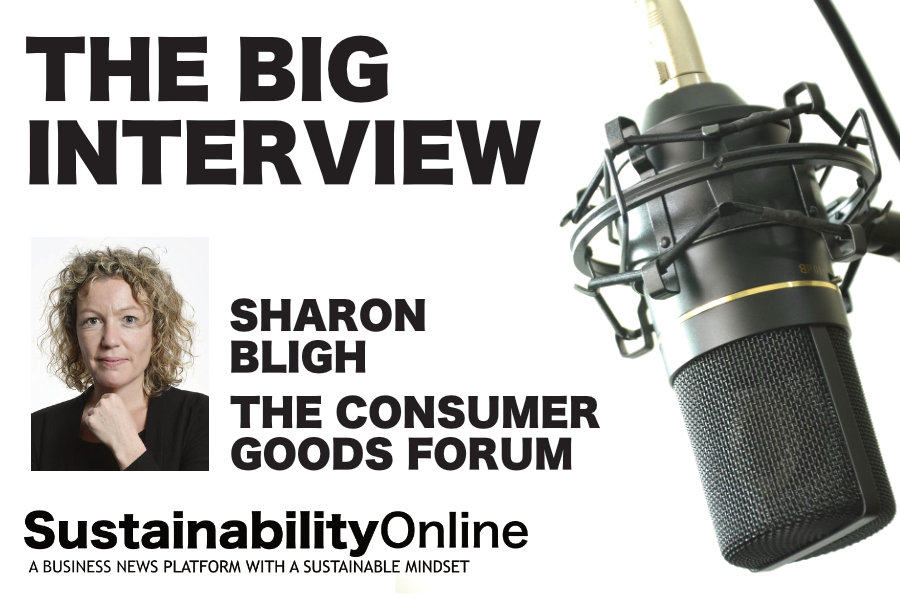
The Consumer Goods Forum’s Food Waste Coalition of Action recently reported a 22% reduction in average company-level food waste intensity among its members since 2021, as it tracks progress towards the goal of halving food loss and waste by 2030. The coalition, which is co-chaired by Walmart and Babybel manufacturer Bel Group, currently includes 18 retailers and manufacturers.
SustainabilityOnline caught up with Sharon Bligh, director of Health & Sustainability at The Consumer Goods Forum (CGF), at its recent Global Summit in Vienna, Austria, to learn more about the progress being made, and the challenges involved.
Food waste intensity
As she explains, while manufacturers have made progress in managing food waste, retailers continue to face hurdles.
“We chose ‘intensity’ as a metric for tracking food waste, because as you grow as an organisation, your tonnage is also going to grow,” she says. “That meant that it was hard for us to compare progress, so we picked intensity as a way of measuring how a business is managing its food waste. We’re happy with it as a metric, because we can really see what we’re getting better at.
“It changes the conversation. Nobody wants to buy things and waste them. And the leading pack is now helping the others to improve as well.”
By working with WRAP to gather data, the coalition has been able to better understand the food waste journey, while supporting newer members with measurement and reporting tools. The coalition has also published guidance on its Target, Measure, Act approach, to help companies and local food waste groups improve reporting – according to Bligh, measurement remains a barrier because companies can find the process difficult.
“We believe the reason more people aren’t reporting is that it’s actually quite challenging, and confusing as to what you should do,” she says.
A business issue
While the macroeconomic picture remains challenging, Bligh believes that food waste should be considered a business issue, because products that are purchased and subsequently wasted represent a financial loss.
“Why would you want to bleed money as a business?” she says. “It makes no sense. But there’s still something about food waste that doesn’t get that cut through.”
The coalition is currently developing a Value of Food Framework, alongside Systemiq, to assess the environmental, financial and nutritional impacts of food waste, extending the focus to upstream and consumer waste.
“We can quantify what it means in terms of emissions, euros and nutritional calories,” she says. “So companies then have a full picture of what food waste reduction means beyond just tonnage or intensity.”
At the same time, she believes that food waste remains difficult for food businesses to discuss, because it raises questions about inefficiencies in their supply chain.
“A lot of the manufacturers that I talk to say, ‘Well, I’ve got this sorted. I don’t need to join a coalition to do this’,” she says. “But even if 2% of your operations are still affected, for a global manufacturer, that’s still a huge amount of food waste.
“There is a perception, particularly in manufacturing communities, that they don’t necessarily need the collaborative aspect of it, whereas retailers really understand that they need help.”
Supply chain intervention
The coalition is also examining food waste across supply chains, with its Global Farm Loss Tool involving manufacturers, retailers, growers and buyers assessing contracts and product specifications and “considering what more they can do together”,” says Bligh.
Downstream, members are similarly sharing approaches to reducing household food waste, with the coalition exploring how artificial intelligence could be harnessed to tackle waste in the home.
“We’ve done a lot of sharing sessions on using AI for waste reduction, and we’re now discussing a modelling project with Wageningen University to explore the most impactful levers for reducing household waste,” says Bligh. “Is it about date labelling? Is it about helping people with their shopping lists? That’s a big project.”
She believes that food waste messaging should encourage people to use what they already have rather than make them feel guilty, pointing to the approach taken by Tesco, which encourages customers to use food already in their fridge, thereby avoiding unnecessary purchases.
“Tesco has found that simply changing the messaging to help people use everything they have, or giving them recipes and ideas, has created more loyalty. There are some companies who say, ‘Why would I encourage people to buy less from me?’ But they’ve received really positive feedback through their loyalty Clubcard data, and customers actually appreciate that messaging.”
Looking ahead
The Consumer Goods Forum remains committed to UN Sustainable Development Goal 12.3, which seeks to halve food waste by 2030, although she admits that reaching the target is not guaranteed.
“We have the data now, so we’re able to model whether we’ll get there or not,” says Bligh. “It’s not guaranteed that we will. Honestly, it’s not.
“But the reason we’re developing this Value of Food Framework is that we see that for our members, it’s just not going to be enough to focus on their own operations. They’re going to need to work with the farming community, and they’re going to need to bring consumers on the journey.”
With the new decade just four years away, the coalition has also begun discussions about its role beyond 2030, with new members showing eagerness to remain involved for the foreseeable future – “if you join this, you’re in it for the journey,” as Bligh puts it.
She also acknowledges that attitudes towards sustainability targets are changing, with greater acceptance of progress even when businesses do not fully achieve their stated goals.
“There’s more transparency in the way companies are talking about it now,” she says. “That has changed compared to several years ago, when you would get criticised for not meeting a target.
“I think there’s just more acceptance that this is not easy. ‘Ok, you got to 98% – you didn’t quite get to 100%, but you’re almost there’. People are much more open about that now, in this space.”
Learn more about The Consumer Goods Forum’s Food Waste Coalition of Action at www.theconsumergoodsforum.com/coalitions-of-action-industry-solutions/food-waste/