Global municipal waste is projected to rise from 2.1 billion tonnes in 2023 to 3.8 billion tonnes by 2050. Yet UNEP estimates that shifting towards a circular economy could turn the growing cost of waste into a net annual gain of $108.5 billion by 2050.
For businesses, one of the simplest opportunities can be overlooked. The US Environmental Protection Agency (EPA) places reduction and reuse ahead of recycling in its waste hierarchy, encouraging organisations to preserve the useful life of materials before processing them into something new.
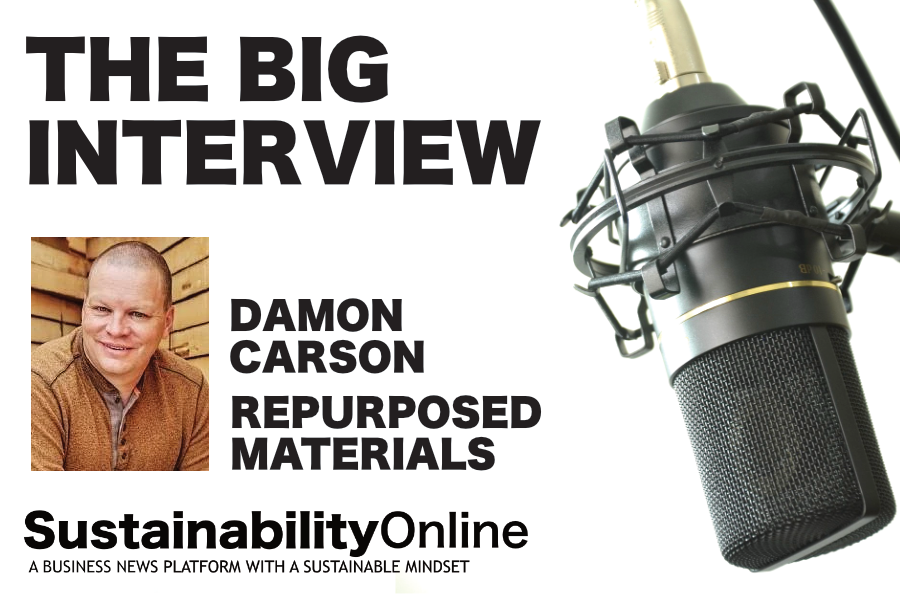
Damon Carson has built a business around that principle. As founder and president of repurposedMATERIALS, he helps find second uses for industrial materials that companies no longer need, with the business now operating across six US locations.
Speaking exclusively to the Sustainability Speakers Agency, Carson explains why obsolete does not necessarily mean waste, how materials discarded by one industry can solve problems in another, the practical barriers to industrial reuse and how businesses can build repurposing into their sustainability strategies.
What do you want businesses to understand about waste and material repurposing?
I think a big misnomer is that the only option for things that are obsolete to primary industry is landfill, waste to energy or recycling.
Most people think, ‘well, if it’s no good to us, it’s just no good anymore’. But things that one industry deems obsolete or useless, the castoffs and discards, can find a very different second life. That’s what we call repurposing.
Just because something doesn’t fit your company and your application any longer doesn’t mean it is totally valueless. It may have utility again if you change how you think about it and how you use it.
It could have a very long extended life in an alternate application.
What is the most creative application of material repurposing you have seen?
The list is quite long. As one example, we had a bunch of concrete pads come from a telecommunications company.
They were four inches thick, four foot by four foot, just concrete pads. They would set their telecommunications equipment on them, drill holes in the concrete and run out cable television to the homes in a subdivision.
They were done with them and didn’t want them anymore, so they reached out to us: can you find a second life, a different life, a repurpose for these?
We brought them in. It didn’t take but two or three weeks, and a motor freight trucking company bought them because they have a big problem in the trucking industry when they have light loads, where their trucks are not full, and they’re travelling in areas that are very windy. Their trucks literally can blow over.
So on days they have light loads and it’s windy, they’re going to use those concrete blocks as ballast to add weight and lessen the risk of the trucks blowing over.
These concrete pads, obsolete to the telecommunications industry, became a solution for the trucking industry.
What are some of the biggest hurdles you’ve faced in repurposing materials?
I think there are multiple challenges. One is logistics. It’s a very logistics-intensive business. A lot of the industrial materials that we re-home are very heavy. A lot of times they have to go across the state or across the country, so there’s lots of logistics involved.
It’s also hard to make other, diverse industries aware of these materials that they could potentially repurpose. So it’s both a marketing challenge and a logistics challenge.
Thirdly, you don’t make the matches instantly. The materials have to sit somewhere. They have to be stored. So warehousing, which is a subheading of logistics, is a big challenge to this whole repurposing.
How can businesses incorporate repurposing into their sustainability strategies?
I think one of the things companies can do is take fresh eyes to the waste streams they create. Most people work in a company for months or years and they’re used to walking by the dumpster. It’s just trash, it’s no good.
But if they step back and put fresh eyes on it, just because it’s obsolete to them doesn’t mean there isn’t something across the street, across the province or across the nation, another industry they don’t even know about or interact with, that could give new life to these discards and castoffs.
I think it’s a matter of broadcasting and getting people to step back and say: it’s no longer good to us, but maybe there is a different industry that could give this an alternate or second life.
This exclusive interview with Damon Carson was conducted by Tabish Ali of the Motivational Speakers Agency.