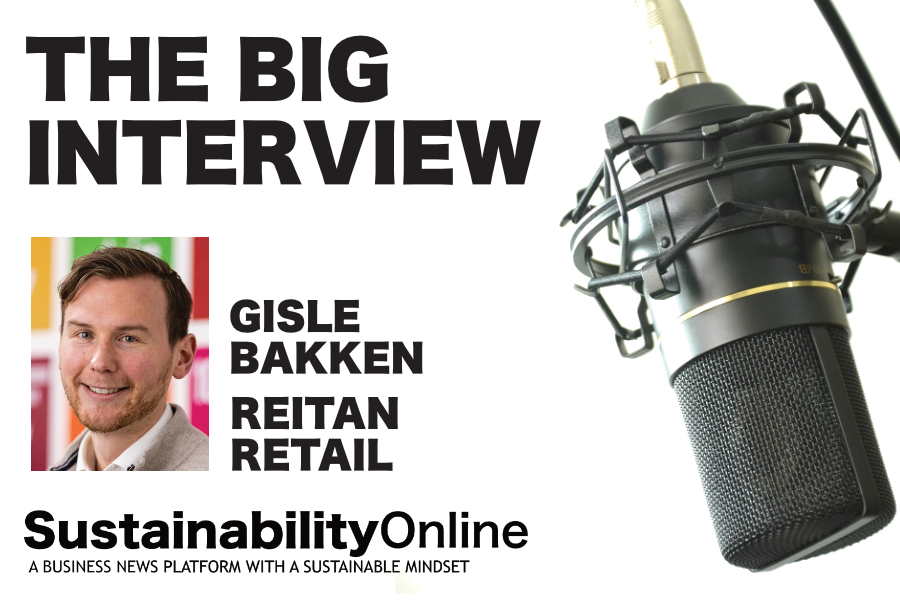
Reitan Retail is one of the largest retail conglomerates in the Nordic and Baltic region, and is home to brands such as REMA 1000, Narvesen, R-kioski, Pressbyrån, Caffeine, Uno-X Mobility, and the regional franchise for 7-Eleven.
Gisle Bakken is head of operations at Reitan Retail Innovation, the group’s unit for sustainable innovation and scaling. At the recent Economist Enterprise Sustainability Week Europe Summit in Amsterdam, Bakken took part in a panel discussion on the topic of ‘decarbonising complex value chains’, where he discussed how the business sees to engage with its value chain on solutions to reduce emissions, and alleviate the ‘innovation gap’ when it comes to climate action.
“My role is to find innovations that can help us, at a reasonable cost,” he explained at the event. “The business case has to underpin everything we do.”
‘At the core’
SustainabilityOnline caught up with him on the sidelines of that event, where he explained that sustainability is central to his department’s agenda.
“It’s at the core of our mandate,” he says. “We’re dedicated to finding new solutions that will reduce emissions in our value chain.”
Reitan Retail uses climate accounting reports to identify its main emissions drivers and prioritise action in its value chain. As an example, building on work examining the poultry value chain, Bakken’s team identified common sources of emissions across different food systems, including feed production.
“Looking at the full scope of retail, most food systems are connected,” he says. “They use the same kind of technology, the same raw materials. So, we examined the emission drivers we could aggregate across products such as red meat, white meat and fish. That led to 10 drivers that basically account for all the emissions in our value chain.
“You need scale for lower-emissions solutions, so if you can create novel proteins that can go into fish feed but also poultry feed and pork feed, that becomes more achievable. That’s the sort of approach we take.”
Financially competitive
According to Bakken, sustainability investments need to be financially watertight if they are to succeed over the long term.
“We’ve always viewed sustainability as something that also needs to be financially competitive, because if it’s not, it will eventually fall down as an endeavour,” he says, citing the group’s investment in renewable energy solutions on farms.
“We need to make sure they deliver a positive return on investment for farmers. Otherwise, we risk driving that part of the value chain into the ground. We can’t afford to do that.”
He also cites the importance of cross-industry collaboration, particularly in pre-competitive areas such as establishing consistent methods for calculating emissions.
“I think there is more collaboration upstream in the value chain,” he says. “There is also close dialogue when it comes to setting standards for how to calculate emissions.
“Across industry, it’s important to make sure that everyone is operating by the same methodology. We do projects, for example, where we work with dairy suppliers on how to improve shelf life and reduce waste, which can benefit the whole industry.”
Independent certification
As a largely discount-focused retailer, Reitan Retail needs to remain competitive on price, however Bakken believes that local sourcing and animal welfare are increasing in importance when it comes to purchase considerations. This is where independent certification can play an important role.
“If you make a claim on animal welfare, you have to ensure that there’s a third party who has audited that claim,” he adds. “Otherwise, it doesn’t really have a value. REMA 1000 and Norsk Kylling was the first retailer and poultry producer to fully implement the European Chicken Commitment [also known as the Better Chicken Commitment], which makes the animal welfare message way easier to communicate to the customer.”
Enabling technology
Technology, in particular AI, is playing an increasingly important role in supporting Reitan Retail’s sustainability work – “AI is becoming part of more and more of what we do,” says Bakken – with applications in animal feed, identifying new technologies and improving supply chain efficiency, as well as collecting better data on energy consumption at farms and in buildings.
As such, he believes that technology will play an important role in enabling the group to achieve its 2050 net zero targets.
“I think it’s important for us to stay optimistic when it comes to technology and not underestimate it,” he says. “Otherwise, we could miss out on opportunities in this area. And this is where collaboration comes in as well.”
Learn more about Reitan Retail’s sustainability journey at www.reitanretail.no/en/responsibility/environment.