A new study by Enverus Intelligence Research (EIR) has suggested that the water footprint of AI data centres is less than that of household electricity systems, almond milk, and golf.
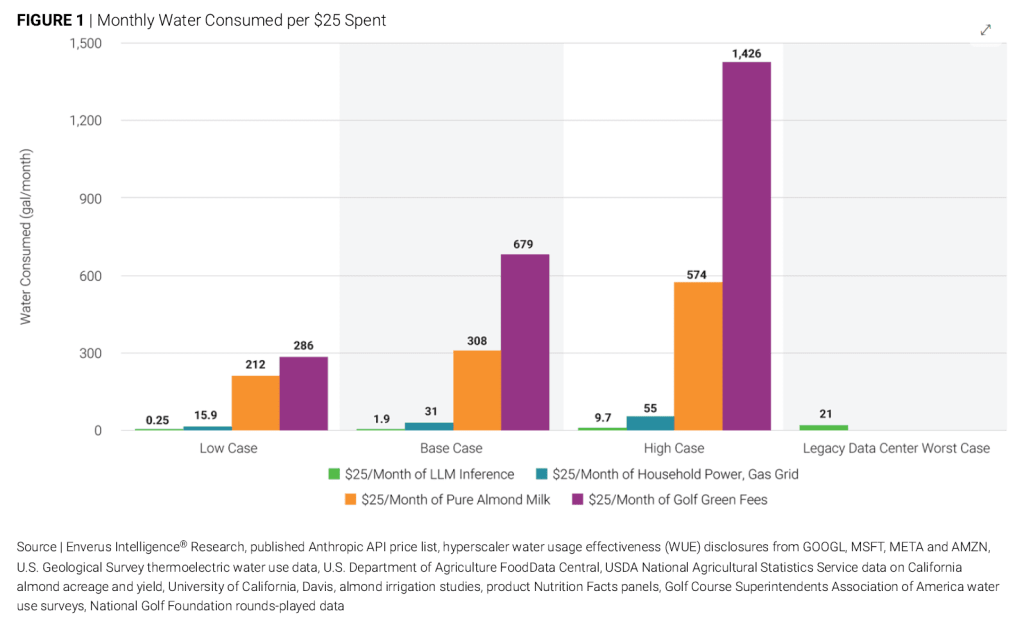
The report, Data Center Water Use: Setting the Record Straight uses a monthly spending benchmark of $25 to compare water consumption across different activities.
As it claims, this level of spend on frontier large language model (LLM) inference corresponds to around 1.9 gallons of water consumed, including the water used to generate its electricity.
By comparison, the same amount spent on household electricity supplied by an entirely natural gas-powered grid corresponds to 31 gallons of water consumption. For almond milk consumption, this rises to 308 gallons, while for public golf course green fees, it totals 679 gallons.
‘A consistent basis’
“Water use is a real factor in data centre siting, but the numbers people quote rarely have a consistent basis,” commented Ryan Luther, director of Energy Transition Research at EIR.
“If a typical consumer is worried about their water footprint, skipping one almond latte a week does more than giving up AI chatbots entirely.”
Power generation
According to EIR’s report, power generation accounts for most of the water consumption associated with AI inference – around 90% is utilised at power plants rather than at the data centre itself.
It also claims that a modern hyperscale data centre campus consumes less water per acre – around 32,100 gallons per acre per month – than irrigated crops such as rice, almonds and alfalfa, and around the same amount as an average US golf course.
EIR said that its analysis draws on several data products, including its Enverus ONE platform. EIR is a subsidiary of Enverus, a SaaS provider to energy producers.
Water scarcity
Separate recent research from the Carnegie Institution for Science and Stanford University found that 25% of the world’s more than 9,300 data centres are located in areas experiencing at least one month of water scarcity annually, a figure that could rise to a third by the 2040s.
The same study also noted that while data centres are projected to account for only 0.1% of global water consumption – and around 1/800th of what irrigated agriculture consumes – by the end of the decade, their impact can be significant at local level, with water supply competing with that of households, agriculture and ecosystems.