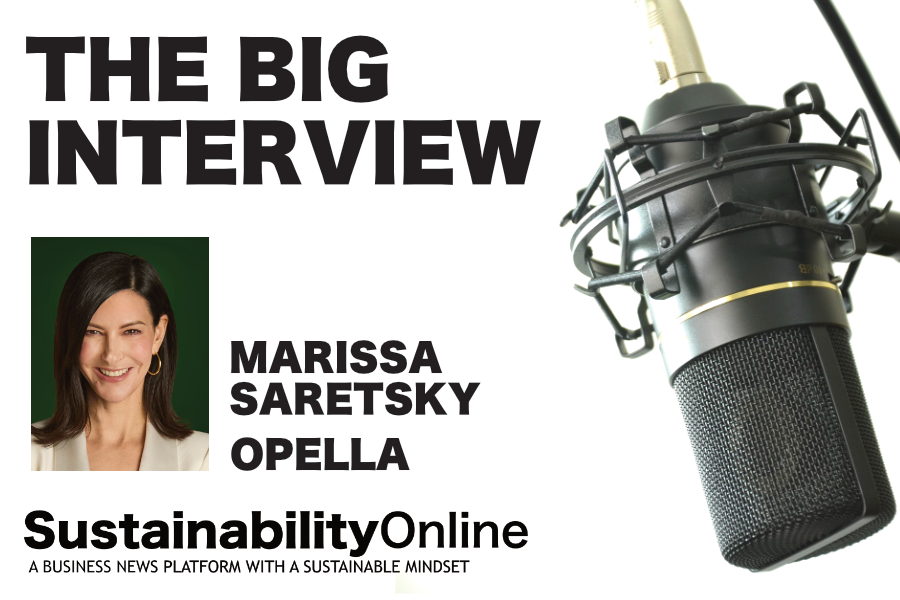
Headquartered in France, Opella says that its mission is to bring health back into people’s hands by making self-care as simple as it should be.
Formerly known as Sanofi Consumer Healthcare, the business, which boasts more than 100 brands across the over-the-counter medicines and vitamins, minerals and supplements sectors, is seeking to move healthcare away from a reactive model and towards prevention and long-term health management.
At the recent Economist Enterprise Sustainability Week Europe Summit in Amsterdam, Marissa Saretsky, chief sustainability officer at Opella, took part in a panel discussion on how consumer-facing companies can connect sustainability with business value and innovation.
As she tells SustainabilityOnline, at Opella this means finding ways to make its products more environmentally responsible while maintaining their effectiveness.
‘Making it easy’
“We’re the third largest consumer healthcare company in the world,” she explains. “My job is to make sure that each and every product we put on the shelf is as sustainable as possible, while making it as easy as possible for the consumer to choose a product that is not only going to be effective for their health, but also for the planet.”
As Saretsky notes, while the moral case for sustainability is well understood, ensuring the business case stacks up requires a different way of thinking. Opella focuses on two areas: preserving value by considering the cost of inaction and potential future savings, and creating value in the shorter term.
“It’s also about framing that for our different stakeholders, whether that be the board, our executive committee, or senior leaders in the different functions of our business, because they need to understand the context,” she says. “Is this about today, or is it for tomorrow? Or, is it going to help us operate in five years from now, when climate change impacts might make it difficult for us to get the active pharmaceutical ingredients we need?”
‘A win-win-win’
According to Saretsky, sustainability needs to deliver value for the business, consumers and the planet. She cites a recent packaging reformulation in which the plastic used in a squeezable product was reduced by 20%, a process that also made the product easier to use.
“That’s key for us,” she says. “The efficacy and the safety of the product is first and foremost, but we also want the consumer experience to remain positive. And sustainability can be used to enhance that.
“It’s actually a win-win-win – you’ve got sustainability, business performance, and consumer acceptance, which drives loyalty and brand equity.”
Opella sees packaging as presenting significant opportunities for sustainable innovation. Through the PulPac collective, it is working alongside competitors such as Kenvue and Haleon to develop paper pulp alternatives to conventional plastic and aluminium blister packs.
“It’s a pre-competitive collaboration, because let’s be honest, a blister pack is not going to give you market share,” says Saretsky. “So, we’re working together to make that shift happen. We know that there’s power in numbers.”
Sustainability strategy
Opella recently launched a new global sustainability strategy, Health³, which positions planetary health, human health and business performance as interconnected rather than separate priorities.
“The concept is very simple,” says Saretsky. “If you don’t have a healthy planet, you won’t have the raw materials and resources you need. You won’t have consumers, and you won’t have healthy workers, whether in your own operations or across your value chain.
“This interconnectedness is something we’re going to hear discussed much more at a societal level going forward.”
She points to recent heatwaves in Europe as an example of how climate change can affect both employees and business operations, creating direct costs for companies. This, in turn, underlines the need to factor climate-related risks into product innovation and business planning.
“When you turn climate and carbon into capital, and risk into roadmaps, you start to show the interconnectedness of these topics,” she says. “So it becomes a question of how we build climate impacts into our innovation. How do we better meet consumers’ needs if climate change is going to affect their health needs? It’s about looking at the planet, people and business holistically, as one equation.”
Health literacy
On preventative care and self-care, Opella has partnered with the International Pharmaceutical Federation on a five-year health literacy initiative, with the aim of helping people make more informed decisions about their health needs. The company is focusing on four skills identified by the World Health Organization: accessing, understanding, evaluating and applying health information.
It also plans to work with 250,000 pharmacists by 2030 to measure health literacy levels across the different markets in which it operates.
“We know today that four in five people do not feel confident making decisions about their own health,” says Saretsky. “Two out of three people are also not treating minor conditions. And we’re seeing people increasingly turning to AI and other sources for diagnoses.
“We live in an information paradox. People have more information than ever before, but they don’t know what to do with it. They’re getting conflicting information from AI, from what their aunt or uncle might say, and from what their pharmacist might say. That’s why health literacy has become so important to us. We have to play a strong role in putting the right information out there and making sure it reaches people across different channels.”
Long-term relationships
Could such efforts, however, lead to reduced demand for OTC medicines, in turn affecting Opella’s sales? Saretsky believes they instead offer an opportunity to build longer-term relationships with consumers, reinforcing the company’s Health³ strategy.
“We recently produced a campaign in France for our pain medication, Doliprane, called The Right Dose, where we encourage people to assess what might be causing their symptoms before taking paracetamol,” she says. “Maybe they’re dehydrated. Maybe they need to sleep, or cool down. We suggest different options before they actually take the medication.
“That’s what we mean by The Right Dose. Perhaps the right dose is simply the right amount of water, some sleep or something else. That’s an example of responsible healthcare, and we believe it will foster brand loyalty and brand equity in the long term, vis-à-vis our consumers.
“We want people to trust Opella for the information we provide, and we’re genuinely trying to make them more informed and empower them to take better care of themselves. We’re thinking much bigger picture.”
Learn more about Opella’s Health³ sustainability strategy here.