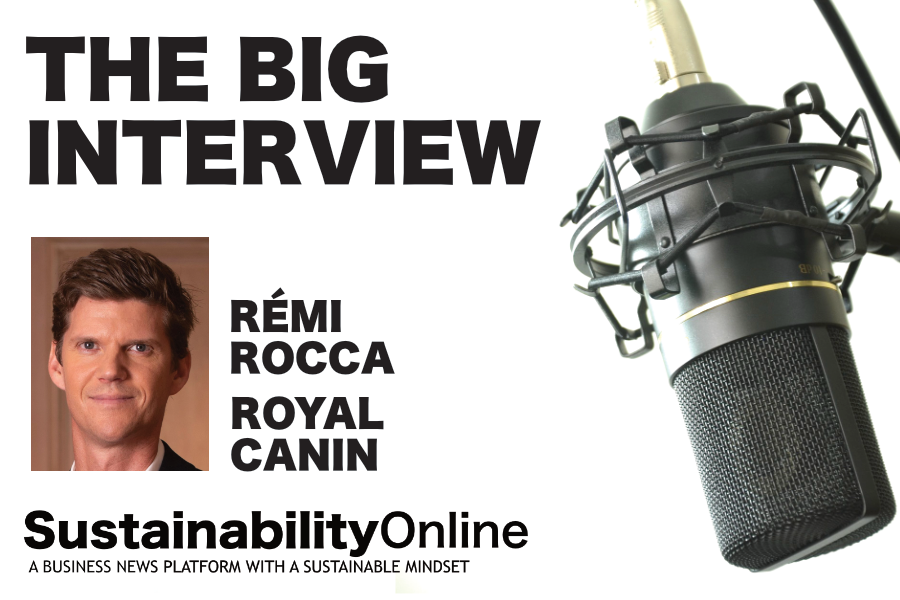
Collaboration will be essential to finance the transition to regenerative agriculture, according to Rémi Rocca, global vice-president of sustainability at Royal Canin, part of Mars Petcare.
Rocca, who leads the global sustainability strategy for Royal Canin, with a particular focus on regenerative agriculture and responsible supply chains, recently took part in a panel discussion at the Economist Enterprise Sustainability Week Europe Summit in Amsterdam on the need for businesses to work together to expand regenerative agriculture programmes and reduce Scope 3 emissions.
“Scope 3 belongs to everyone,” he told the panel. “We are lucky to be a family-owned business that has decided to invest a lot in regenerative agriculture. […] But we need to find some partners along the supply chain.”
Shared ambition
SustainabilityOnline caught up with Rocca following the panel discussion, and we started by asking him why he believes it’s so important that regenerative agriculture becomes a shared objective.
“At Mars Incorporated, we have a Scope 3 goal to reduce emissions by 50% in absolute terms by 2030, compared with 2015, which is definitely a big target to achieve,” he explained. “The company has a strong commitment and real intentionality around that.
“The fact that we are family-owned means we are making our own choices in this direction. In France, 100% of the grain we source is now covered by regenerative agriculture – we are talking about 65,000 hectares and 100,000 tonnes of CO2 reduction. We have also committed to providing €11 million over five years, which will go to farmers to incentivise their transition.
“At the same time, the question is: how can we continue to fund this transformation at scale? And by scale, I mean globally – everywhere – and how can we sustain that for the next 10 to 15 to 20 years? I think that’s why it’s fair to ask for support from our colleagues in the supply chain.”
Working together
Mars is adopting different approaches to pre-competitive collaboration, depending on the region and sector – Rocca cites partnerships Royal Canin has developed with ADM and PepsiCo, in which each party sources different products from the same farmers, allowing them to share the costs and benefits of regenerative agriculture.
“Working together, we can share the cost and get the benefits in terms of tackling our Scope 3 emissions, without double counting or double paying,” he says. “It’s a very strong value add.”
As Rocca explains, financial incentives for farmers are fundamental to ensuing a successful regenerative agriculture strategy, however he adds that this only represents part of the overall benefit.
“It’s not just money, it’s investment. Year after year, farmers can realise that with more organic matter in the soil, they can become more resistant to drought and to flooding. So, therefore, it’s good for the farm long-term, and not only short-term. This is very important.”
Soil Capital
A three-year partnership between Royal Canin and Soil Capital, launched in 2024, has used carbon insetting, satellite mapping and artificial intelligence to measure and monetise emissions reductions.
“It’s huge,” he says. “This is made possible thanks to all the technical innovations that we see in these sectors and the monetisation of carbon credits.”
Royal Canin also recently announced a partnership with wheat processor Roquette to co-finance a transition programme for regenerative wheat farming in France, through a co-investment model developed with Soil Capital. The programme, which covers more than 60 farms and 4,700 hectares, will see 70% of the value of each Soil Capital certificate paid directly to farmers.
Farm resilience
Rocca adds that Royal Canin is playing the long game when it comes to its investment in regenerative agriculture, with the benefits of farm resilience likely to become more apparent as the years progress.
“Farmers can see the benefits within just a few years,” he says. “In terms of yield, for example, they can maintain a yield that is much higher than that of their neighbours. The ability to continue producing the same amount of wheat on their farm is significant. It’s a long-term commitment.”
Learn more about Royal Canin’s commitment to regenerative agriculture here.