As much as 90% of Europe’s planned battery production could be at risk by the end of the decade if proposals to weaken EU manufacturing requirements and vehicle emissions standards are adopted, Transport & Environment (T&E) has said.
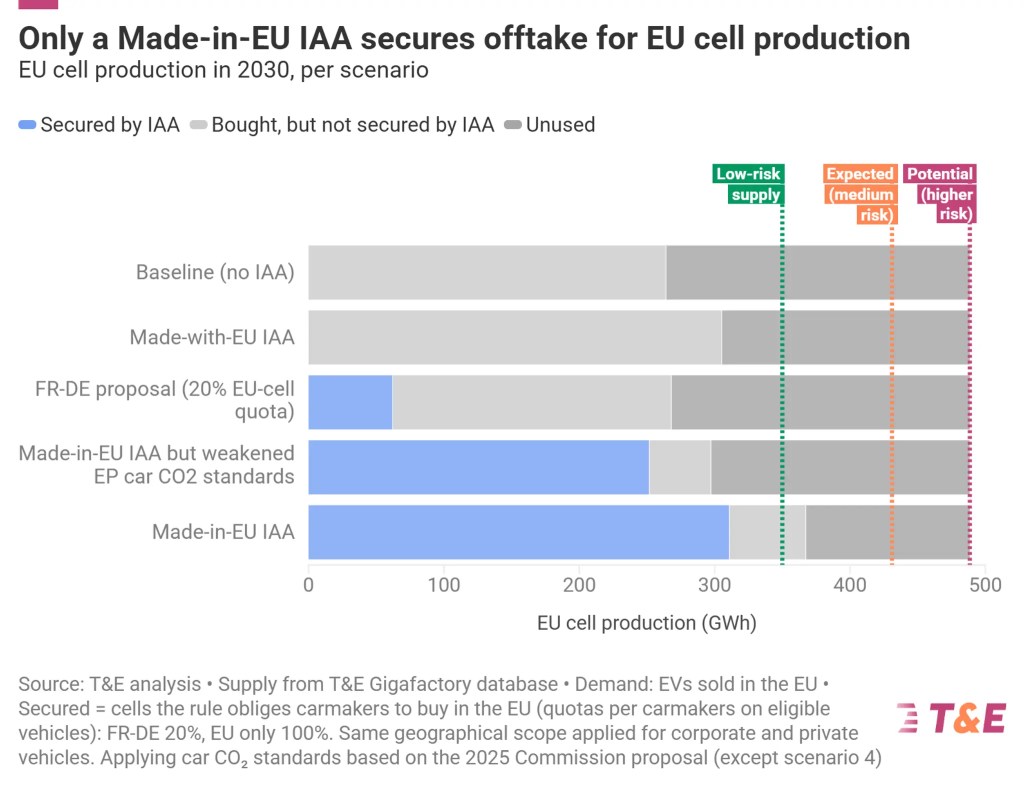
According to T&E, the proposed Franco-German car deal – which seeks to support Europe’s automotive sector while revising EU emissions targets and ‘Made in Europe’ manufacturing rules – would secure just 3% of Europe’s planned battery cell production in 2030.
This, in turn risks ‘handing over the market’ for battery production to overseas competitors, it added.
Industrial Accelerator Act
In conducting its analysis, T&E examined the proposed local content requirements under the EU’s Industrial Accelerator Act (IAA), which is intended to use public subsidies and corporate tax incentives to support domestic manufacturing.
As it noted, weaker Made-in-Europe provisions could allow 100 GWh of battery cell demand and 250 GWh of cathode active material demand to move outside Europe by 2030 – equivalent to 1.5 million battery packs for electric vehicles.
“The Franco-German deal is a disaster for Europe’s battery industry,” commented Franziska Grüning, raw materials officer at T&E.
“Securing a full European battery value chain, from mining to production, and the high value jobs it will provide, should be a top priority for Europe’s leaders. Instead, they are debating how far to weaken rules that would secure domestically produced batteries.”
Franco-German proposal
The Franco-German proposal would require EU-made battery cells in 10% of eligible vehicles in 2028 and 2029, rising to 20% in 2030 and 2031, and 70% from 2032.
This would secure cell production equivalent to around 900,000 electric vehicles in 2030, compared with 4.6 million under a stricter Made-in-EU approach in the IAA.
T&E also noted that proposed changes to EU vehicle emissions rules could reduce demand for European battery cells by 247 GWh between 2027 and 2032 – equivalent to approximately 3.7 million electric vehicles.
This impact could extend beyond battery cell manufacturing to the wider supply chain, it added, and raise viability questions about planned production facilities, such as Lyten’s Swedish factory, on the former Northvolt site, PowerCo’s Salzgitter plant in Germany and Verkor’s Dunkirk facility in France.
“Weak local content incentives for batteries in the IAA will send a terrible political signal for the future of Europe’s battery industry,” said Grüning. “Homegrown companies struggling to cross the valley of death should benefit from an IAA demand boost.” Read more here.