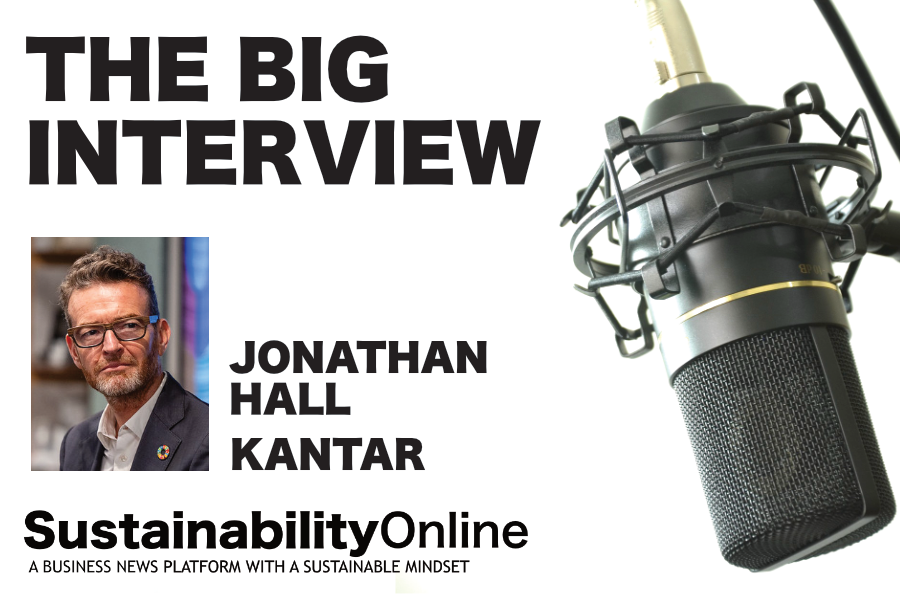
Earlier this year, market research and analytics firm Kantar published an extensive report – How organisations can remain commercially compelling, socially legitimate and strategically resilient in a disrupted world – which explored the challenges associated with connecting sustainability strategies with brand positioning, innovation, marketing and communications.
According to report author Jonathan Hall, managing partner at Kantar’s Sustainable Transformation Practice, short-term financial pressures, organisational silos and weak governance often prevent firms from connecting their sustainability strategies with market realities.
“The main questions that clients come to us with at the start of the journey would be: ‘I’m a chief sustainability officer or a chief marketing officer, and we, as an organisation, have a publicly stated ESG/sustainability strategy. But we’re having problems connecting that with the marketplace. So, how do we actually create value out of that sustainability strategy?’
“This comes up time and time again. ‘How do we connect sustainability to our portfolio strategy?’ ‘What does it mean in terms of our brands?’ ‘How does it start to drive innovation?’ And ‘how does it affect communication?'”
From morality to materiality
Hall argues that sustainability has moved from being primarily a matter of corporate values, compliance and risk management towards becoming a source of commercial growth, citing WBCSD head Peter Bakker’s recent description of the sustainability landscape moving from ‘morality to materiality’.
“It’s that idea of moving from a values-led proposition, something that was more about compliance and risk, into a growth opportunity,” he says. “I think the best way to help people understand that is by framing it in terms of the strategic questions they need to be thinking about in order to stay relevant as an organisation.
“If markets are changing, if finance is changing, if governments are changing, and if consumers, citizens and voters are changing quite significantly, then if you don’t stay in line with that, you’ll become irrelevant.”
‘Quarterly doom loop’
At the same time, he believes that most organisations still struggle to reconcile long-term sustainability investment with short-term financial reporting pressures.
“The vast majority of organisations are still caught in this quarterly doom loop,” he says. “I think the best-practice thinking from academic institutions suggests that new forms of leadership are required.
“But interestingly, if you look at businesses that are family-owned, they can allow themselves to take a longer-term view. With that comes, I think, the opportunity to have a broader understanding of stakeholders and to price in the sustainability challenges facing that business, whatever it may be.”
Organisational silos can also prevent progress, he suggests, adding that stronger governance and greater collaboration between functions are needed to ensure sustainability can be effectively embedded into business decision-making.
“We do a lot of work at the intersection between sustainability and marketing, and the fact that there isn’t much interaction between the two,” he says. “Sustainability doesn’t really understand what marketing does, and marketing certainly doesn’t understand what the sustainability function does.
“But more broadly, I think it’s to do with the overall governance of a corporation – what is it for? I think if organisations see themselves simply as generators of short-term profit, rather than as stewards of wealth for their employees, builders of value for consumers and, ultimately, as businesses that can solve social issues in a way that is profitable for them, then they’re inevitably going to start hitting the buffers.”
Effective collaboration
The report cites collaboration as being an essential piece of the jigsaw in driving systemic change, however recent history has taught us that while most firms understand the importance of collaborating, competition concerns tend to get in the way. “When it comes to collaboration partnerships, they sort of collectively groan about it,” says Hall.
However, the work of organisations such as the Ellen MacArthur Foundation on circularity, fashion and plastics provides valuable examples of how companies can collaborate on shared sustainability challenges across industries, he adds.
“You can develop an industry-wide understanding of why you should do this together rather than on your own. You can come together to tackle some of these major issues, such as water stewardship, supply chain reform and circularity, collaborating at the pre-competitive stage. Then, when you reach the point of commercialisation, companies can interpret that work in their own way, in line with their brand equity and consumer needs.
“I think that’s the best way forward. If you start thinking in those terms, you not only accelerate progress on issues that need collective attention, but also stop wasting time as a business on issues where there are significant commercial opportunities.”
Behavioural barriers
Businesses also need to better understand the reasons behind the gap between consumers’ sustainability intentions and their purchasing behaviour, Hall notes, citing recent Kantar research that found that while 85% of people wanted to live more sustainably, only 29% said they followed through by purchasing more sustainable products.
“Around two-thirds of the world’s population really want to be more active on sustainability,” he says. “But there are significant behavioural barriers, and those barriers are not difficult to identify.
“The main barrier tends to be – across any sector or category – price. Then, depending on the category you’re in, there are perceptions of quality, lesser quality, performance, efficacy, poor aesthetic design, accessibility and convenience. They’re not difficult to identify, and I think brands need to take responsibility for the fact that they’re not solving those frictions in people’s lives.
“If you’re a marketer, normally you would see it as your job to understand deeply what a consumer need is in a given category and then produce solutions to it. Here, however, brands are signally failing to actually do that.”
There are some notable exceptions, of course, with P&G’s Tide, Reckitt’s Finish and Natura’s eco-moisturiser range being examples of where sustainability is integrated into products and brand propositions rather than being treated as a marketing message.
“It’s a question of sustainability being much more hardwired into the business generally, as well as into the propositions that you’re putting out to consumers in the marketplace,” says Hall.
Integrating sustainability
Looking ahead, Hall says progress in sustainability integration varies from business to business and from market to market, and often depends on leadership understanding how different functions connect.
“I think it’s highly inconsistent across different corporations,” he says. “And it’s most successfully done when leadership is fully cognisant of how sustainability is fully integrated across the business.
“When you get integrated P&Ls – I mentioned Natura, and Asahi and IKEA are other great examples – that gives you a strong starting point. And then, once that’s established, the other aspects start to unwind.”
To find out more about Kantar’s perspective on sustainable brand growth, click here.