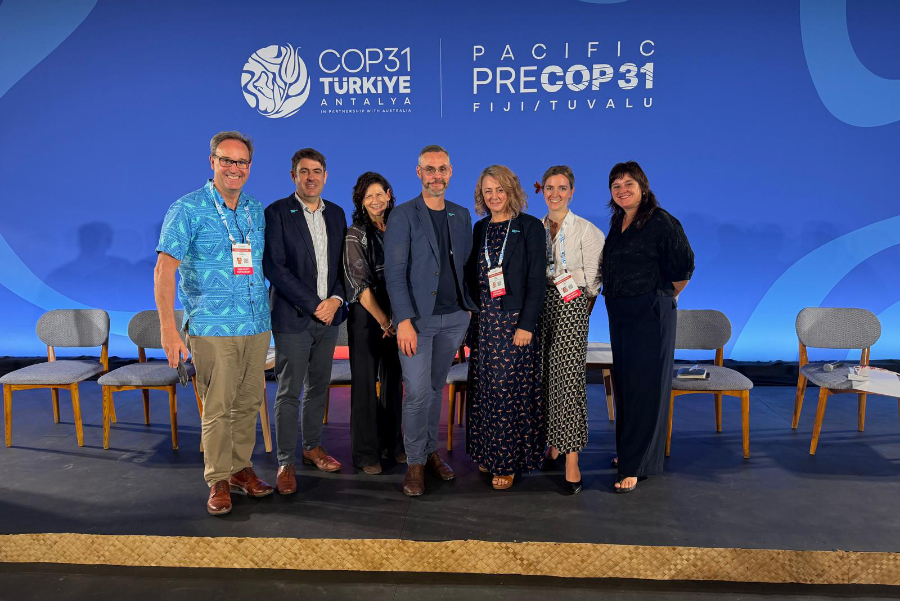
Op-ed by Climate Resource CEO Rebecca Burdon and Energy Efficiency Council CEO Luke Menzel.
Pre-COP in Fiji in October was a remarkable event that gave the world the opportunity to see first hand the existential threat climate change poses to the Pacific, and to hear from local leaders and advocates on the agenda for COP31, currently underway in Antalya, Türkiye.
And while much was discussed, the meeting provided the world with a very clear compass bearing. Keep the ambition embedded in the Paris Agreement in play. Stay focused on 1.5 degrees, and pursue every measure to limit overshoot.
So what is to be done? Well, a lot of things, some of which the world is already focused on.
COP28 saw the world commit to triple renewable energy capacity and double the rate of energy efficiency improvement by 2030, both crucial near term measures for lowering emissions.
However COP28 did not address a third lever that we need to pull quickly to keep a 1.5 degree world within reach – electrification.
It is one of the reasons Türkiye announced a voluntary target to take the percentage of global end use powered by electricity to 35% by 2035 in Bonn in June. They backed that up with the 35×35 Global Electrification Pledge at New York Climate Week last month.
The pathway to 1.5°C
So is Türkiye’s target aligned with science based 1.5 degree scenarios? Climate Resource’s report, Electrification and the pathway to 1.5°C, provides the modelling to tell us.
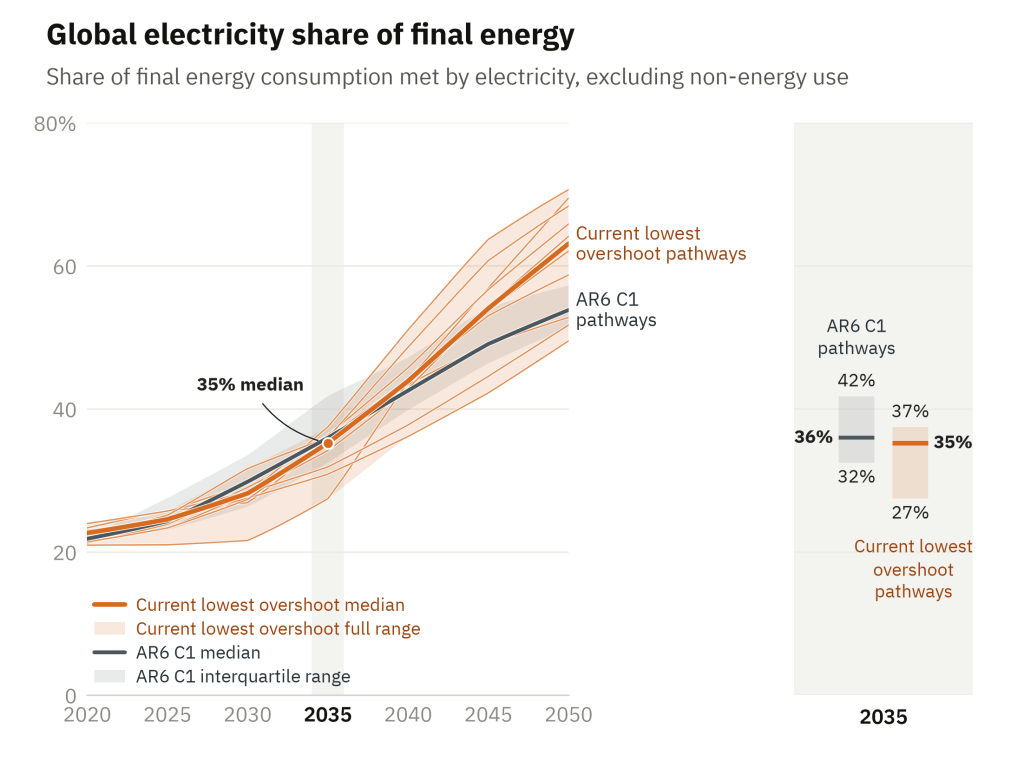
The analysis assesses the consistency of a global electricity share of around 35% of final energy by 2035 with current lowest-overshoot pathways. These specific pathways limit end-of-century warming to 1.5°C after a peak of up to around 1.7°C.
The analysis found that 35% electrification by 2035 is 1.5°C-aligned. It is the median of the current lowest-overshoot pathways to 1.5°C that became publicly available a few weeks ago, which will inform the IPCC’s upcoming Seventh Assessment Report and be an anchor of climate science and policy.
The transformation required is immense, and upping the electrification rate to around 35% is critical.
But so is increasing renewable energy capacity. It’s like a pair of scissors: Clean power is one blade, electrification is the other. Either alone can’t cut fossil fuel use as quickly as when they work together.
And of course energy efficiency makes the whole job easier – like having less paper to cut in the first place.
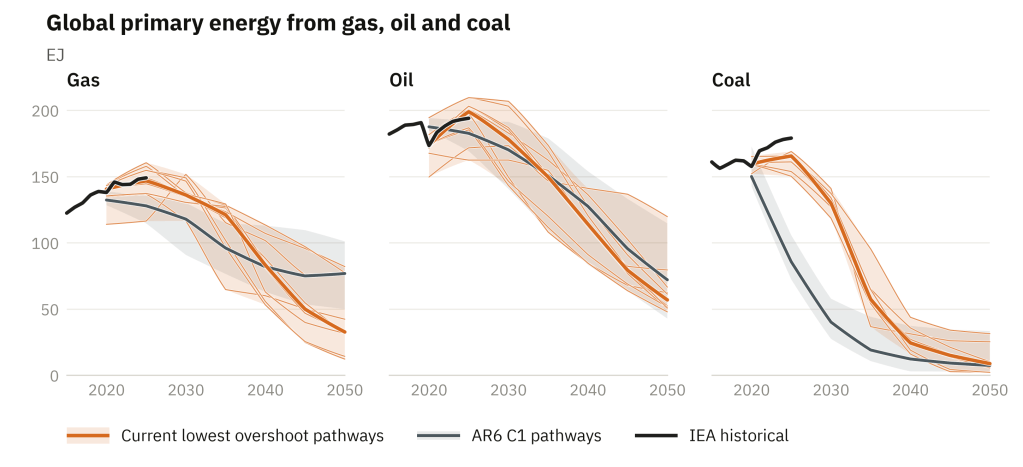
Pursuing electrification, renewables and efficiency in tandem has a big impact on fossil fuel use. Under the lowest-overshoot pathways that deliver 35% electrification by 2035 and achieve and extend the existing goals to triple renewable energy and double the rate of increase in energy efficiency by 2030, coal use falls by about two-thirds by 2035, and oil and gas falls by around a fifth.
‘Striking distance’
But, right now, the world is not moving fast enough.
In 2025, electricity met around 23% of global final energy demand, excluding non-energy use. The International Energy Agency’s latest projections suggest this will reach nearly 30% by 2035 under current policy settings, a trajectory that falls short of the 35% median required for the most ambitious climate pathways.
It’s worth noting that the IEA says that 35% is achievable, and most of the journey to that target is already cost-effective. The IEA found that reaching the global electrification target is within “striking distance” using existing technologies, could slash household energy costs by 15% and cut global energy import bills by over USD $400 billion.
However, the IEA also found we won’t meet these targets without stronger policies and action. This is where international leadership plays a role. The 35% by 2035 target sets a level of ambition that is aligned with 1.5. Countries should back that ambition, and work together on a strong, coherent and actionable implementation agenda that will allow it to be achieved.
Different agendas
That agenda must recognise that electrification means different things in different parts of the world. Where we live in Australia, it is about switching away from petrol, diesel and gas to efficient electric technologies in transport, buildings and industry.
In emerging and developing economies like those in the Pacific, Africa or Asia, it is also improving energy access, bringing electricity to towns and villages for the first time to raise living standards and boost economic development.
In short, electrification is relevant around the world, but will play out differently depending on national circumstances. And critically, the global south will need more support on finance, grids, and renewable deployment to unlock the opportunity – something the newly announced Electrify Now Finance Coalition will help with.
There is much to be done. The COP31 Presidencies of Türkiye and Australia have planted a flag in the sand; governments should rally around it.
By securing action on electrification as a core outcome of COP31, the world can ensure it takes its place alongside renewables and energy efficiency as a critical lever for keeping 1.5°C alive.
About the authors
Rebecca Burdon is CEO of Climate Resource. She has a background in economics and over 20 years of experience in policy, regulation and climate change. She is a Member of the Technical Council of the Science Based Targets Initiative (SBTi) and Senior Advisor to Melbourne Climate Futures at the University of Melbourne.
Luke Menzel is the CEO of the Energy Efficiency Council and a member of the Steering Committee for the global Electrify Now movement.