The business case for sustainability is increasingly being defined by its contribution to “resilience, efficiency and long-term business performance”, rather than through standalone environmental initiatives.
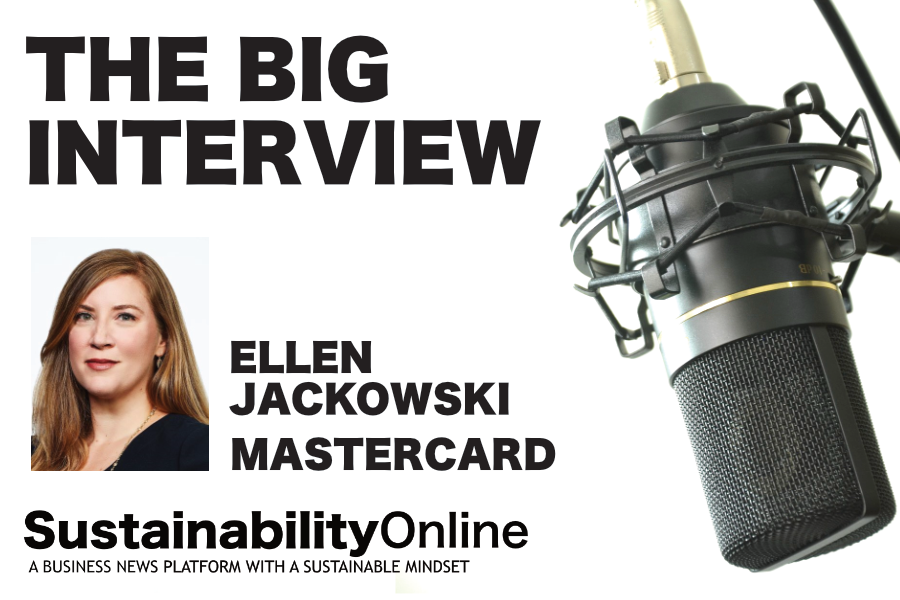
That’s according to Ellen Jackowski, chief sustainability officer at Mastercard, who has witnessed first-hand how sustainability and growth can be achieve concurrently, with no trade-offs required.
“We are seeing a shift in how companies think about sustainability,” she says. “In 2025, we continued to grow [Mastercard’s] business while reducing emissions across our operations and value chain. To me, that’s the clearest indicator of which sustainability initiatives are built to last. They’re the ones that help make the business stronger, more resilient and better prepared for the future.”
She points to recent investment in renewable energy projects at Mastercard’s facilities, including a geothermal heating and cooling system at its headquarters in Purchase and a solar installation at its tech hub in O’Fallon, Missouri. While both investments are necessary from an emissions-reduction point of view, they also help to “strengthen the resilience of our operations and critical infrastructure,” she says.
“In a world where severe weather and other disruptions are becoming more common, investments like these help ensure we can continue operating and serving our customers while reducing our environmental footprint. That’s a good example of what I think we’re seeing more broadly: the most effective sustainability investments are the ones that create value for both the business and the planet at the same time.”
Consumer shift
According to Jackowski, consumer attitudes towards sustainability are changing as economic pressures affect purchasing decisions. Mastercard’s research found that 63% of consumers consider cost an important purchasing factor, while 54% say they would choose a brand or product that aligns with their values even if it costs more.
“To me, that signals a real shift: consumers aren’t choosing between value and values anymore, they’re looking for both,” she says.
Growing interest in circular consumption is another factor. As Mastercard’s research noted, in the 20 leading circular shopping economies, secondhand clothing sales increased by 28% year on year in 2025, compared with 8% growth in clothing stores. Its research also found that 38% of consumers are seeking secondhand products more often, while 71% would rather repair a product than replace it.
“These aren’t niche behaviours anymore,” she says. “They reflect a broader shift toward choices that are affordable, durable and more conscious.
“One of the clearest lessons from the data is that sustainable and circular choices gain traction when they’re convenient, trusted and make sense economically. That’s where Mastercard is focused. We’re working with partners to make circular options more seamless and accessible.”
The role of leadership
With sustainability increasingly becoming embedded in how businesses create value, the role of the chief sustainability officer, or CSO, is evolving, says Jackowski.
“Today, it’s less about managing a separate sustainability agenda and more about helping the business understand how markets, consumer expectations, technology and risk are changing, and where those shifts create opportunities for growth, resilience and innovation,” she says.
“That means paying close attention to emerging trends and behaviours and asking how sustainability can be embedded into them in ways that create value. Whether it’s shifts in how people consume, advances in technology or new business models, sustainability leaders have an opportunity to help organisations innovate and meet changing needs.”
She sees an important role for Mastercard in connecting sustainability to business strategy, identifying opportunities that strengthen the business while delivering positive environmental or social outcomes.
“At Mastercard, our commitments to people, prosperity and planet are directly connected to long-term business success. It’s what we mean when we say ‘doing well by doing good’. We leverage our technology, data, partnerships and global network to embed sustainability into everyday systems.
Mastercard has applied this approach to its work on deposit return schemes. At flagship sites, including Aarhus, Blenheim Palace, the Eden Project, Lisbon’s CopoMais, Copenhagen and Frederiksberg, the company is using digital payments infrastructure to support reusable packaging systems.
At Blenheim Palace, for example, visitors can pay a deposit for a reusable cup and receive it back by tapping their card at a reverse vending machine, through Mastercard Move technology. The programme has reduced beverage packaging costs by 50% over one year, eliminated more than 320,000 single-use cups and avoided 1,150 kilograms of CO₂ emissions.
“That’s a perfect example of a win-win-win, says Jackowski. “It creates value for our customers through lower costs and a better consumer experience, creates new opportunities for Mastercard to apply our technology and payment capabilities, while delivering measurable environmental benefits.”
Sustainability targets
Looking ahead to the end of the decade, Jackowski says Mastercard is aiming to reduce Scope 1, 2 and 3 emissions by 60.2% by 2030, against a 2016 baseline, in turn supporting its goal of reaching net zero by 2040. The company has already reduced Scope 1 and 2 emissions by 44% and Scope 3 emissions by 46%.
She says success will also depend on using Mastercard’s network – “which includes more than 150 million acceptance locations, hundreds of millions of digital access points, thousands of financial institution partners and 3.7 billion cards in circulation” – along with technology, data and partnerships to help businesses and consumers make more sustainable choices.
“Through our network, we have the ability to bring innovations and solutions to market that help inspire, inform and enable more sustainable choices at scale, while making those choices easier and more accessible,” she says.
“Sustainability is already embedded in how we operate and create value, and by 2030 I hope we’ve continued to expand our impact. While we’re committed to reaching net zero by 2040, I’m equally excited by the opportunity to leverage our network, technology, data and partnerships to help others make progress as well. If we’re reducing our own emissions while helping businesses and consumers make more sustainable choices every day, I’d consider that a success.”
Learn more about Mastercard’s sustainability strategy here.