While international standards have a key role to play in helping translate climate commitments into practical business measures, closer cooperation and greater engagement with users are needed to accelerate their adoption, Sergio Mujica, secretary general of the International Organization for Standardization (ISO) tells SustainabilityOnline.
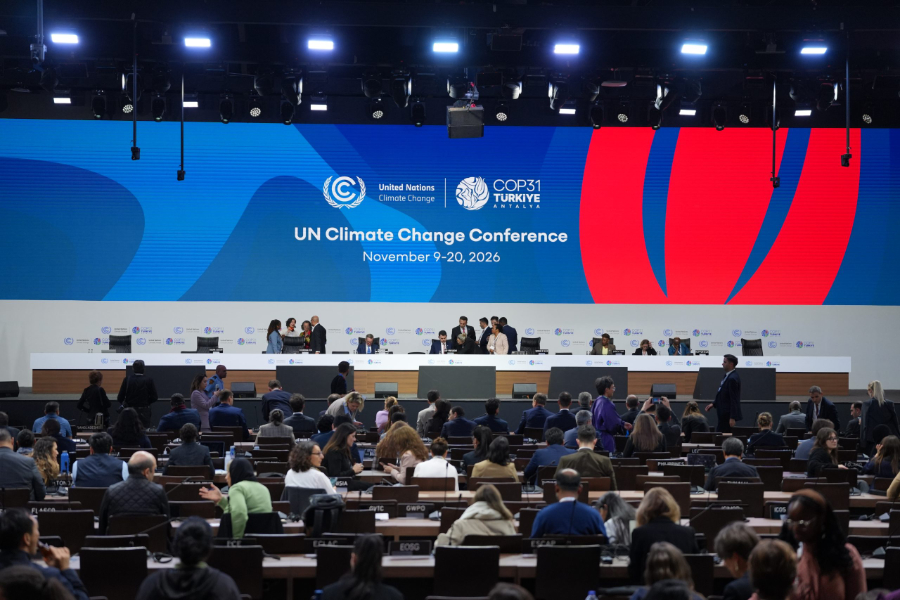
SustainabilityOnline caught up with Mujica at COP31, where the ISO, along with the International Electrotechnical Commission (IEC) and UL Standards & Engagement (ULSE) was hosting the third annual Standards Pavilion, providing a platform for 16 international standards organisations, UN agencies and private sector groups to work more closely together.
“I think the most important thing is to work together with one voice, positioning standards as a key partner in translating ambition into concrete action,” he says. “That is the main thing that works for policymakers, regulators, negotiators and also for each organisation that’s here – the ambition to contribute, to be part of the solution and not part of the problem.”
Greater coordination
At COP31, the three groups called for standards to be integrated into climate policy, finance and reporting frameworks. As Mujica notes, this will require greater compatbility between standards bodies.
“We need greater coordination between standards makers, because they are working with the best of intentions,” he says. “We’re working with IEC, GHG Protocol and others, and we try to contribute and create our own solutions, but these are not necessarily fully interoperable or compatible. So there’s a conversation to be had there.
“Having said that, we’re making a great effort to create greater convergence. This standards pavilion is testament to that.”
A second priority, according to Mujica, is ensuring that standards organisations take responsibility for supporting implementation after a standard has been published.
“As standards makers, our job is not done when a standard is published,” he says. “We also need to work with stakeholders and organisations to support its implementation.
“There is a lot to do in terms of raising awareness. Some standards are not well known, while others are perceived as barriers. There is much more to do in terms of engagement.”
Viewing international standards as another layer of regulation is an inaccurate simplification, Mujica adds.
“Standards are voluntary by nature,” he says. “What we do is support the implementation of regulation, policy ambitions or the ambitions of individual companies, because many of them want to be part of the solution.”
Making it relevant
Ensuring that standards can help to accelerate implementation begins with helping organisations identify what standards are most relevant to their needs.
“In the case of ISO, we have 26,000 standards, so when we engage with an organisation, we cannot simply tell them, ‘Here are 26,000 standards, good luck’,” he says. “We need to provide more guidance and support them through the discovery phase: ‘What is it that you need, and which standards can help you in that effort?’
“That’s the very first step. Then we need to engage with them to identify the best way to implement those standards, working together with government, policymakers, academia, consumers and others.”
At COP31, the Standards Pavilion played host to 39 events, including more than 25 sessions, workshops and roundtables, covering topics such as carbon accounting, industrial decarbonisation, clean energy, climate adaptation, biodiversity and sustainable finance. According to the ISO, the event marked an ‘important step forward’ for the international standards community. Learn more here.