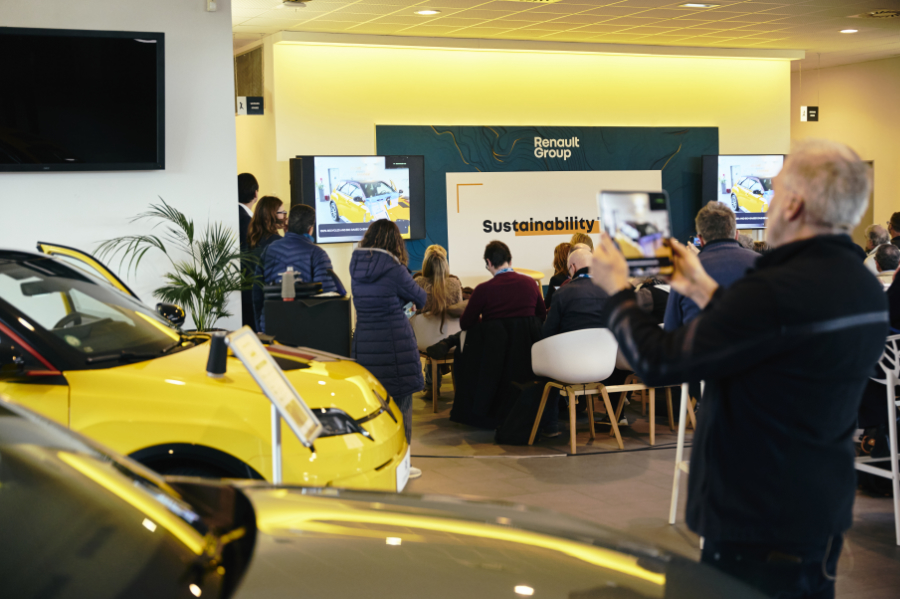
Renault Group has outlined how it intends to reduce the lifecycle carbon footprint for future vehicles to as low as five tonnes of CO₂, at a sustainability event held at its Lardy Technical Centre in France.
At the event, which was attended by SustainabilityOnline, as well as journalists from around the world, Renault said that it has reported global carbon emissions from 138 million tonnes of CO₂ in 2019 to 107 million tonnes in 2025, a reduction of 22%. The automotive firm is targeting climate neutrality in Europe by 2040 and worldwide by 2050.
As Laurens van den Acker, chief design officer, explained, as well as electrification, vehicle design and material selection are likely to play a key role in ensuring lifecycle emissions can be kept to a minimum.
“We’re looking at how we can make sure that the materials we use can be reused and recycled as much as possible. […] Of course, this is ambitious, but the sooner we start, the better we will be able to achieve our goals,” van den Acker explained.
Lifecycle assessment
Renault‘s lifecycle assessment for an internal combustion engine vehicle, based on 200,000 kilometres of driving over 15 years, estimated emissions at 50 tonnes of CO₂. For an electric vehicle, the equivalent figure falls to 22 tonnes, primarily because of the removal of tailpipe emissions, however the production and refinement of battery materials offsets this to some degree.
To achieve its five-tonne target, the carmaker is turning to recycled steel, aluminium and plastics, as well as investing responsible sourcing, lightweight construction and battery chemistry. It is also designing components for disassembly, making it easier to separate materials for recycling.
“For a very long time, sustainable materials had a bad name,” van den Acker said. “People considered them cheap, or considered them bad quality. But the recycling business has made a huge transition revolution, and now our goal is to make them look desirable, and make people want them.”
It pointed to its Renault Emblème concept car as a longer-term benchmark for future vehicle development – the prototype vehicle incorporates around 100 innovations, including a smaller battery combined with a hydrogen fuel cell, recycled materials, lightweight construction and low-carbon energy, bringing its lifecycle emissions down to the five-tonne mark.
At the event, Renault also introduced Renative, an in-house brand that brings together its circular economy aftersales activities, such as remanufactured parts, reconditioned batteries and accessories made from recycled materials, through which it aims to both ramp up its circular design capacity and reduce costs.
Sustainable materials
Renault also acknowledged that cost pressures and competition have affected the resources available for sustainable materials, with Cléa Martinet, VP Sustainability, saying that the firm had reduced its target cost allowance for sustainable materials as it faced geopolitical pressures and competition.
“When we started rolling this out five years ago, we had a really high budget per vehicle to absorb the premium costs of green materials and recycled materials,” she explained. “We had to lower this budget because of geopolitical constraints, trade wars, and competition, particularly from Chinese manufacturers.”
This, in turn, led Renault to reduce the cost of goods per electric vehicle by 40%, she noted.
“We were ready to make the investment, but the pressure on costs and price competition meant we had to make other choices. We are still very sustainable and still best in class, but honestly, without those cost and price challenges, we could do even more.”
Martinet added that sustainability had been embedded in Renault’s strategy since 2021 and that the company remained aligned with the 1.5°C pathway of the Paris Agreement. [Main photo by Martin Colonbet]