Paper carrier bags boast a lifetime carbon footprint ranging from 16.6g to 82.9g of CO₂ equivalent per bag, a new study by The Paper Bag, conducted by RISE Research Institutes of Sweden, has found.
The study, which quantified the carbon footprint of paper carrier bags ‘for the first time’, assessed three typical kraft paper carrier bags used in Europe – a small ‘takeaway bag’ without handles weighing 20g, a ‘medium shopping bag’ with twisted handles weighing 55g, and a ‘large shopping bag’ with flat handles weighing 100g.
The bags included in the study were primarily made from virgin-fibre kraft paper supplied by members of CEPI Eurokraft. Bags with a high content of recycled material were not included in the study.
‘Increasingly important’
“Reliable carbon footprint data is becoming increasingly important,” commented Jan Lif, secretary general of CEPI Eurokraft. “It helps businesses understand where emissions occur across their supply chains. With this study, we are creating greater transparency and establishing a baseline to measure our industry’s progress over time.”
The study also compared the footprints of paper bags with average car emissions, based on data from the German Environment Agency.
As it found, the footprints of the three bag types correspond to approximately 100 metres, 280 metres and 500 metres of passenger car travel, respectively.

Carbon footprint
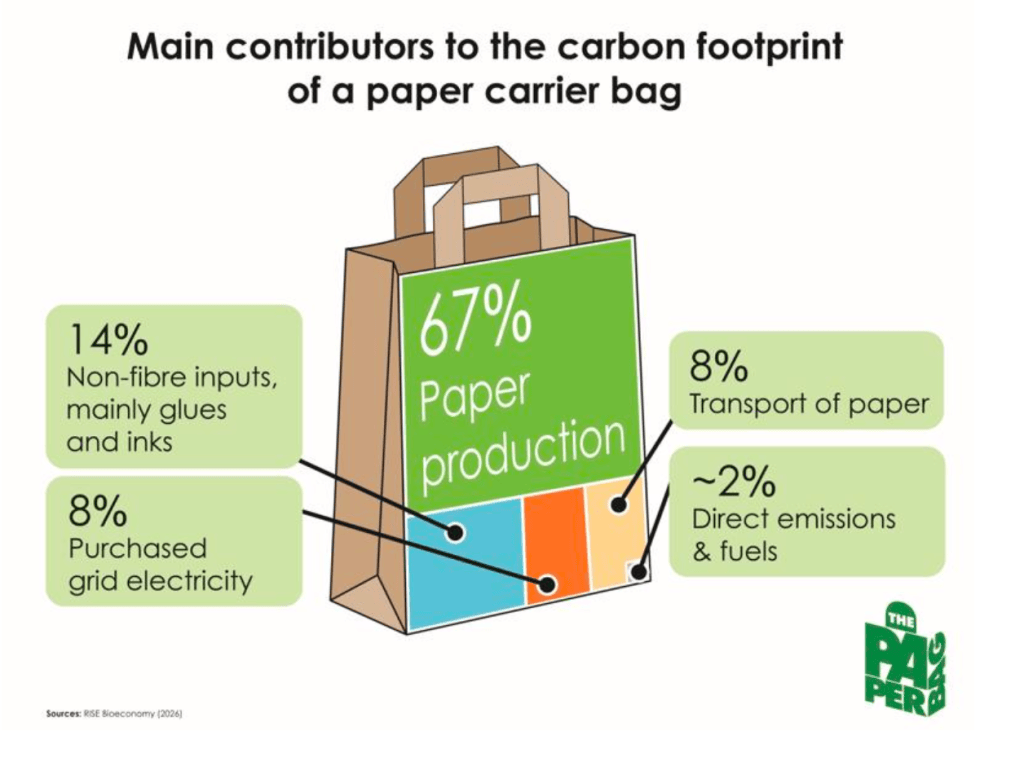
Paper production is by far the largest contributor to the carbon footprint of paper bags, accounting for 67% of the total, with the remaining emissions coming mainly from non-fibre inputs, including glues and inks, electricity used at converting plants, and the transport of paper to converting facilities.
“Beyond their carbon footprint, paper carrier bags are made from a renewable, bio-based material and can be recycled, which keeps valuable paper fibres in circulation,” said Lif. “Choosing and using packaging responsibly can contribute to positive change.” Read more here.