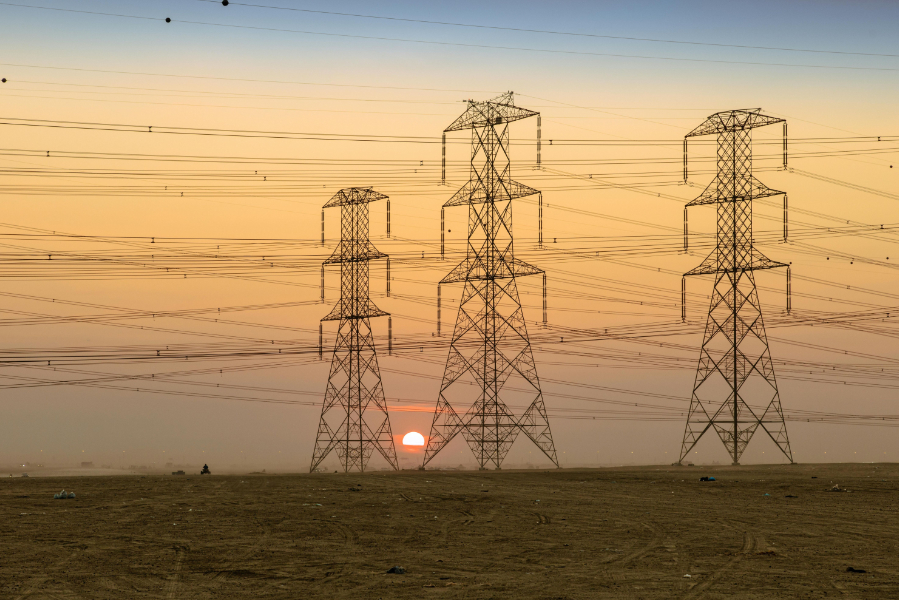
The increasing frequency and severity of heatwaves has a direct impact on European countries’ ability to generate and supply electricity, a new study has found.
According to the study, Heatwave-induced capacity bottlenecks in European electricity grids, which was led by the University of Cambridge, France, Spain and Italy are at the highest risk of supply bottlenecks and possible grid failure as a result of heatwaves.
Germany and the UK were found to be ‘comparatively more resilient’, the study found, however here too, the severity of heatwaves – such as the recent hottest August on record – is causing strain.
‘Identify vulnerabilities’
“We hope power providers will use these tools to identify vulnerabilities in their systems and take necessary action to stop them collapsing during future heatwaves,” commented co-corresponding author Professor Srinivasan Keshav from Cambridge’s Department of Computer Science and Technology.
In conducting the study, the research team, which also included researchers from City University of Hong Kong and The Chinese University of Hong Kong (Shenzhen), developed an open-source toolkit to assess how high temperatures affect electricity generation, transmission and demand.
They assessed the impact of heatwaves in 2019, 2022 and 2024, and modelled the effects of these periods on the electricity grids of eight European countries: Spain, Portugal, France, Italy, Germany, Belgium, the Netherlands and the UK.
As they found, heatwaves put pressure on electricity systems through several connected effects – demand rises as households and businesses seek to keep cool; solar panels can become less efficient; wind turbines stop spinning; power plants may need to reduce output to avoid overheating; and power lines are forced to operate at reduced loads to avoid exceeding temperature limits.
“Once you combine all the factors together – demand increase, generator capacity decrease, transmission capacity decrease – you can discover hidden bottleneck regions that existing methods can’t find,” added lead author Professor Enming Liang from City University of Hong Kong. “I think that’s the most surprising outcome of our simulations.”
Load shedding
Looking ahead, the researchers assessed the impact of future heatwave scenarios based on a period of ‘conservative’ annual demand growth over the next five years, and excluding the expected expansion of data centres.
“Even under that ideal assumption, existing storage resources are still insufficient to prevent load shedding,” said co-corresponding author Professor Minghua Chen, from the Chinese University of Hong Kong (Shenzhen) and City University of Hong Kong. “I think that’s a genuinely alarming, surprising finding from this research.”
The study was published in the journal Nature Energy. Read more here and here.