Europe should prioritise the most effective opportunities to embrace electrification, using targeted financial support, energy taxation and investment in flexibility to accelerate the transition, according to Adrian Hiel, director of the Brussels-based Electrification Alliance.
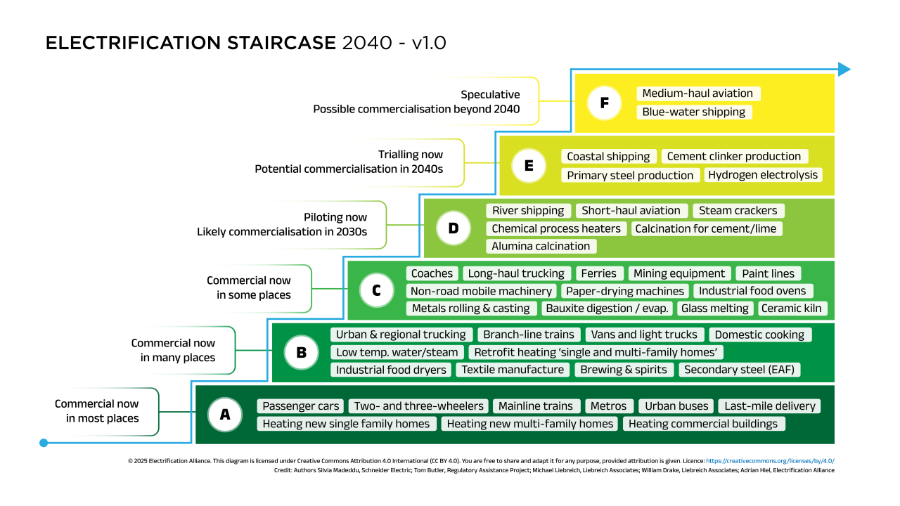
Speaking at the recent Business Post Next Gen Energy Transport Water Summit in Dublin, Hiel presented the ‘Electrification Staircase’, a framework for identifying where electrification can deliver the greatest impact and how policymakers should sequence investment and action.
“There are certain things that are very easy to electrify now,” he tells SustainabilityOnline. “And if we do those things first, then the things that are hard to electrify become much easier.”
Quick wins
As he noted during his presentation, the ‘first three steps’ of the staircase – which address issues such as transport, buildings, manufacturing and consumer habits – account for a significant proportion of the issues that electrification can address, presenting a template for further development. However, legacy issues, including an energy system that has remained relatively unchanged for decades, present hurdles.
“Europe’s energy policy over the last 60, 70 or even 80 years has been about burning the cheapest thing possible,” he says. “That’s what it’s entirely focused on. So, that’s embedded into a lot of policies – land use policies, tax policies, industrial policies, energy policies.
“Pulling out of that is going to take a lot of time. It will take effort, but it has to be done.”
The energy turmoil of recent months – particularly the effect that the Hormuz crisis has had on fuel prices globally – has proven an accelerator for electrification, particularly in the automotive sector. Hiel believes that even if the crisis were to dissipate tomorrow, and fuel prices come back down, that this momentum would be maintained.
“Things have fundamentally changed – there’s no question,” he says. “Would the increase in electrification slow down if Hormuz opened tomorrow? Well, I wouldn’t necessarily expect to see EV sales doubling every 12 months. But oil prices are going to be high for the next 12-18 months even if Hormuz opens up. Prices don’t come down right away.
“There’s been a period of really high momentum [on electrification] that is baked in now. Things are just fundamentally different.”
Support mechanisms
On the short-term supports that governments can provide for households and businesses that can’t immediately afford the switch, he believes several simple levers aren’t being pulled. For example, people buying a new home could be encouraged to install a heat pump from the outset, with the cost incorporated into a long-term mortgage.
“But for regular people day to day, there’s a lot of uncertainty there,” he says. “It costs a lot of money to invest in a car or a new heating system. It’s completely normal that you wait and delay decisions, or that you stick with what you know. That’s a really normal thing. Changing those habits takes really specific, targeted efforts.
“At the same time, we can all do things in our lives that would save us money that we don’t do. If you compare your insurance providers, you’d be able to save a certain amount every year. Do you do it? No, because it’s a pain to change.
“So we need to really focus on the social element and identify the moments when it makes the most sense.”
Energy taxation
Hiel identifies energy taxation as one of the quickest ways to encourage electrification. Reducing taxes on electricity while shifting some of the burden towards gas could improve the relative attractiveness of electric technologies.
“We need to stop taxing electricity like it’s alcohol or cigarettes, which is what we have done for decades,” he says. “Thirty years ago, electricity was largely coal-fired. It made sense to tax it heavily so that people would use it less – in other words, treat it exactly the same as we did cigarettes and alcohol.
“It’s not coal-powered anymore. Reducing the taxes on electricity, and putting some of them onto gas so that electricity becomes a no-brainer choice, that’s the easiest lever to pull. Without question.”
He also believes that further investment in energy storage and flexibility are essential to integrating renewable electricity efficiently.
“Storage and flexibility go hand in hand,” he says. “You don’t have one without the other, and they’re absolutely fundamental. If you don’t have flexibility and storage, then you’re building out way more infrastructure than you need and you’re not seeing the lower prices that you need to get people to electrify.”
Independent assessment
The Electrification Alliance recently called for a Europe-wide independent assessment – similar to the Draghi Report – on the pros and cons of electrification. The core goal of this assessment, Hiel notes, should be to deliver methods European countries could implement to reduce annual EU gas consumption to below 200 billion cubic metres.
“Once we get below that level, we’re no longer completely exposed to the whims of global gas markets,” he says. “So, the question is, how do we do that really, really quickly? Is it through electrifying with heat pumps? Is it through giving our regulators more time and effort to implement things? Is it through adjusting energy taxations?
“Each country has a different mix, a different context, a different industrial base. So, what are the levers that we can pull in each country right now, or over the next couple of years? Reducing dependance on gas is the key unlock, and electrification is going to be how we get it down.”
Learn more about the Electrification Alliance at electrification-alliance.eu.