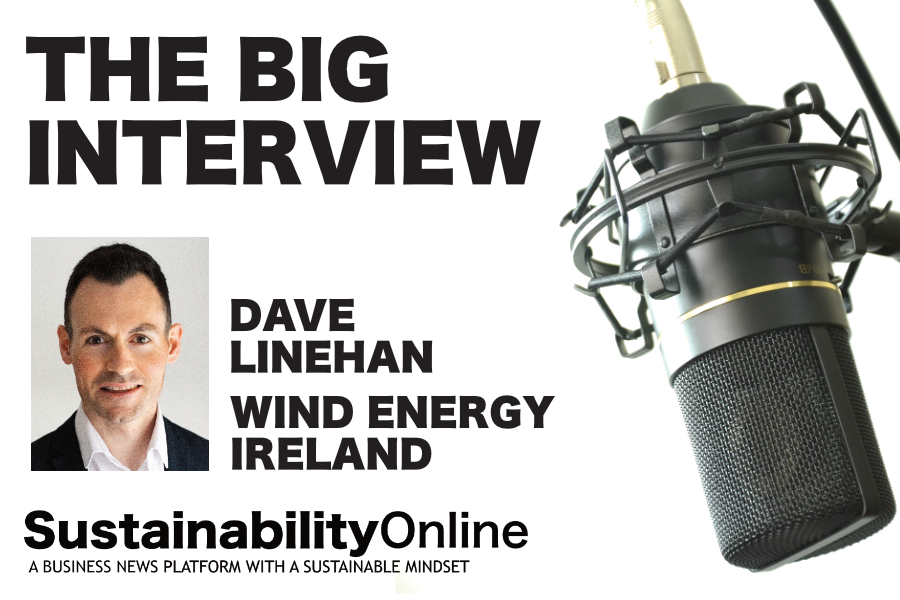
Ireland’s electricity grid is becoming a major constraint on the expansion of renewable energy, with more than 3,000MW of proposed onshore wind capacity already holding planning permission but waiting for grid connections. It’s a situation that needs to be addressed urgently, Dave Linehan, director of policy and research, Wind Energy Ireland, tells SustainabilityOnline.
“We recently published our Onshore Wind Action Plan, which was a product of almost six months of meetings with our members, to understand what the bottlenecks and barriers are,” he says. “To boil it all down, there was a lot of alignment, and the grid came out as the overarching single biggest bottleneck.
“Because, put simply, we’ve got a really healthy pipeline. We’ve seen a bit of a turnaround in terms of decisions being made more efficiently, in areas such as planning and implementation. But now the focus is very much on will the grid be there? Will our grid connection arrive on time? In other words, will we get connected when they tell us we’re going to be connected, or will that get pushed out?
“That’s leading to growing investment concerns around the levels of dispatch-down [the intentional reduction of available renewable electricity output by grid operators], which stood at 15% in the first six months of this year. You’ve effectively got the resource there, the wind is blowing, the sun is shining, but the grid isn’t strong enough to accommodate it. So you’re turning those turbines off 15% of the time.
“That’s not ideal, and it’s adding cost to the consumer at a time when we should be making that process more efficient.”
Short-term solutions
SustainabilityOnline caught up with Linehan at the Business Post Next Gen Energy Transport Water Summit in Dublin, where he acknowledged the investment in renewables and the grid planned under Ireland’s current PR6 price review period, but added that short-term measures were also needed while larger infrastructure projects were being delivered.
“It’s always been the case that there’s been a couple of years from when you get your consent to when you get your grid connection,” he says. “You don’t just connect the next day. But what we’re seeing is a gradual push-out of those dates more and more. So, we’re aware of projects that are planning now which have been given grid connection dates in the late 2030s.”
Long-duration energy storage and hybrid connections could allow more renewable electricity to be used during periods of low demand, he notes.
“That’s an obvious solution to the issue of dispatch-down. But the pace and the urgency around some of those short-term measures, comes back to this regulatory perception around red tape and delay, rather than just getting on with implementation.
“My role is director of policy, but I’m increasingly realising that we don’t need that much more policy. We just need delivery of what’s already been announced, and implementation of the huge ambition that’s already out there.”
‘Serious catch-up mode’
Linehan describes Ireland as being in “serious catch-up mode” on electricity grid infrastructure, adding that greater use needs to be made of existing infrastructure while new capacity is developed.
“The obvious contrast is to how the motorways were built out over the last 25 or 30 years, while at the same time, the high-voltage grid has effectively stayed at a standstill. The spare capacity that we did have from that massive build-out in the 1980s is now gone, effectively.”
Wind Energy Ireland previously outlined its ambitions for Ireland to become an ‘electro state’ – where the economy is electrified across transport, heating, industry and other core sectors – with demand growth doubling or tripling between now and 2050.
“For us, it’s how do you take that demand and fulfil it with homegrown, domestic energy – where your price, your security, how clean your supply is, isn’t dictated by people thousands of kilometres away,” says Linehan.
“We’re currently faced with massive price spikes, completely outside of our control, which is something that we’ve been grappling with now for the last five years, really. So, how can we get ourselves self-sufficient, and how can we use our domestic resources to do that?”
Public engagement
Looking ahead, Wind Energy Ireland is seeking greater public engagement around the energy transition and infrastructure investment. Its action plan calls on the government to invest in a national communications campaign focused on grid investment, electrification and reducing reliance on fossil fuels.
“Everything that will happen with the transition is grounded in public support,” Linehan adds. “I think there’s a complete mismatch there in terms of the public’s understanding of the need for some of these things.
“The government needs to take the bull by the horns and effectively lead a national communications campaign on the need for grid capacity, on the need for the transition, and on the need to wean ourselves away from fossil fuels.”
Learn more about Wind Energy Ireland at www.windenergyireland.com.