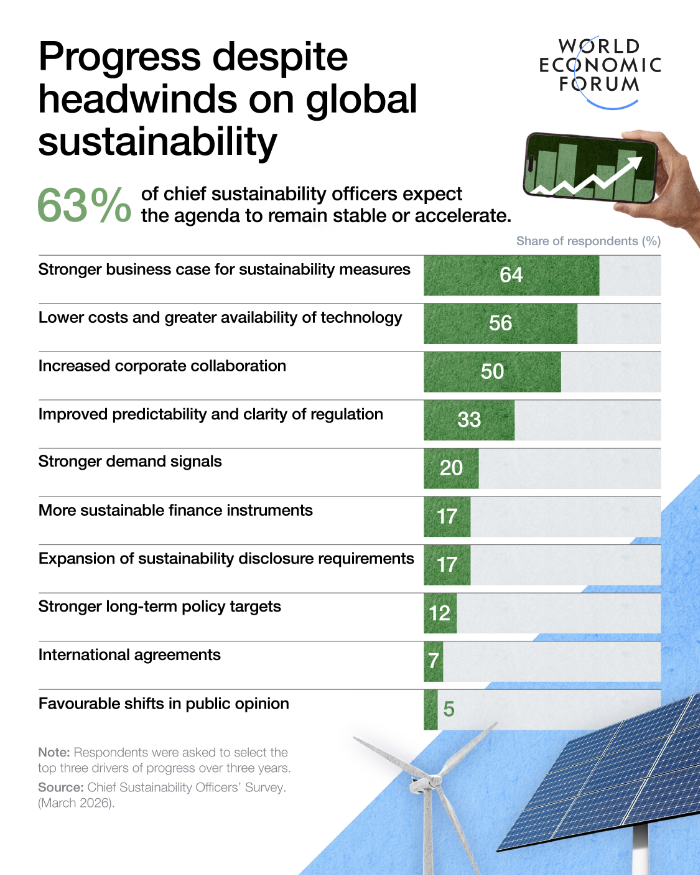
Some 63% of chief sustainability officers expect progress on sustainability to ‘hold steady’ or ‘accelerate’ in the short-term, according to a new report by the World Economic Forum.
According to the Forum’s Chief Sustainability Officers Outlook, which surveyed some 103 CSOs around the world, while progress on sustainability implementation is continuing, the ‘forces driving it are evolving’, with sustainability leaders focused on turning ambition into action and sustaining momentum.
Business case for sustainability
Over the next three years, around two thirds (64%) of CSOs identified a stronger business case for sustainability measures as the leading accelerator of progress, followed by the availability of cheaper and more applicable technologies (56%).
‘Sustainability can be more durable when the decisions that determine what is financed, built and scaled are commercially grounded,’ the Forum noted.
However, at the same time, policy uncertainty (68%) was cited as the main constraint on progress, followed by short-term business pressures (61%) and international tensions (54%).
The Forum described this evolving landscape as ‘green divergence’, where sectors and markets are moving at different speeds, driven by factors such as competitiveness, resilience, energy security and industrial priorities.
‘Commercial and sustainability goals will not always align automatically,’ it noted. ‘Durable value depends on understanding the resources, infrastructure and supply chains on which a company relies. Decisions that improve productivity or open markets while strengthening resilience are more likely to endure; those that lock in resource exposure or physical risk can narrow future options.’
The role of the CSO
The report also found that the role of the CSO is changing – while compliance still remains a key focus of the CSO’s role (cited by 65% of respondents), some two fifths (41%) say that they are tasked with viewing sustainability as a source of business growth or value.
Elsewhere, technology is another area of focus, with close to three quarters of CSOs expecting AI and related technologies to support sustainability through areas including risk modelling, resource efficiency, measurement and reporting. However, 77% identified the energy and resource intensity of AI infrastructure as a significant negative sustainability impact.
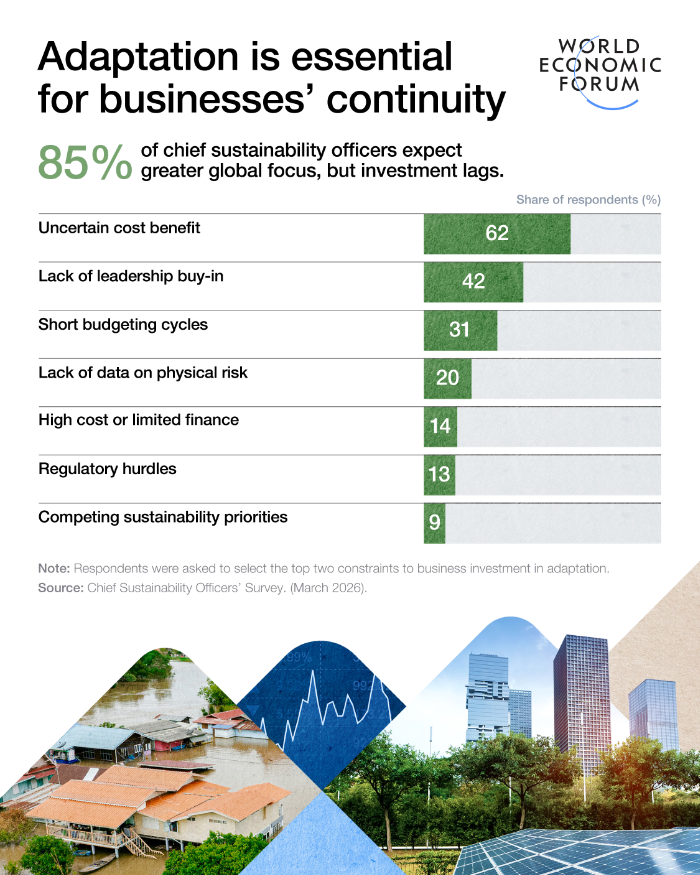
Lastly, adaptation is increasingly being seen as ‘essential for business continuity’, according to the report, with 85% of CSOs expecting adaptation to receive greater global attention.
However, 62% of respondents identified uncertainty around the cost benefits of adaptation, while 42% noted a lack of leadership buy-in, and 20% cited a lack of dat a on physical risks. Read more here.