The ozone hole above the Antarctic has expanded at an ‘above average’ size for this time of year, according to the Copernicus Atmosphere Monitoring Service (CAMS).
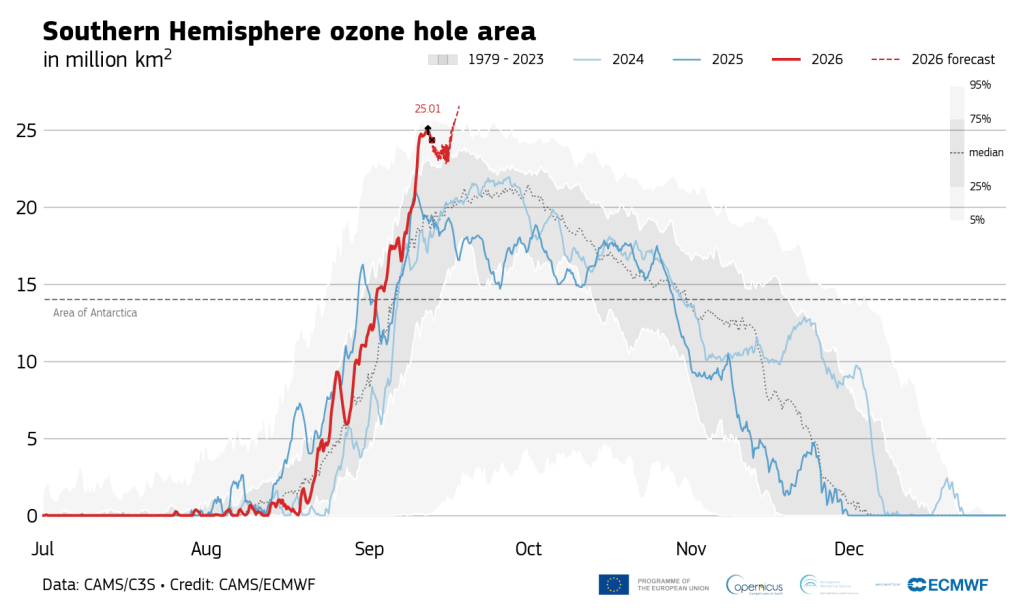
As CAMS noted, while the ozone hole had been developing at a typical rate in the period leading up to August 2026, in the first half of September, this ‘increased sharply’ to an estimated 25 million square kilometres.
This is around five million square kilometres above the average for this time of year.
Atmospheric factors
“The Antarctic ozone hole’s development can vary considerably from year to year, depending on a range of atmospheric and chemical factors,” commented Laurence Rouil, director of CAMS. “While we have seen its area increase rapidly in early September this year, other indicators remain close to historical averages.
“These findings highlight the importance of monitoring the complicated interaction between human-made disturbances and natural factors. CAMS provides the high-quality data, forecasts and analyses needed to understand the state of the ozone layer and track its long-term recovery.”
CAMS made its observation ahead of United Nations International Day for the Preservation of the Ozone Layer, which falls on 16 September.
As it noted, the expansion in the ozone hole is linked to conditions in the stratosphere over the Southern Hemisphere, and coincided with a sudden fall in minimum temperatures around 20 kilometres above the South Pole.
Recovery indicators
The largest recorded area for the ozone hole was 29.6 million square kilometres, which was recorded on 9 September 2006. CAMS added that recent years have seen ‘smaller and shorter-lived’ ozone holes, indicating a degree of recovery.
‘The thinning of the ozone layer is most pronounced over the Antarctic – where the area of low pressure and cold air (polar vortex) and stratospheric winds are more stable – with the ozone hole there opening each year during the austral Spring’, it added. Read more here.