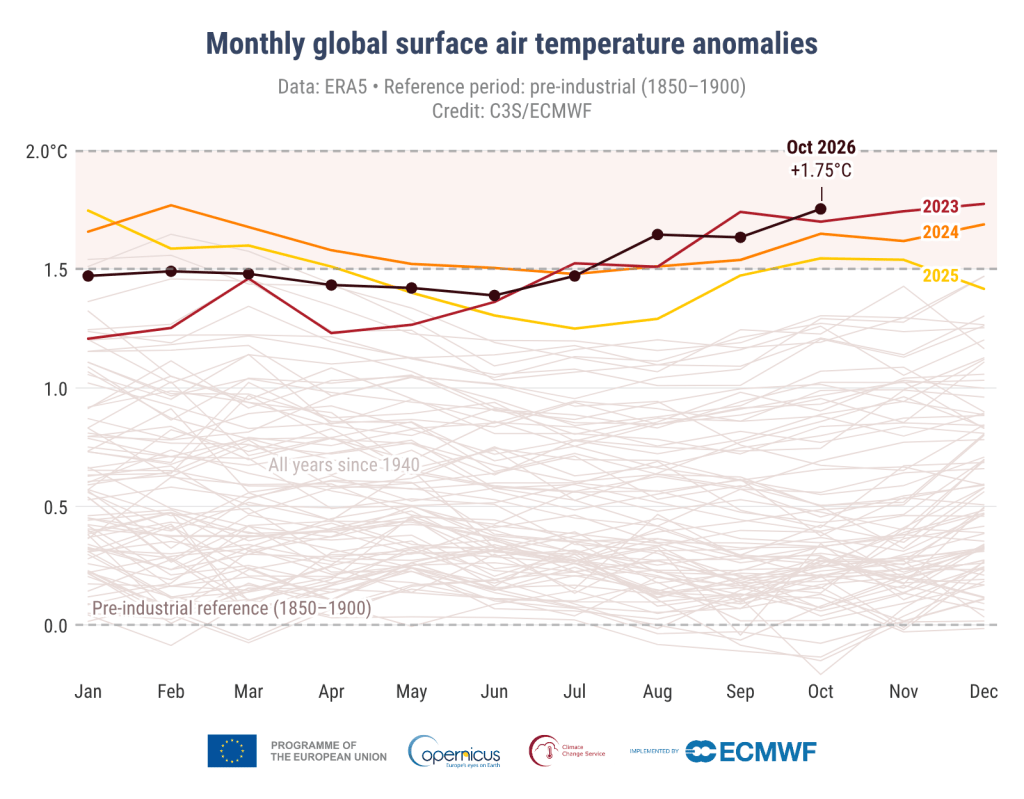
Global temperatures are ‘virtually certain’ to exceed 1.5°C above pre-industrial levels for the full year, following an October that was the warmest on record, new data from the Copernicus Climate Change Service (C3S) has revealed.
According to the latest C3S climate bulletin, published by the European Centre for Medium-Range Weather Forecasts (ECMWF), global surface air temperatures stood at 15.35°C in October, which was 0.90°C above the 1991–2020 average and 1.75°C above estimated pre-industrial levels.
As the data showed, October was the third consecutive month in which temperatures exceeded 1.5°C above pre-industrial levels, for the first time since April 2025.
Sea surface temperatures also remained ‘exceptionally high’ in October, with average sea surface temperatures outside the polar regions reaching 20.95°C, a new high for the month. In the tropical Pacific, where El Niño conditions gained in strength, the monthly average sea surface temperature reached 29.94°C.

‘Remarkable global warmth’
“October has continued the pattern of remarkable global warmth, with record global and surface ocean temperatures,” commented Samantha Burgess, strategic lead for climate at ECMWF.
“An exceptionally strong El Niño is adding further heat to a climate already warmed by human activities, while 2026 is on track to become the second calendar year above 1.5°C. Particularly significant is that the four-year average is also expected to exceed 1.5°C, highlighting how sustained this period of global warmth has become.”
European temperatures
Europe experienced its ‘second warmest October on record’, C3S noted, with temperatures standing, on average, at 1.49°C above the 1991–2020 reference period.
‘In contrast to September and much of the summer, temperatures were most above average in eastern Europe and Scandinavia, while much of western and central Europe experienced smaller warm anomalies,’ it noted.
While some areas of Europe, such as the Rhine, Danube and Vistula, experienced ‘exceptionally low’ river flows during the month, heavy rainfall and flooding was reported in other areas, such as the UK and Ireland, Spain, Greece, and Türkiye. Read more here.