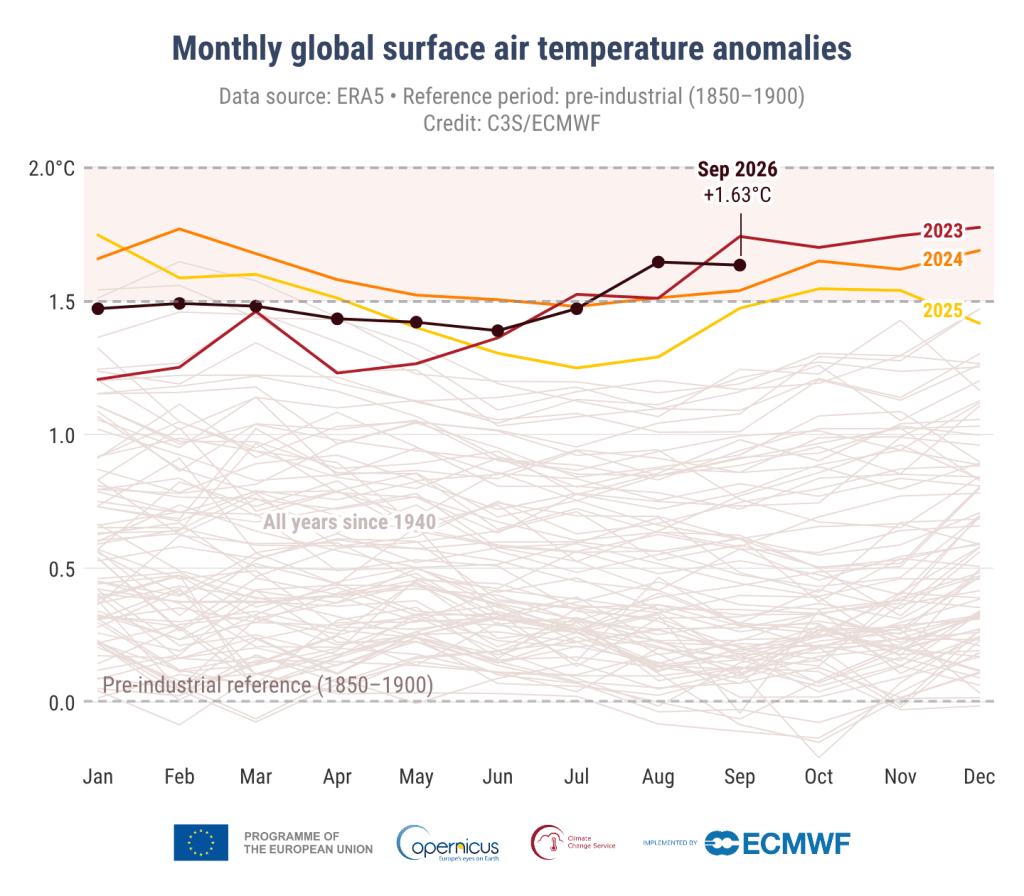
September 2026 was the second-warmest September recorded to date, as global average temperatures reached 1.63°C above pre-industrial levels, according to new data from the Copernicus Climate Change Service (C3S).
The data indicates that September was the second consecutive month this year where global temperatures exceeded 1.5°C above the pre-industrial average, while global sea surface temperatures were the highest on record for the month, driven by a strengthening El Niño.
‘El Niño conditions continued to strengthen in the equatorial Pacific, likely resulting in one of the strongest El Niño events ever recorded,’ C3S noted. ‘Meanwhile, around Antarctica, the sea ice extent reached its third-lowest annual winter maximum.’
Elsewhere, global average surface air temperature stood at 16.27°C in September, which was 0.82°C above the 1991–2020 average and 0.11°C below the previous record for the month, which was set in 2023.
European conditions
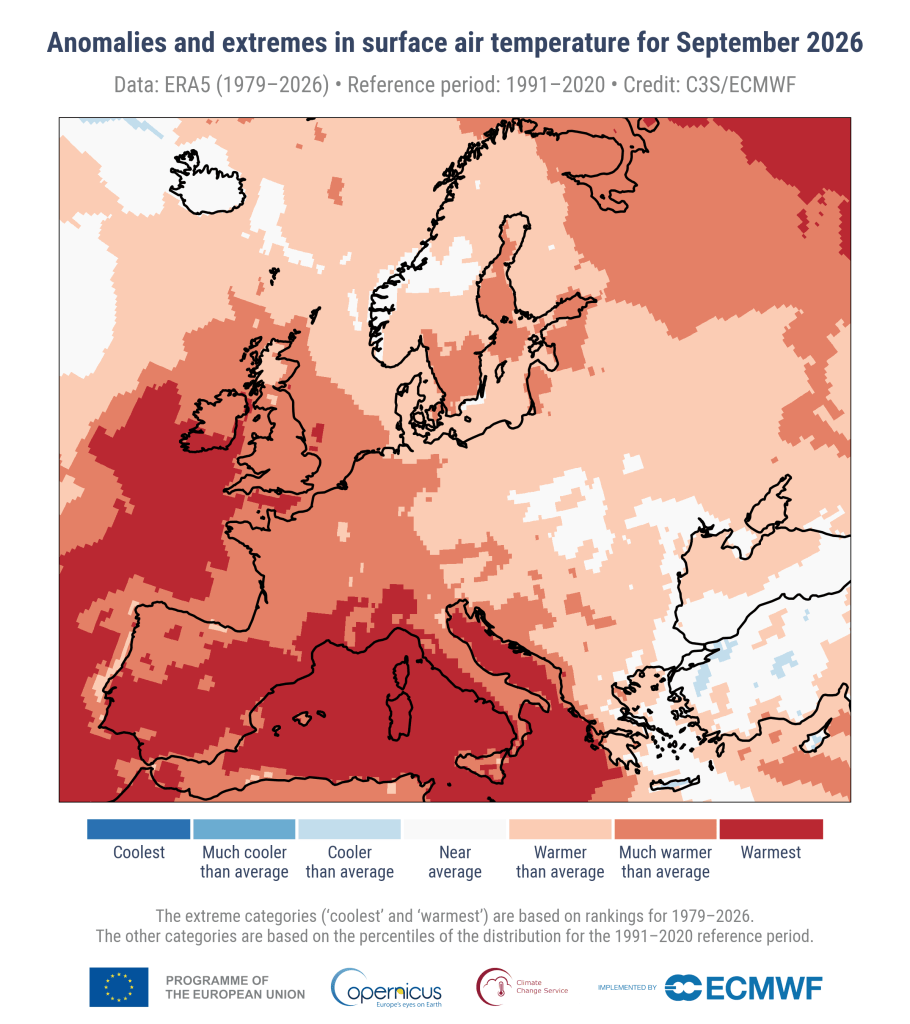
In Europe, conditions remained ‘unusually warm and dry’ in September, with an average land temperature of 16.26°C, or 1.54°C above the 1991–2020 average. In Western Europe, September was the joint warmest on record, the data showed.
Dry conditions intensified or expanded in parts of Iberia, France, Italy, the western Balkans and Greece compared with the previous month, while river flows were ‘exceptionally low’ in parts of the Rhine, Danube, Vistula and Garonne-Dordogne.
Wetter-than-average conditions were evident in parts of northern and northeastern Europe and Türkiye, meanwhile.
‘Exceptionally high temperatures’
“September was the second warmest on record globally, with exceptionally high temperatures experienced again across parts of Europe after an extreme summer,” commented Carlo Buontempo, director of the Copernicus Climate Change Service.
“We are in a new run of months above 1.5°C, and with a strong El Niño still intensifying it is likely to last into 2027. Crossing the Paris Agreement’s long-term limit is only a matter of time. How far we overshoot, and for how long, is still up to us. Copernicus data to guide that choice are free and open to all.” Read more here.