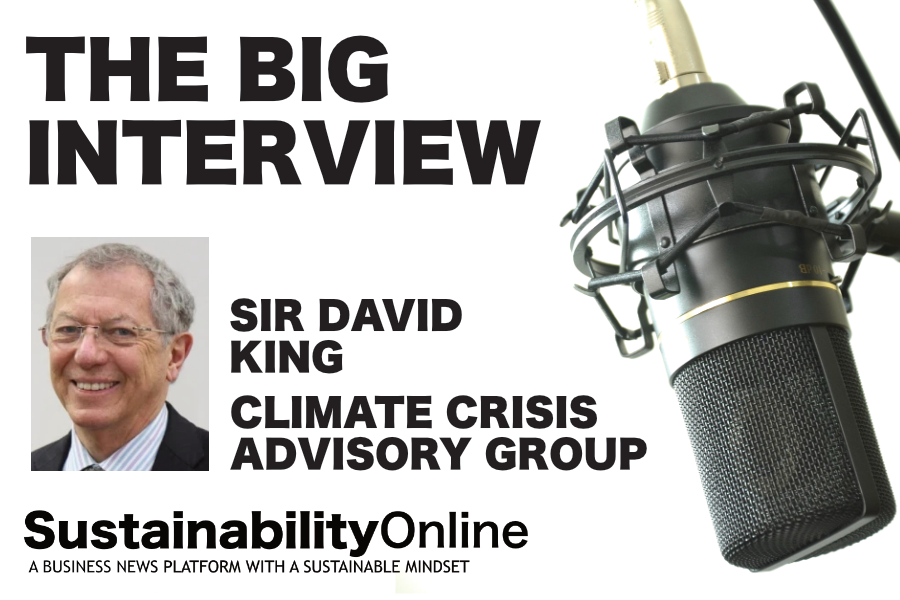
Sir David King has spent decades at the intersection of climate science and public policy, serving as the UK Government’s chief scientific adviser from 2000 to 2007 and special representative for climate change from 2013 to 2017.
He is founder and chair of the Climate Crisis Advisory Group and founder of the Centre for Climate Repair at Cambridge, where work continues on responses to climate change beyond emissions reduction.
This exclusive interview with the Sustainability Speakers Agency explores Sir David’s views on fossil fuels, individual carbon footprints, supply-chain emissions and the consequences of delaying climate action.
Why does reducing fossil fuel use remain central to tackling climate change?
The major cause of climate change is our use of fossil fuels, which has been expanding rapidly over the last 120 years. The result is that we’ve put an enormous amount of greenhouse gases into the atmosphere.
Imagine you’re lying on a bed and feeling cold. You pull a duvet over yourself and it keeps you warm. That’s the function of greenhouse gases. But if you put a second duvet on your bed, you get hot.
What’s happening in the Arctic Circle region is going to influence, and is already influencing, the whole planet.
The ice that used to cover the Arctic sea has melted significantly during the summer, exposing the blue sea to sunlight. Temperatures there are rising rapidly.
That’s the nature of the threat we’re faced with. Whatever position we hold, we have to use that position to attempt to manage a safer future for humanity.
Beyond cutting fossil fuel use, which changes in food, transport and consumption can reduce an individual’s carbon footprint?
We can take many steps. One thing I haven’t mentioned is the loss of forests. We’re losing forests at a fantastic rate.
One example is beef. We are eating more meat around the world as prosperity rises, and forests are removed to meet demand and allow cattle to roam. We need to look at what we eat and how we live.
If we travel privately, we should move towards electric vehicles. Wherever possible, we need to travel publicly, by trains and buses. Each one of us is in a different situation, and we need to look carefully at how we can reduce our carbon footprint.
What should businesses measure and disclose across their supply chains if they want their climate strategies to be credible?
Businesses must recognise that their supply chain may include products causing the removal of forests or contributing significantly to climate change. For example, if products have to be flown into factories, that in itself creates a big carbon footprint.
When businesses communicate their climate change strategy, they should set out the value of the carbon emissions from their supply chain. That is critically important.
What should governments and organisations understand about the long-term consequences of delaying climate action?
The first message is to understand that this is a challenge about the future of humanity. I’ve got grandchildren. My youngest grandchild, Lola, is three. She will be over 70 by the end of the century. Whether she will survive to the end of the century becomes a real question.
This isn’t me trying to exaggerate the situation. Each one of us belongs to a larger family, humanity. If we don’t operate in a proper fashion very quickly, we will no longer survive as a civilisation.
The world will continue. Our ecosystems and biological systems will continue without us. We need to learn that managing our ecosystems, instead of dumping rubbish and carbon dioxide into them, is critically important to our own lives.
This exclusive interview with Sir David King was conducted by Tabish Ali for the Sustainability Speakers Agency.