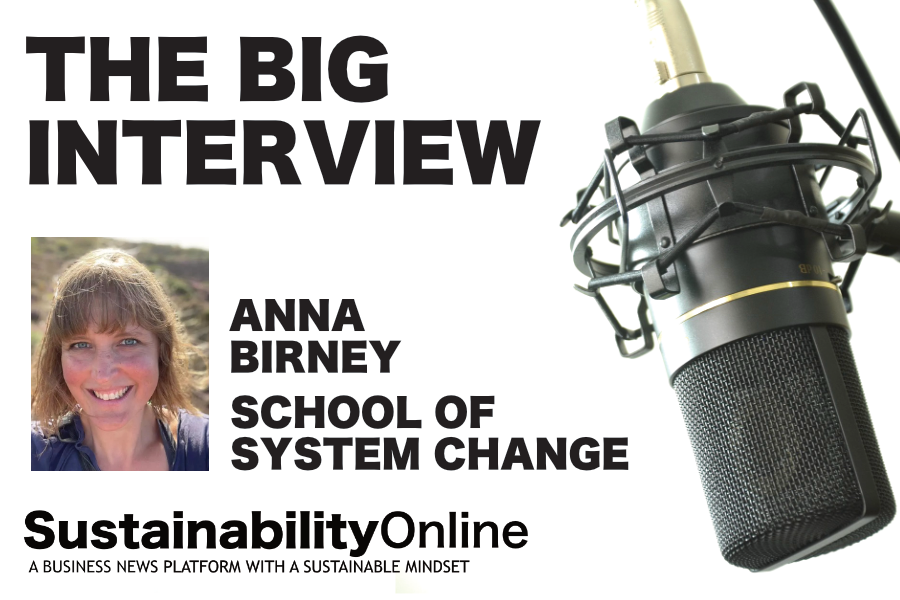
Anna Birney is the co-founder and CEO of the School of System Change, an international community of changemakers seeking to address the complex challenges of our times.
A sustainability speaker and systems change practitioner with over two decades of experience supporting organisations, communities and leaders to rethink how change happens in complex environments, Birney’s work focuses on helping people move beyond isolated initiatives towards systemic, long-term transformation.
She has led various multi-stakeholder initiatives since 2002, including roles at WWF-UK and Forum for the Future, as well as work with public, private, and civil society organisations. She is also the author of Cultivating System Change: A Practitioner’s Companion.
In this exclusive interview with The Sustainability Speakers Agency, Anna Birney shares her perspective on system change, innovation and what it takes for organisations to operate sustainably in an increasingly complex world.
System change is often discussed but rarely defined clearly. How do you distinguish between system change as an outcome and system change as an ongoing process, and why does that distinction matter?
We have two ways of looking at systems change. One, a lot of people talk about systems change as an outcome. So we try to change the system – be it the education system, the health system, or the food system.
What that really means is that we need to change the structure and the patterns of how we deliver and organise within that system. That is the first kind of definition.
But systems change is also about a process. It is the process of creating change systemically. How do we create change from a systemic viewpoint? We are looking at it as continual emergence, working at multiple levels of creating change. There are two different levels: both the change we want to see in the world, as well as the process of creating that change.
You place strong emphasis on building a global learning community. In a world shaped by complexity and constant disruption, why is collective learning now essential to tackling systemic challenges?
If we zoom out to the bigger picture, we are living in a very complex world. A lot of our systems challenges, such as addressing climate change and looking at structural inequality, are really complex issues. There is not actually one solution or one idea that will solve them.
We are also living in a very changing world. We saw that with COVID – a world that is continually changing and moving. Critical to that is both our ability to learn and adapt, and our ability to work with those challenges.
There is also our collective capability. Our capability to think about change in a different way and apply different tools and approaches, from strategy to collaboration, to address these complex issues. In order to do that, we need a learning infrastructure. A way of learning, a way of thinking about the world, and a way of enacting change in the world that really supports us to address those challenges.
With markets, technologies, and societal expectations shifting rapidly, how should businesses rethink innovation and experimentation to remain viable over the long term?
The key thing for businesses is that they need to start thinking about the fact that the external world is changing. The products and services, or the businesses they have today, are not necessarily going to address the challenges we are going to face tomorrow.
Innovation and experimentation therefore become a critical need. For many businesses, this is not just the business case, but also the values case. It is about saying ‘we will not have a business in the future unless we innovate and experiment’.
That need for experimentation is critical to the success of any business, especially in the world we are currently living in. There is also something about taking on a strategy that recognises we cannot necessarily have five-year plans anymore. We need to adapt and respond to changing markets.
There is something about marrying long-term vision and intention with short-term innovation and adaptability, and working with context. Then there are internal processes.
How do you set this up? How do you create your own skunk works or labs to give legitimacy to people in your business, and work externally with others to find different services and solutions to the big challenges?
Some organisations still treat sustainability as a peripheral concern. What would you say to business leaders who remain hesitant to integrate sustainability into their core strategy?
If people have reluctance or resistance, it speaks to whether they want to be in operation in the future. The time has come where sustainability is not just a nice-to-have, or an add-on to the business.
The ability to sustain ourselves and to sustain your business in a world with collapsing ecosystems, economic challenges looming, value chain challenges, and issues around suppliers and resources is fundamental. These are all being impacted by big global trends and environmental changes, as well as social issues.
This is not about a little bit of CSR on the side, or a little bit of ESG. It is fundamental to how a business operates in this world. This is not a separate strategy. It is about integrating sustainability into how a business thinks and operates.
Rather than focusing on a single intervention, what mindset shift do businesses need to adopt if they are serious about becoming truly sustainable and regenerative?
I think that is a false question, if I am honest. One big change is not going to do it. The whole point of taking a systems approach is recognising there are multiple levers and multiple areas where action is needed.
The biggest change is to orient intention and strategy towards understanding a business’s role within the bigger system. That is a mindset shift. It is about contributing to a future that is not just sustainable, but also just and regenerative.
That means addressing social and equity issues and the root causes of why our biosphere and resources are collapsing. It is about not just taking less out, but actively regenerating our ecological and social systems.
That becomes the north star. Behind that, there need to be multiple interventions across multiple fronts. Setting up mission-orientated areas of work within organisations, focusing on climate, social issues, and key priorities, and galvanising around them is critically important.
This exclusive interview with Anna Birney was conducted by Jack Hayes of The Motivational Speakers Agency.