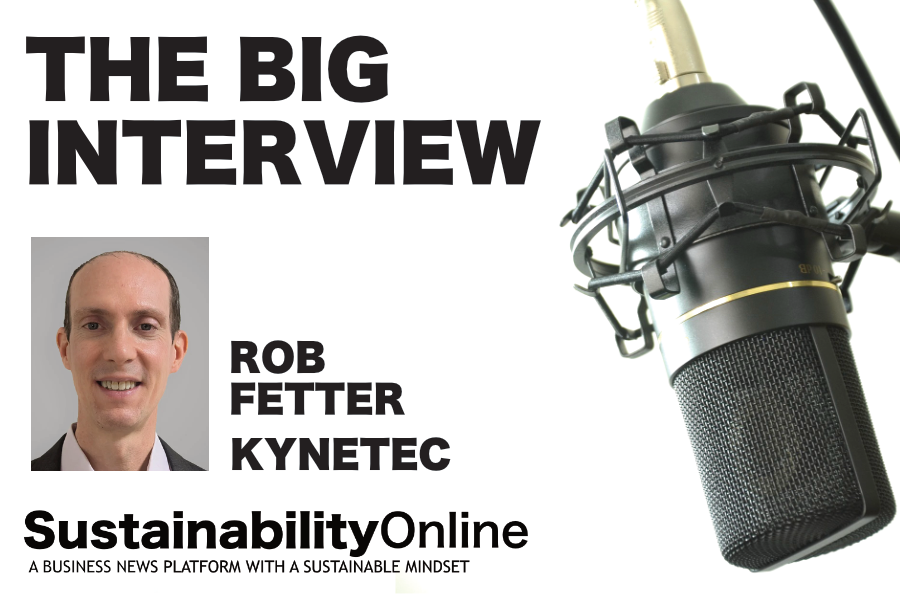
Kynetec’s Rob Fetter on supporting resilience investments with actionable data
Operating in more than 80 countries and processing more than 10 billion data points annually, Kynetec is a provider of data, analytics and insights across agriculture, animal health, and nutrition, supporting organisations in making informed, data-driven decisions.

As global sustainability lead at Kynetec, Rob Fetter leads initiatives to drive data-driven decision making into agricultural sustainability. Along with his team, Fetter gathers data from large-scale farmer surveys (across 50+ countries and 90+ crops), capturing real-world practices such as fertiliser use, crop rotation, and irrigation. This, in turn, enables agricultural firms to better measure greenhouse gas emissions and water use, and build more resilient supply chains.

In February, Kynetec announced a high-profile partnership with dsm-firmenich to enhance its Sustell life cycle assessment platform, enabling more accurate measurement of animal feed footprint data, and deliver more tailored sustainability assessments. “As animal feed is a significant contributor to life cycle assessment, ensuring accuracy and regionality of feed footprint data is essential in understanding how to make protein production systems more efficient,” says Fetter.

Systemic understanding

SustainabilityOnline caught up with Fetter at the recent Sustainable Foods event in London, where he was speaking on a panel on how food system resilience can deliver tangible commercial outcomes. As he explains, his work with Kynetec echoes back to his experiences as a young agricultural enthusiast.

“I dropped out of college to work on farms, and I spent three years thinking I was going to be a farmer for the rest of my life,” he says. “We had 40-plus acres of organic vegetables and fruits, plus dairy and some animal protein.

“That led me to go back to college to study farm economics, because I wanted to understand why we couldn’t sell our really high-quality organic lettuce into local retailers down the road, and why they were sourcing lettuce from 3,000 miles away. I wondered what kind of crazy business system had been set up that would allow that kind of nonsensical supply chain – I wanted to get a systemic understanding of it. And that’s kind of been what I’ve been after ever since – trying to get that systemic understanding.”

Knowledge gap

As was discussed on the panel, a critical knowledge gap is evident when it comes to commodity sourcing, with most consumer goods firms not fully appreciating how environmental conditions influence the availability of key crops.

“I think sometimes that when it comes to supply chain resilience, the conversation still has some maturing to do,” Fetter explains, adding that while the recent cocoa shortage in west Africa led to ripples across global markets, the potential climate impact on other crops shouldn’t be overlooked.

“Some 70% of the world’s cocoa is grown in two countries in West Africa, and so, when there is a shock to that region, it’s a big shock to the system,” he says. “But what about everything else. Could the same thing happen in corn? Is it also true of soy? What about potatoes? What about wheat? I think that’s the piece of education that still needs to be really absorbed here.”

In other words, the commercial availability and functional properties of several commodities are highly environment-dependent, and Fetter’s role at Kynetec is to translate these nuances into actionable insights.

“Some crops and regions are more material than others in terms of the materiality of the resilience threat and the nature of the threat,” he says. “Take wheat, for example. Its protein content and structural properties vary significantly, affecting functionality. These characteristics are shaped not just by the seed variety or traits introduced by seed companies, but also by environmental conditions such as heat, water stress, and fertilisation.

“As a result, wheat is difficult to hedge through geographic diversification alone, because growing conditions directly influence grain quality, which in turn affects the shelf life and performance of flour and baking products used by CPG companies.”

Defining resilience

Resilience is the buzzword when it comes to sustainability these days, and that is particularly the case when it comes to agriculture. However, resilience doesn’t have to be a universal target, with more traditional methods, such as supplier diversification, more than adequate in some categories.

“As an economist by training, I’ve been thinking a lot about how we integrate sustainability into the business conversation,” says Fetter. “How do you talk to your CFO about securing more resources for your sustainability programme? The answer is to make it central to the business case. That means talking about the procurement function – in this case risk management – and why its so important to put specificity and data into that analysis.

“I say that because, if 80% of what your company sources is corn and soy, then resilience can often be managed through supplier diversification.”

The complexity of supply chains and the influence of large suppliers mean that consumer goods companies should understand these dynamics to prioritise interventions effectively. In other words, resilience should be integrated into business decision-making and risk management rather than treated as a generic requirement.

“It’s very fashionable to talk about resilience these days – and for really good reasons – but in doing so, we risk oversimplifying it,” says Fetter. “There’s often a lack of understanding about where resilience is truly material, and where risks can’t be managed through traditional tools. And precisely that’s where good data comes in.”

With this in mind, Kynetec collects data from hundreds of thousands of farms on inputs, practices, fertiliser and pesticide use, pest and disease incidence, and yields, informing analysis on where resilience matters most, and where insights can be turned into actionable strategies.

“First, you need a structured way to diagnose where the real risks lie – then the data to inform and support that approach,” Fetter adds.

Learn more at www.kynetec.com

Discover more from Sustainability Online

Subscribe now to keep reading and get access to the full archive.

Continue reading