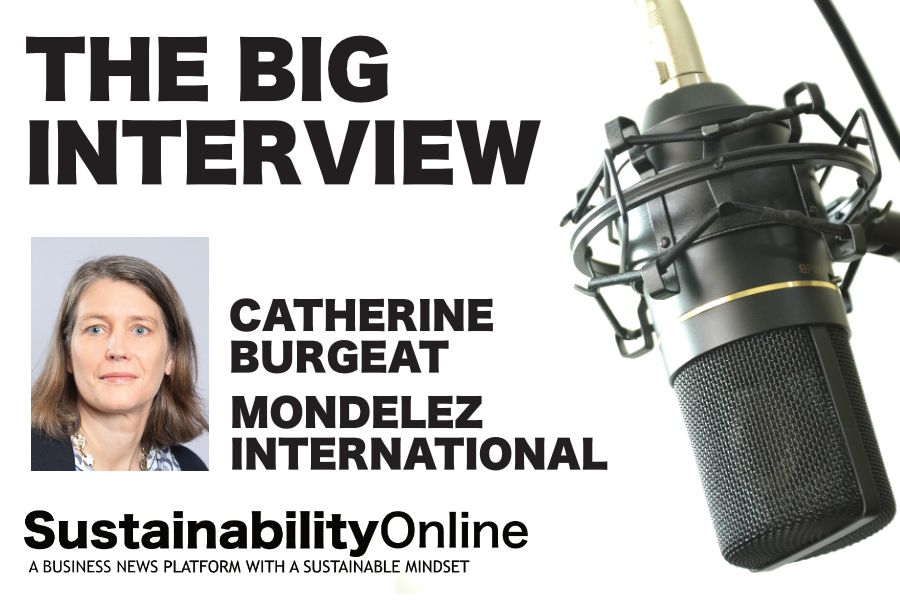
As senior director, sustainability Europe, at Mondelēz International, Catherine Burgeat leads the snacking giant’s sustainability agenda across four key pillars – ingredients, social progress, climate, and packaging – focusing on integrating business performance with sustainability goals.
At the recent Sustainable Foods event in London, Burgeat participated in a panel discussion on how net zero is likely to be defined in future food systems, the role of supplier engagement and shared standards when it comes to emissions reduction, and the effectiveness of current net zero strategies.
The net zero debate
As became clear during the discussion, few anticipate an easy path ahead. SustainabilityOnline asked Burgeat for her take on why pessimism continues to linger when it comes to net zero.
“There are no quick wins,” she says. “It’s a combination, I believe, of the fact that it’s incredibly difficult, and that we have a set target of 2050 for net zero. Many of us also have intermediate targets for 2030. And that’s very soon.
“So, the question arises – are we doing enough? Are we going fast enough? When you combine the complexity and the time element, you are always going to have these questions.”
In recent years, there has been a reassessment of the value of fixed-time targets. On one hand, they provide a clear direction of travel; on the other, they can become a liability if targets are not met. While Burgeat believes that incremental improvements can serve as a motivating factor, she also argues that more ambitious goals can help sharpen organisational focus.
“For me, fixed targets are more positive in terms of getting traction internally,” she says. “As an organisation, you need that push. I think it’s very embedded into how we work as a large company.
“My background is in marketing, and we had market share targets. If we didn’t have those, how would we push ourselves? I see sustainability in the same way.”
Sustainability programmes
Mondelēz International remains “on track” to meet its 35% emissions reduction target by 2030, she notes, however the bulk of the challenge sits along its supply chain, with ingredients (such as dairy and cocoa) accounting for 70% of carbon emissions. Programmes such as Cocoa Life (its cocoa sustainability programme) and Harmony (its wheat sustainability programme), which were initially developed to support farmer communities, are also playing a role in targeting emissions reductions.
“For me, quantitatively, because of the share of cocoa in our carbon emissions, and because of the deforestation component linked to it, by working on zero deforestation for our cocoa sourcing, we can see the biggest reduction,” she says.
“The starting point for Cocoa Life, back in 2012, was about ensuring fair trade, recognising and supporting the communities behind the cocoa, rather than focusing on carbon emissions. But by doing that, there was a connection.”
Good for business
Sustainability has to be good for the bottom line, of course, and at Mondelēz International, sustainability and business performance are managed through a single decision-making framework rather than separate short- and long-term trade-offs. Sustainability targets and net zero initiatives are developed and scaled according to their economic viability, says Burgeat.
“Of course, reducing our carbon footprint is an important environmental consideration,” she says. “But how we get there – the initiatives we select, how we scale them, and what we invest – will depend on the business case behind them.
“If it’s not economically viable, it won’t last, and then it won’t serve its purpose. Ensuring the right economics are in place is also a way to make sure these initiatives endure and become part of business operations.”
Driving efficiency
In addition, efficiency measures, such as using less energy or reducing material inputs, such as packaging, can serve the dual purpose of supporting both environmental and financial goals.
” I often say the best packaging is the one that doesn’t exist,” says Burgeat. “And when you don’t use packaging material, when you don’t use energy, you also achieve cost savings. So how can we be smart about building a total business case that delivers environmental benefits and offsets, while also creating a solution that is economically viable?”
As regards the role that Mondelēz International can play in encouraging consumers and society to act more responsibly, Burgeat notes that while general awareness of climate issues is strong, purchasing decisions remain driven by traditional pillars such as taste, quality, convenience, and price – in other words, for sustainable messaging to get cut through, it needs to have relevance within these parameters.
“We produce snacks,” she says. “What consumers want is taste, quality, and convenience at the right price – a competitive price. There is no direct link to sustainability in anything I just mentioned.
“Therefore, sustainability becomes, at minimum, a hygiene factor. It’s something that can play a role and be valued by the consumer if it connects with those things. It’s more an expectation that we’re doing the right thing as a business.”
Learn more about Mondelēz International’s sustainability targets at www.mondelezinternational.com/snacking-made-right.