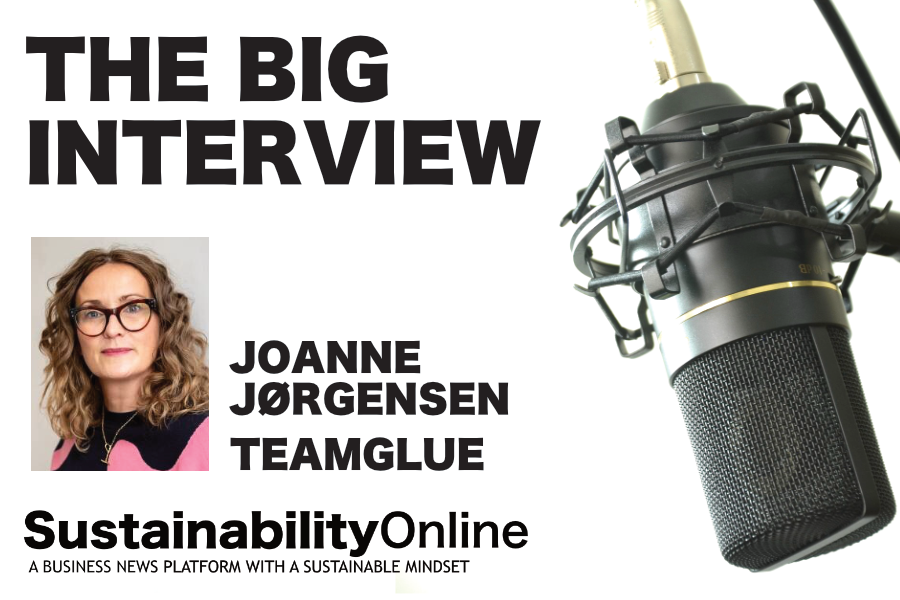
Joanne Jørgensen is a globally respected sustainability leader who spent nine years at sportswear giant Nike as sustainable materials innovation director, helping to drive sustainable material innovation and redefine how performance footwear is designed and manufactured at scale.
At Nike, she helped guide the development of the Flyknit platform, dramatically reducing material waste while challenging long-established production norms.
In 2024, she founded TeamGlue, currently serving as creative director, where she advises leaders and organisations on embedding regenerative thinking into strategy, culture and product development. She is widely recognised as a leading female inspirational speaker on sustainable transformation.
In this exclusive interview with the Sustainability Speakers Agency, Joanne shares hard-won lessons from global manufacturing, innovation leadership and systemic change, offering a clear-eyed perspective on how businesses can move beyond incremental sustainability towards meaningful, future-proof impact.
Your early career exposed you to global manufacturing systems. How did that experience shape your commitment to ethical design and sustainability?
I was lucky enough early in my career to work for very large global brands and travel to factories. I’m talking about the ’90s – travelling to factories in Asia and really seeing the process at a global scale and the end-to-end process.
When you see that, for me as a curious person, there were more questions than answers. One of the big things that I found really challenging to get my head around was creating product just to fill a store or meet minimum order quantities with the hope that it would sell, which for me created a lot more questions than answers.
I was probably that annoying early-years designer who was constantly curious, but that’s where I thought, surely we can do things better than this. So it started from the very beginning, to be honest.
Drawing on your work developing Nike’s FlyKnit technology, what structural lessons should businesses take from innovation-led transformation?
I think, first and foremost, it’s the importance of investment in R&D or innovation hubs. When I say innovation hubs, I don’t mean an innovation team that is dragged into the day-to-day. I really mean something that is separated off, that isn’t stuck in constant meeting cycles and is able to experiment, pilot, and roll out processes for the business or products.
I think this is really key in where we’re at today, because we’re in a space where so many businesses are struggling, but when you look under the hood, they’re doing the same old thing expecting different results. I would say the same for a lot of leadership courses as well.
We are in a space where we need a different approach to leadership, but also a different approach to team structure.
When we look at Nike, they had a big history of designing trainers and a successful history of doing that in one way. But a traditional trainer has 40-plus components cut out of rolled goods. The waste at scale for these companies is incredible.
What they did was take a risk on a completely new method of making through having innovation hubs and through having R&D that is zero waste. I really believe that taking people out of the day-to-day to answer the difficult questions is critical. Yes, we’re successful at doing this one way, but we’re damaging our planet. How can we create a different way?
I think there’s a lot to be learned for many companies from that. We’ve got into a habit of being ‘always on’, and that could be back-to-back Zoom meetings. I see this a lot as an executive coach. Often the problem that executives, leaders, and founders come to me with is a lack of time – time to get to know their team, time to do specific projects.
What I find interesting is that white space is where our ideas come from. When we are calm and able to step off the hamster wheel, it’s where our brain connects everything. There’s no happenstance when people say, “Oh, I get ideas when I go for a run or while napping.”
When you have that space for R&D away from the hamster wheel, that is where the eureka moments and the most important strategies for your business can come from.
For organisations seeking to embed sustainability meaningfully, what practical and structural changes are required?
The main thing I often say is that this is not a ‘band-aid solution’. It’s not just about hiring one ESG expert or someone with sustainability in the title. It should be something foundational that goes throughout your company and your organisation and sits in everybody’s strategies and everybody’s KPIs.
The problem with a siloed approach, if it’s the ESG or sustainability team, is that it’s seen as something that everyone else doesn’t need to worry about. As humans, we generally do not like change, and you can really see that with things such as legislation coming in for sustainability.
The EU, for example, is very clear on the legislation and when it’s coming in – for example, digital product passports, which show the ingredients of everything that is in a product. It is not new news that this is coming in 2027, but if I could tell you how many brands haven’t even started looking at this, it is insane.
If it’s everybody’s priority to work towards this, you will have a strategy. You won’t be scrambling, and you ultimately won’t be fined for not adhering to these things or end up hurting your bottom line. So it is really important that it is everybody’s strategy and everybody’s foundational approach.
This exclusive interview with Joanne Jørgensen was conducted by Tabish Ali of the Motivational Speakers Agency.