Ireland boasts a sizeable share of Europe’s peatlands, which play a key role in carbon storage and emissions reduction. Restoration of these natural ecosystems has the potential to reduce national emissions by 5%, however, peatland restoration is not always sufficiently incentivised.
Enter Peatland Finance Ireland (PFI), a non-profit organisation that manages a blended financing system for peatland restoration. Founded in 2022, PFI focuses on mobilising investment to support peatland recovery and associated environmental outcomes.
Last August, PFI celebrated a big win with the announcement that tech giants Meta, Microsoft, and Google have committed more than €3 million to restore between 400 to 450 hectares of degraded peatland, in an initiative co-facilitated by Bonneville Environmental Foundation (BEF) and Agua Segura. Restoration will commence at a pilot site in the Wicklow Mountains Special Area of Conservation.
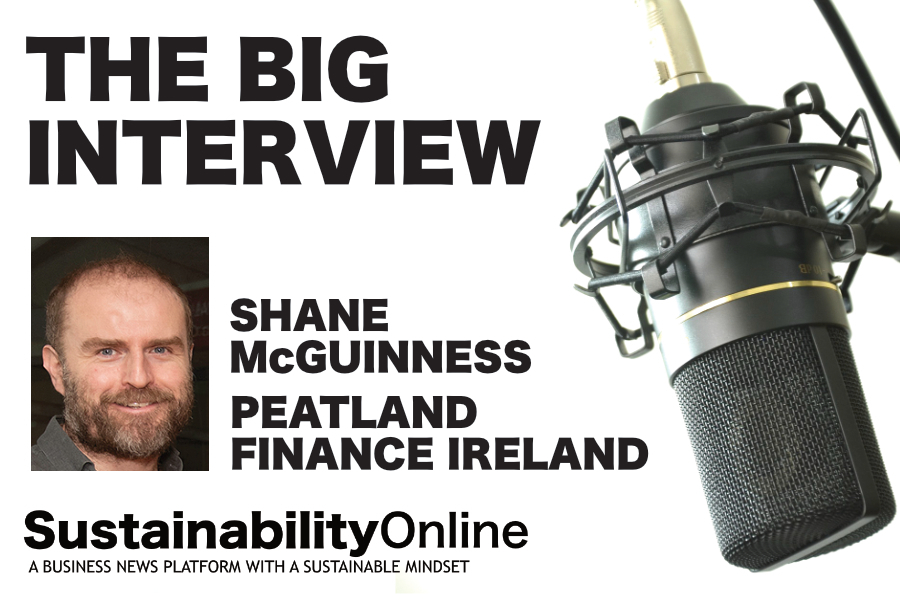
The founder and director of Peatland Finance Ireland is Shane McGuinness, assistant professor in sustainability and a climate fellow at University College Dublin. SustainabilityOnline caught up with him.
“It’s been a learning curve,” he says of PFI’s journey so far. “The challenge is convincing people on both sides of the aisle that it’s as important as it should be.”
Business certainty
At PFI, the focus is on creating certainty for businesses around environmental claims and outcomes, providing verified data and frameworks that allow private organisations to support restoration projects and stand behind environmental claims.
“We need to ensure that we have the pieces in place to allow private actors to stand behind whatever claim is made, and whatever action is taken, and quantify that,” McGuinness adds. “With emerging legislative frameworks, companies are either obliged to meet requirements or have voluntary commitments – or increasingly, a mix, where voluntary targets feel almost mandated.”
Peatland restoration can help reduce emissions, improve water quality, and support biodiversity, while also ensuring more resilient landscapes, including reducing flooding risks. But rather than “speak in hyperbole and shout from the rooftops”, as McGuinness puts it, PFI focuses on building credibility and long-term trust with corporates. Its approach has earned support from the NTMA, government departments, academia, community groups, semi-states, Bòrd na Móna, Uisce Éireann, and other national bodies.
“It’s about growing the roots,” he says. “Think of a tulip bulb – most of the growth comes six weeks before you see anything emerge above ground.
“Investors are looking for certainty, over periods of 10 years or more, while ecosystems require 30, 50, even 100 years. This isn’t a short-term research project.”
The story so far
The question needs to be asked, however – why hasn’t this been done before? According to McGuinness, to date peatland restoration has lacked clear leadership due to responsibilities being spread across multiple government departments and agencies. PFI was created to fill this gap.
“The problem was that it fell under everybody’s remit – and therefore nobody’s,” he explains. “While everyone played a small part, nobody was leading.
“As refreshing as having a blank canvas was, it also meant starting from scratch – developing the registry, creating the peatland standard, and coalescing our stakeholder group, the ‘group of the willing.’”
PFI uses soft diplomacy to align government, corporate, and semi-state interests, ensuring long-term, trustworthy outcomes. In addition, by focusing on long-term, quality restoration over short-term carbon quick-fixes, it avoids a “race to the bottom”, as McGuinness puts it, pointing to the stagnation of carbon mitigation projects in Scotland, where “everybody’s holding back, and speculating”.
Sustainability frameworks
So, why are multinationals such as Google, Microsoft, and Meta attracted to projects like PFI? According to McGuinness, the fact that peatland restoration is embedded in national policy offers stability and trustworthiness, as well as meeting firms’ own sustainability and biodiversity frameworks.
“When those three approached us, it was initially on the basis of water – they were running massive internal deficits of water, and they have really ambitious water neutrality targets,” he says. “There are very few other ecosystems in Ireland that can deliver the kinds of water return that Irish peatlands can. “
Restoring peatlands also provides measurable environmental outcomes without social or reputational risk. “We are embedded with communities,” he adds. “We have close connections with them. We’re not chasing people off their land. And we’ve communicated that to the techs quite clearly, that you will not be put at reputational risk from it.
“In fact, if anything, it helps them more from a messaging perspective in supporting rural economies, and supporting people.”
Bundled ecosystem certificate
PFI’s bundled ecosystem certificate incorporates mandatory co-benefits for water, biodiversity, and social outcomes, ensuring measurable and secure results without speculative trading. According to McGuinness, the focus is on ensuring the development of a stable, policy-aligned system with transparent pricing and long-term credibility, thereby avoiding the risks associated with some carbon market solutions.
“In summary, it’ll save you money and it’ll save you reputation,” he says. “The tech companies that we’re involved with have got that flexibility to be able to be a bit braver. But there are opportunities for organisations in other sectors to get involved.”
PFI has a pipeline of between 12 and 15 projects in various stages of development, and has spent a lot of time baselining whether particular sites are viable for restoration. As McGuinness notes, Ireland is well positioned to take advantage of this capacity, given the presence of so many multinational firms.
“We’ve got a good opportunity here,” he says. “We’re stable, we have the land available, and our story is stronger than other jurisdictions. We’re also good at working with people – we’re not just cold, clinical business people. We know our stuff, but we can also talk to someone as a person.”
Learn more about Peatland Finance Ireland at https://peatlandfinance.ie/