Plant Based Treaty is an initiative that seeks to put food systems at the heart of the climate transition.
At COP29, the group advocated for a global plant based treaty as an add-on to the Paris Agreement, which it says would lower emissions, boost biodiversity, improve health, and lead to untapped business opportunities – as the group puts it, a transition to plant-based systems could save 75% of the emissions generated by the food industry.
Its proposals have already been endorsed by over 30 cities around the world, including Edinburgh, Belfast, Los Angeles and Amsterdam, thousands of elected officials and representative groups, and countless celebrities, including Joaquin Phoenix, Alicia Silverstone and Paul McCartney.
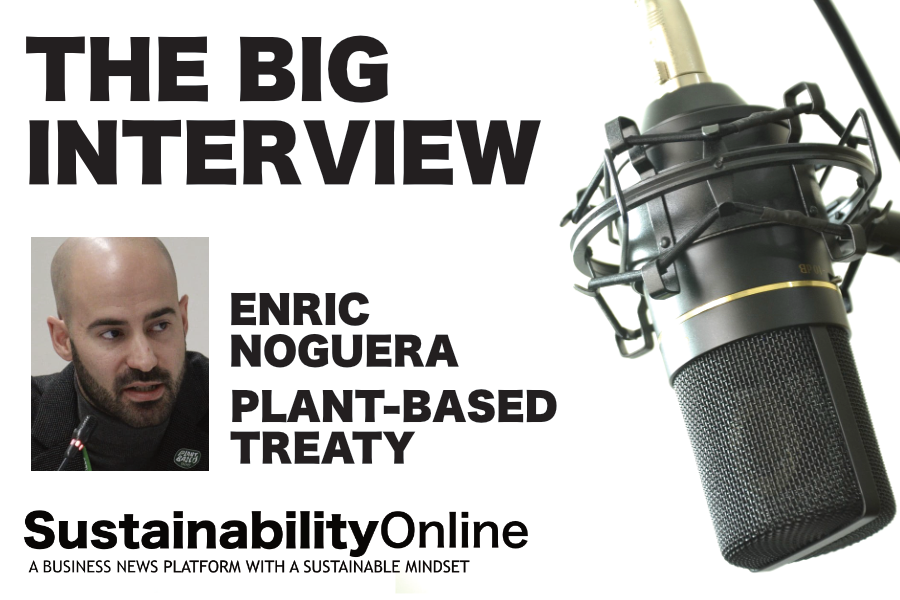
SustainabilityOnline caught up with Enric Noguera, European cities campaigner at Plant Based Treaty, to discuss the challenge of transitioning a legacy-based food system to a plant-driven alternative.
Recent discussions around climate change and sustainability have brought together people who, in the past, may have been diametrically opposed. Plant Based Treaty is advocating for a plant-based future; it’s advocating for a move away from animal protein. But are you also saying, ‘let’s bring everyone together, and come up with a workable solution?’
Yes. We are very much trying to combat that narrative by being a solutions-oriented organisation, a positive messaging organisation. I think the world needs more of that. What we’re trying to do is bring everybody to the table, because every crisis brings opportunity at the same time.
I think the beauty of this transition, specifically on food systems, is that everybody can benefit from it — people, farmers, politicians, investors. And the only way we can do that is by coming to the table, talking about it, and moving in that direction. That’s very much our focus and our approach.
Where have you been able to move the needle on that in recent years?
I think the best example is our city campaign. At the moment, we have 34 cities that have endorsed the treaty.
Through this, we have seen how procurement companies, schools, and public institutions are coming together to develop programmes to roll out, and then addressing health perspectives and sustainability perspectives. This is a great example of collaboration.
Within cities, how is that being applied? You’re working with the mayor, you’re working with local governments?
It very much depends on the city. In Amsterdam, for example, which was a campaign that I personally worked on, we started working with the city’s sustainability department, and then we went through the councillors. But we also try to develop campaigns in parallel to that.
For example, we have a ‘menu change’ campaign that goes through businesses to try to encourage them to incorporate more plant-based options. Following on from that, we collaborate with plant-based companies to bring in those solutions, to bring in those products, and then we also work with universities to try to encourage students to create awareness campaigns around that.
When you develop a city campaign, it’s not just about talking to the mayor’s office or some councillors. It’s about talking to different stakeholders within the city to bring in those solutions.
Coming from our grassroots approach — this is very much our expertise — we have seen that campaigns are much more sustainable and reliable when you work with different stakeholders. When you involve people on the ground, and involve communities, it becomes more effective, That’s how you get the momentum.
Is the campaign being driven more by Western, developed economies, than developing markets?
No, actually, we have 19 cities in India that have endorsed it. We have a strong presence in Asia as well.
We’re talking to a lot of African countries, a lot of Southeast Asian countries, also South America as well. We talk to everybody and then we see where the openings are. In terms of the cities we work with, I would say it’s roughly half Global North, half Global South.
We are also looking to expand, and it very much depends on where we have teams on the ground.
There has been a lot of talk recently about the effect the climate transition will have on the millions of farmers around the world. There needs to be financial mechanisms in place to encourage that transition, whether that’s public or public-private partnership, or blended finance. In terms of Plant Based Treaty’s position on that, how are you involved in facilitating that conversation?
We have a very strong social component at heart, which means every part of society needs to be involved, including farmers. We are very much dependant on them – we acknowledge that they are an essential part of the transition.
One of the things that we are advocating for is around public finance, so redirection of subsidies, for example. Right now there are a lot of policies that aren’t addressing farmers’ needs, and helping them to move on.
One example was in the Netherlands, where the Dutch government set aside a package of €25 billion for buyouts of livestock farms. Basically, they were not giving farmers an alternative. It was a case of ‘we will pay you 120% of your farm value, then you’re out.’ That’s not really a solution.
That’s what sparked us to think about how we could develop solutions for farmers. ‘What do you want to do? You need to move away from livestock farming? How can we help?’
We are advocating for public finance to come in and provide these options, and then retrain, repurpose the land, and compensate the farm for greener practices. We have many examples around the world of organisations that are already doing that.
A farmer in the Netherlands, for example, repurposed to plant-based agriculture, and left a space for rewilding. He then brought in ecotourism, and also an educational aspect, so schools could come in. There are also projects in Switzerland that have made similar transformations.
There are many different options, and I think governments are an essential means of providing the technology, the knowledge, and the funds as well.
There is almost certainly going to be some pushback from some governments, from local authorities – what sort of negative messages do you receive?
We definitely get negative messaging because there is, first of all, a lack of knowledge in terms of what is happening or what it’s bringing to the climate crisis, even from a health perspective. There are also a lot of economic interests involved.
But it’s not ‘us versus them’. We are all in the same boat. Let’s find solutions together.
Obviously, with Plant Based Treaty, you don’t want it to be a one-shot deal, where you go in, make a big noise, and then things regress back to the way they were. How do you evaluate, measure, and adapt your strategy when you’re working with cities over time?
We have dynamic, flexible campaigns, so we’re learning as we go. We’re incorporating new strategies and getting feedback. A lot of this pushback is actually useful for us to understand how to tackle those challenges as well, because a lot of this resistance comes from fear of losing livelihoods – it’s a very legitimate fear.
One of the examples I could give you in practical terms, is that we have taken the 40 proposals we have, and gathered examples from all over the world to show how these practices can be applied, and highlight the wide range of options we actually have.
Then we can go to cities and governments and say, ‘Look, this is happening all over the world. This is how it’s being done. Let’s find something that works for you.’
We’re going into 2025 now, the middle part of the decade. There are a lot of organisations and businesses that set 2025 targets on things like plant-based transition or plastic waste, and they’re not going to meet those. What message would you have for the business community in 2025?
As I mentioned earlier, for the business community, every crisis brings opportunities.
We recently went to a presentation in Singapore, and they were talking about precision fermentation, lab-grown meat, and explaining the benefits it brings. You reduce costs, you reduce the resources needed, it’s environmentally friendly, and it’s available for everybody – that includes vegans, halal, and people with allergies. You’re creating a product with tremendous output, with tremendous opportunities.
In many cases, it’s a question of how you can fill the gaps in the market. Bring in technologies, partner with certain companies, and fill the gaps with practices that can ensure food security, create jobs, and maintain climate resilience.
We’re getting that message across now, and we’re also seeing that the animal agriculture lobby is spending a lot of money trying to fill those gaps. However, with all the new technologies that are coming in, many people are realising, ‘wait, there’s a more efficient way to do this.’
Obviously, if you’re the first mover, it’s easier, but you can still make the transition regardless. This is what we’re doing in the Global North, especially in Europe and the US, where animal agriculture is a massive industry. But that doesn’t mean it can’t change.
Once we were riding horses and now we’re flying planes. It’s the same kind of transformation.
Learn more about Plant Based Treaty at plantbasedtreaty.org.