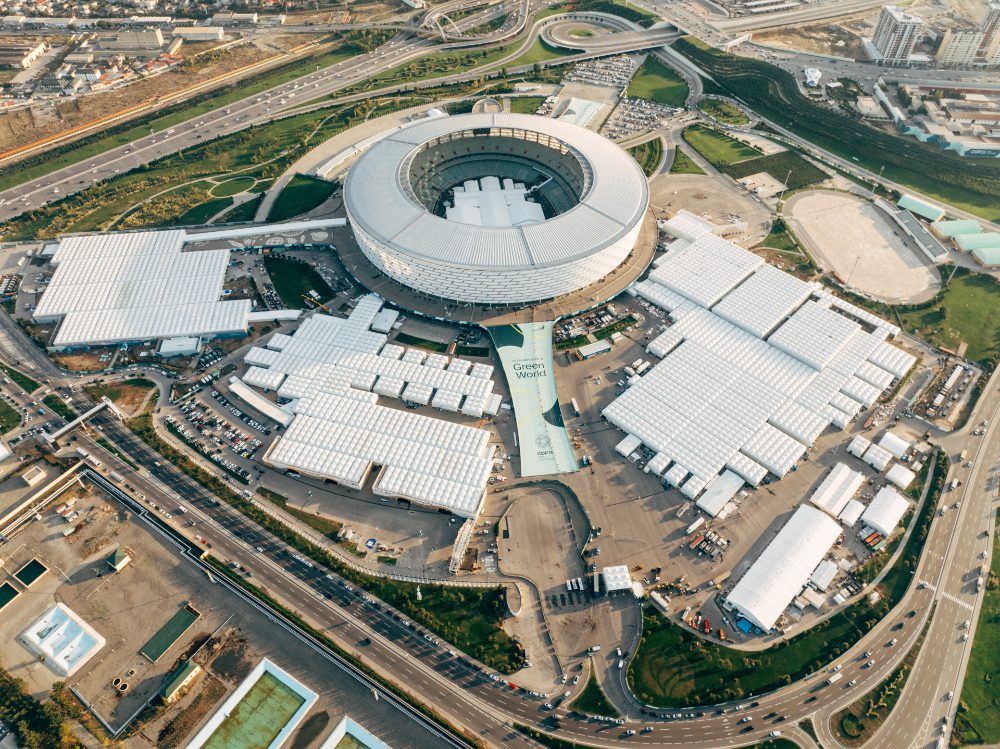
The 29th United Nations Climate Change Conference, more commonly known as COP29, will take place in Baku, Azerbaijan, from 11 to 22 November.
UN Climate Change Executive Secretary Simon Stiell has described the upcoming conference as a “stand-and-deliver COP” – one that recognises that “climate finance is core to save the global economy and billions of lives and livelihoods from rampaging climate impacts”.
SustainabilityOnline editor Stephen Wynne-Jones will be in attendance for part of COP29 (from 17 to 20 November) – if you’re interested in arranging a meeting, contact us here. You can also keep up to date with the key announcements each day through both our website and social media channels.
Here are five things to keep an eye out for at COP29:
1 – Will those in attendance reach agreement on scaling up climate finance?
COP29 has been dubbed the ‘finance COP’, and will focus on scaling up climate finance to aid lower-income countries in transitioning to zero-carbon economies and helping vulnerable communities adapt to climate change impacts.
Climate finance gained particular prominence at COP15 in 2009, when developed nations pledged $100 billion annually by 2020 to support climate initiatives in developing regions. COP21 later extended this annual goal through 2025, creating a need for a new climate finance framework post-2025, now termed the New Collective Quantified Goal (NCQG).
One of COP29’s primary goals is establishing an updated funding target to replace the original $100 billion commitment with a proposed $1 trillion per year. Despite the urgency, agreeing on a strategy to achieve this target will be complex. However, stakeholders recognise the pressing need for action – as UN Secretary-General António Guterres commented recently, unlocking “a new climate finance goal at COP29” is an imperative.
According to Amy Brachio, EY Global Vice Chair – Sustainability, as we head into COP29, the message to leaders is “be ambitious. The agility and innovation of the private sector can play a pivotal role in this, helping find a way to bridge the gap left by insufficient government commitments thus far.
“As the funding ambition moves from billions to trillions, we need to see a more diverse group of contributors to achieve this goal and deliver on financial pledges.”
2 – How many world leaders will show up?
The recent collapse of Germany’s ruling coalition has led Chancellor Olaf Scholz to cancel his planned attendance at COP29.
He joins a growing list of absentees, including European Commission President Ursula von der Leyen, who will be replaced at the event by European Council president Charles Michel, asa well as climate policy chief, Wopke Hoekstra. Other leaders missing from COP29 include France’s Emmanuel Macron, Canada’s Justin Trudeau, South Africa’s Cyril Ramaphosa, U.S. President Joe Biden, India’s Narendra Modi, and Australia’s Anthony Albanese.
Brazil’s President Luiz Inácio Lula da Silva, who recently sustained a head injury, also cannot attend, despite Belém hosting COP30 next year. The event also overlaps with a G20 summit scheduled for November 18-19 in Brazil, where climate finance will also be on the agenda.
Despite these absences, COP29 will welcome more than 100 heads of state, including those from Spain, Greece, Hungary, Finland, Denmark, Poland, the Netherlands, Kenya, Jordan, Saudi Arabia, Turkey, and Pakistan, among others, as well as countless environment ministers from around the word.
3 – How will the re-election of Donald Trump influence proceedings?
The recent re-election of Donald Trump as U.S. president is set to be a prominent topic at COP29, drawing concerns due to his previous withdrawal from the Paris Agreement and renewed emphasis on fossil fuel production.
Observers expect this shift in U.S. policy to weaken momentum for a new global climate finance target, as Trump’s administration is likely to reduce pressure on countries like China and wealthy Gulf states to contribute to U.N. climate funds – if at all.
“Pushing for more ambitious climate finance is going to be almost impossible without the U.S. buy-in, which will de-motivate developing countries from taking seriously the climate ambitions of the West,” Elisabetta Cornago, a senior research fellow at the Centre for European Reform, told Reuters.
Elsewhere, Harjeet Singh, a climate activist for the Fossil Fuel Non-Proliferation Treaty Initiative, told Bloomberg that Trump’s victory is “an alarming escalation of climate risk for the world’s most vulnerable communities. By stepping back from climate commitments, Trump’s actions threaten to unravel trust in a global system already strained by the indifference and inaction of wealthy nations.”
SustainabilityOnline has written previously about the effect that a second Trump administration would likely have on U.S. climate policy.
While he has yet to take office, the shadow of Donald Trump is likely to loom large in Baku.
4 – To what degree will ‘climate adaptation’ be addressed?
While previous COP meetings have largely focused on climate mitigation, the issue of climate adaptation has grown increasingly critical due to a significant funding shortfall hindering countries’ ability to respond to climate impacts. With climate-related damages intensifying, particularly for the world’s poorest, the UNEP’s 2024 Adaptation Gap Report underscores the urgent need for ramped-up adaptation efforts globally.
According to the report, international public adaptation finance to developing countries rose from $22 billion in 2021 to $28 billion in 2022, marking the largest increase since the Paris Agreement. While this progress aligns with the Glasgow Climate Pact’s call for developed countries to at least double their adaptation funding—up from 2019’s $19 billion levels by 2025—it remains a fraction of what is needed. Meeting the Glasgow goal would close only about 5% of the estimated $187–359 billion annual adaptation finance gap.
The report urges countries to adopt a robust new collective climate finance goal and to prioritise adaptation in their upcoming climate pledges, or nationally determined contributions, due in early 2025. This push for stronger commitments is anticipated to be a focal point at COP29.
“Climate change is already devastating communities across the world, particularly the most poor and vulnerable,” said Inger Andersen, Executive Director of UNEP. “Raging storms are flattening homes, wildfires are wiping out forests, and land degradation and drought are degrading landscapes.
“People, their livelihoods and the nature upon which they depend are in real danger from the consequences of climate change. Without action, this is a preview of what our future holds and why there simply is no excuse for the world not to get serious about adaptation, now.”
5 – What will Azerbaijan’s legacy be from COP29?
As the host of COP29, Azerbaijan is committed to ensuring the key goals are achieved, especially securing an agreement on increased climate financing. Despite its reliance on a hydrocarbon-based economy, questions have arisen about its suitability to host the conference. However, the positive outcomes of COP28 in Dubai present Azerbaijan with an opportunity to reshape its image and position itself as a leader in the global climate transition.
As Chatham House recently pointed out, Azerbaijan is ‘well placed to grapple with the challenges at the heart of multilateral climate action. It sits at the crux of many of the dilemmas of climate change and the energy transition, having a hydrocarbon-dependent economy but some ambition for a renewables-focused future. […] It is situated between Europe and Asia, in a region fraught with geopolitical tensions which stand to increase as climate impacts intensify.’
Azerbaijan is collaborating closely with the UNFCCC secretariat and the expert community to ensure the conference’s success, with President Ilham Aliyev stressing the urgency of climate action in his October address to Pre-COP participants.
“As we are entering into the final stage of preparations to the COP29, I call on you to engage constructively and in good faith for the sake of humanity,” he said. “While states have common but differentiated responsibilities, they should put aside disagreements, stop blaming each other and find common ground. We cannot afford to waste time on defining who is guilty for global warming, or who caused more environmental harm.”
COP29 President-Designate Mukhtar Babayev also emphasized the need for countries to come prepared, stating there is “no excuse for anyone to arrive at COP29 without clear political support to make progress”.
Elsewhere, to create a lasting legacy, the organisers have launched the COP29 Academy, aimed at equipping university graduates with professional skills, leadership abilities, and in-depth knowledge of climate and sustainability. The program is designed to foster human capital, improve infrastructure, and support sustainable development in the long term.
Azerbaijan’s leadership during COP29 would send a strong signal to the world about the potential for meaningful climate action.