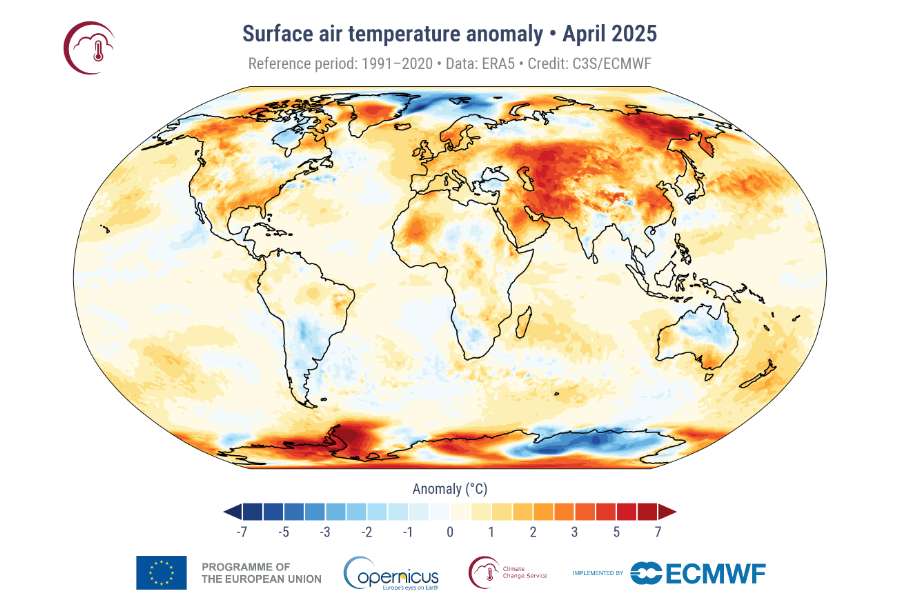
April 2025 was the second-warmest April on record on a global level, new data from the Copernicus Climate Change Service (C3S) has found.
According to the data, an average ERA5 surface air temperature of 14.96°C was recorded for the month, 0.60°C above the 1991-2020 average for April. It was 0.07°C cooler than the record April, recorded in 2024.
It was also 1.51°C above pre-industrial levels, marking the 21st out of the past 22 months that the 1.5°C limit has been breached.
‘Long sequence of months’
“Globally, April 2025 was the second-hottest April on record, continuing the long sequence of months over 1.5ºC above pre-industrial,” commented Samantha Burgess, strategic lead for climate at ECMWF. “Continuous climate monitoring is an essential tool for understanding and responding to the ongoing changes of our climate system.”
The 12-month period from May 2024 to April 2025 also stood out, averaging 1.58°C above pre-industrial levels and 0.70°C above the 1991–2020 mean.
Temperatures across Europe
In terms of Europe specifically, temperatures in April reached an average of 9.38°C over land, making it the sixth-warmest April on record.
The largest warm anomalies were recorded over eastern Europe, western Russia, Kazakhstan, and Norway, however Türkiye, eastern parts of Bulgaria and Romania, the Crimean Peninsula, and northern Fennoscandia reported colder-than-average temperatures.
Outside of Europe, above-average temperatures were recorded across most of North America, the Russian Far East, a large part of west-central Asia and part of Australia. South America and eastern Canada were among the regions to report below-average temperatures.
Sea surface temperatures (SSTs) also remained elevated, with a global average of 20.89°C across latitudes 60°S to 60°N.
This was slightly cooler than the record set in April last year, however it still ranks as the second-warmest April for SSTs, with particularly high readings in the northeast Atlantic and much of the Mediterranean Sea.
Elsewhere, Arctic sea ice extent was 3% below average, the sixth lowest monthly extent for April in the 47-year satellite record. Antarctic sea ice was also significantly reduced, at 10% below average. Read more here.