Art installations have appeared in Germany, the Czech Republic, Slovakia, Portugal, and Moldova to highlight the environmental damage of Russia’s invasion of Ukraine, which this week enters its fourth year.
The art project, under the title ‘Nature on Fire’, focuses on an aspect of the war that doesn’t often make the headlines – the widespread ecosystem damage brought about by the conflict, including mined agricultural land, fires, destroyed forests, poisoned soils and waters, and the deaths of wild and domestic animals.
The environmental damage caused in the four years of war has been estimated at more than $142 billion, while as of December last year, around three million tonnes of harmful substances are spreading across Europe as a result of shell explosions, strikes on oil depots and industrial facilities, and attacks on critical infrastructure in Ukraine.
Marine ecosystem
Vladyslav Balinskyi, head of the NGO Green Leaf and researcher at Tuzlivski Lymany National Nature Park, highlighted the impact that the destruction of the Kakhovka dam, for example, has caused on the environment, with “heavy metals and persistent toxic compounds that will remain in the marine ecosystem for decades,” he commented.
“Russia’s aggression is therefore not only a tragedy for Ukraine, but a direct threat to the environmental stability and biological security of Europe as a whole.”
Art installations
The installations were created by Ukrainian artists Sandra Bereza, Marysia Prus, and Liliia Stetsiuk, with the project implemented by UAnimals, Ukraine’s largest animal welfare organisation, with support from ISAR Ednannia.
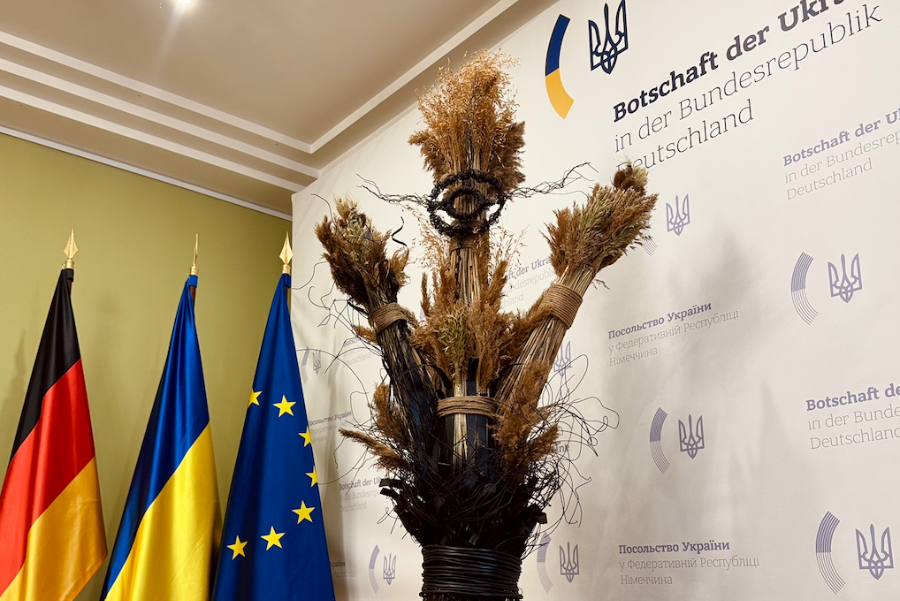
In Berlin, Bereza’s ‘Rodyva’ is a reinterpretation of the traditional Ukrainian didukh (pictured), with charred wheat and metal fragments evoke land scorched by war and embedded with mines and shrapnel.
In Chișinău, Stetsiuk’s installation features a Christmas tree constructed from 4,000 keys representing homes lost to the war, while in Prague, Prus’s ‘Disappearance’ features transparent fabrics symbolising the fragility of nature.
Elsewhere, the ‘Tree of Memory’ in Bratislava, is dedicated to the animals killed in the war, and ‘The Fire That Does Not Go Out’ in Lisbon symbolises the destruction of ecosystems caused by hostilities.
Commenting on the installations, each of which features on the premises of Ukrainian diplomatic institutions, Olha Matsko, head of strategic initiatives at UAnimals, said that it was “critically important” for the group to “speak about Russia’s environmental crimes in Ukraine at the international level. Years of war pass, and every day we see ecosystems suffering, knowing that nature has no borders. These art installations are another attempt to unite the conscious European community in resisting the aggressor and supporting Ukraine and democratic values.”
The project forms part of the international #StopEcocideUkraine campaign, within which UAnimals has organised more than 300 actions in 50 countries worldwide. Read more here.