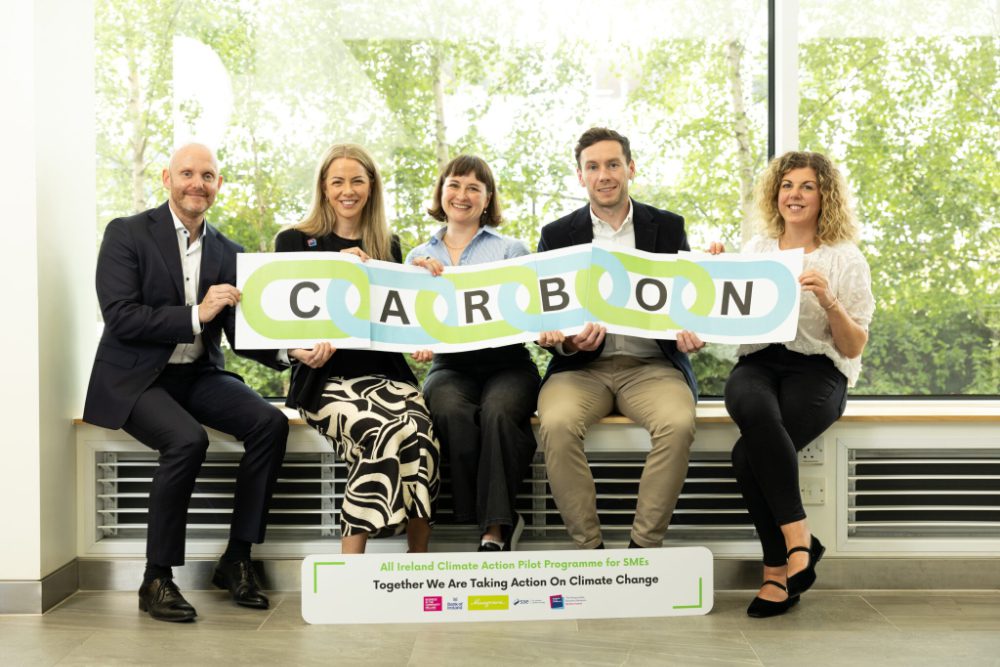
Business in the Community Ireland (BITCI) has announced the outcomes of its All-Ireland Climate Action Pilot Programme, designed to empower small and medium-sized enterprises to reduce carbon emissions.
The programme, which was launched in partnership with the Bank of Ireland Group, Musgrave Group and SSE Airtricity, along with 22 SMEs, underscores the importance of supplier engagement in supply chain decarbonisation by providing Irish SMEs with the skills and resources necessary to lower their carbon footprints effectively, and develop a sustainable business.
About the programme
The programme was delivered through a series of group workshops and one-to-one mentoring sessions with ‘learning by doing’ being the preferred method to maximise understanding of the challenges and scope of opportunities.
The All-Ireland Climate Action Pilot Programme offered accredited carbon literacy training, tailored support, and climate action planning through workshops and one-on-one mentorships, helping SMEs to better understand and act on climate-related challenges and opportunities. After completing the programme, 93% of participants reported a ‘good’ or ‘very good’ understanding of their carbon emissions and climate responsibilities, up from 72% at the outset.
In addition, more than half are now actively developing climate action plans.
‘Collective ambition’
“Time is of the essence in our collective ambition to effectively transition to a decarbonised economy,” commented Tomás Sercovich, CEO, BITCI. “Working collaboratively across supply chains is a critical component if we are serious about meaningful change.
“Despite a plethora of supports and tools available, SMEs feel overwhelmed on where to start. Collaborating and upskilling with their larger suppliers and knowing they will continue to be the supplier-of-choice reinforces the commitment and motivation by both sides to engage on value chain decarbonisation.”
The 22 SMEs that participated in the programme spanned a variety of sizes and sectors, with some 40% hailing from the food and drink sector. SMEs account for more than two thirds (68%) of the total workforce in Ireland.
‘Clear motivation’
BITCI noted that throughout the pilot programme, there was ‘clear motivation’ among SMEs to engage in sustainability initiatives. This momentum represents a critical opportunity to advance skills and implement strategies that could yield significant long-term impacts. The next step, BITCI added, is the development of robust Climate Transition Plans tailored to individual business needs.
“Our recently launched Accelerate, The Business Pact for Climate and Nature will help build on these findings and scale up this programme,” Sercovich added. “Accelerate expands on the success of our Low Carbon Pledge, by getting signatories to set a net-zero by 2050 target and to develop a Climate Transition Plan to track progress and accountability. Companies cannot achieve this target without engaging their entire supply chain.
“Through BITCI, the Accelerate signatories are building a community of action and capacity building, a centre of excellence to inform standards and quality of Climate Transition Plans including opportunities to share insights with peers and policy makers.” Read more here.