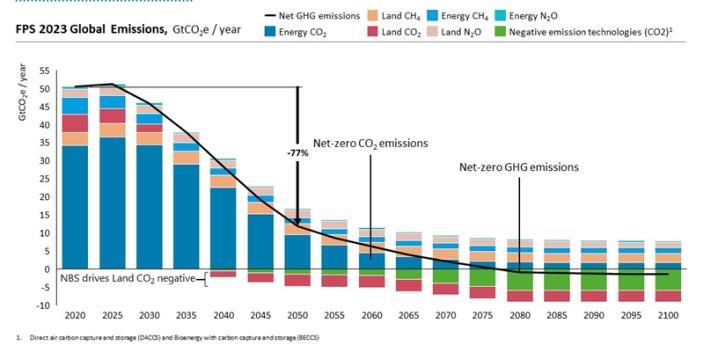
A study of global climate policies, both currently under way and on the horizon, suggests temperature increases are likely to be maintained ‘well below 2°C’.
The forecast, by Inevitable Policy Response (IPR), took into account more than 300 climate policies undertaken over the past two years, as well as incorporating input from over100 climate policy experts across 12 countries.
Climate policies
According to the study, approximately 90% of policies in advanced economies and around 40% in emerging markets and developing economies are currently in motion to support IPR forecasts due to policy acceleration.
In terms of emissions, more than two-thirds of the global policy gap is concentrated in three areas: coal power in China, coal power in India, and overall policy in Russia. China is expected to achieve near-zero coal power emissions by 2045.
Elsewhere, a recent IEA forecast suggested that electric vehicles will constitute approximately 90% of global sales by 2050.
By the mid part of the century, around 20% of greenhouse gas emissions are projected to be associated with ruminant meat, predominantly beef and lamb, although it is likely to account for just 10% of global food intake, the IPR study found.
Also, is suggested that changing policy dynamics in Brazil and Indonesia are anticipated to lead to an effective end to deforestation in both countries by 2030.
Breaching 1.5°C
According to IPR, climate warming is likely to breach 1.5°C by the 2030s, which the Paris Agreement has already suggested would ‘increase systemic risks, including irreversible impacts on natural systems’.
However, it also suggests that global warming’s peak will remain below 1.8°C, a ‘more optimistic future than many anticipate’, adding that temperature increases may drop back to 1.7°C by the end of the century, and could return to below 1.5°C around the 2120s.
Policy acceleration
“While there is a long road to Paris, we are now well under way,” commented Jakob Thomä, project director, Inevitable Policy Response. “The pessimism about missing 1.5°C no overshoot should not overshadow the fact that policy acceleration over the past 2 years increasingly highlights the central climate outcome is now 1.8°C warming.
“No time for complacency, but perhaps time for some optimism relative to previous temperature projections, despite the growing evidence of the systemic risk that comes with overshooting 1.5°C.”