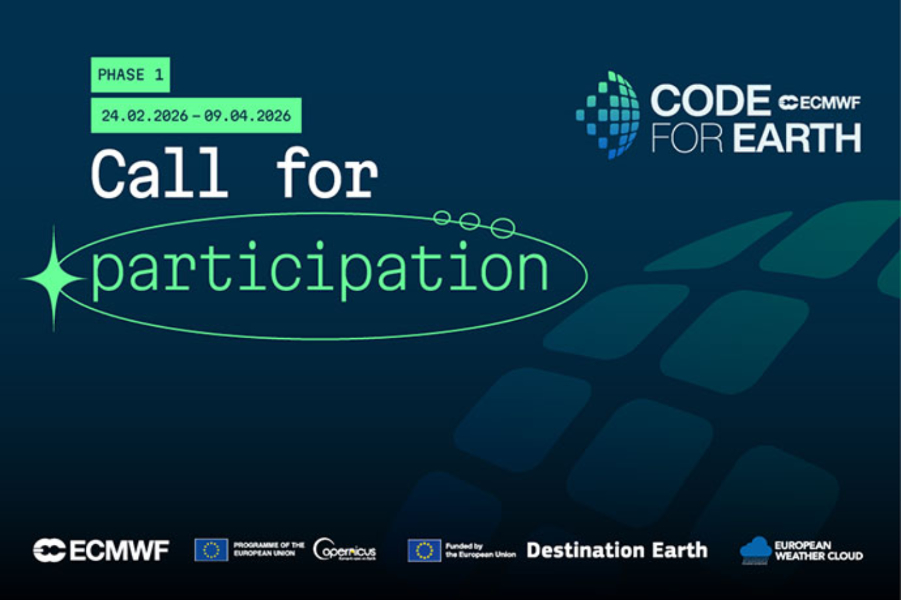
The European Centre for Medium-Range Weather Forecasts (ECMWF) has launched its annual Code for Earth climate and weather data challenges, inviting participants to develop open-source solutions to how Earth science data is visualised and interpreted.
The Code for Earth programme, which was launched in 2018, is open to developers, data scientists and researchers, with this year’s edition featuring challenges focused on rapid decision-making during wildfires, flood forecast data, and detecting implausible behaviour in machine learning, among other topics.
‘Innovation and collaboration’
“We’re excited to announce this year’s round which, as usual, contains a whole variety of opportunities”, commented Athina Trakas, ECMWF innovation actions and partnerships coordinator and lead of the Code for Earth coordination team.
“Code for Earth is all about innovation, collaboration and open-source coding and each year we look forward to meeting the participants and discovering the innovative solutions they bring. As well as the chance to explore new ideas and support ECMWF’s development needs, a big part of Code for Earth is the opportunity to network with like-minded people and build new partnerships.:
Each of the challenges is developed by ECMWF with support from the Copernicus Climate Change Service (C3S), the Copernicus Atmosphere Monitoring Service (CAMS), Destination Earth and Strengthening Early Warning in Africa (SEWA). They span four different streams: data visualisation, machine learning, software development, and a new Africa-focused stream.
Africa stream
This new stream has been developed to strengthen early warning systems, build regional innovation capacity, and help address key weather and climate-related issues in Africa, in collaboration with regional partners.
“Having this additional stream in Code for Earth will also support African young talent through the opportunity to work on real world challenges in the region, bring new innovation to ECMWF, and build on engagement between European meteorological community, and the African WMO Regional Climate Centres,” added Stijn Vermoote, head of the partnerships and engagement section at ECMWF.
Successes from the 2025 edition of Code for Earth included the development of meteorological charts for visually impaired scientists, an interactive platform visualising the impact of extreme weather events on energy systems, and a tool that enables users to gauge how sandstorms or forest fires affect air quality in their hometown.
The deadline for applications for the 2026 Code for Earth is 9 April 2026. Read more here.