Greenhouse gas emissions across the European Union fell by 4.0% in the fourth quarter of 2023, compared to the same period a year earlier, new data from Eurostat has revealed.
EU economy emissions totalled 897 million tonnes of CO2-equivalents (CO2-eq) in the period, down from 935 million tonnes of CO2-eq in the corresponding period in 2022.
Emissions reduction by sector
The economic sectors responsible for the biggest reductions in greenhouse gas emissions in the fourth quarter were electricity and gas supply (- 17.2%) and manufacturing (-3.1%), while emissions from households were ‘almost stable’, Eurostat said.
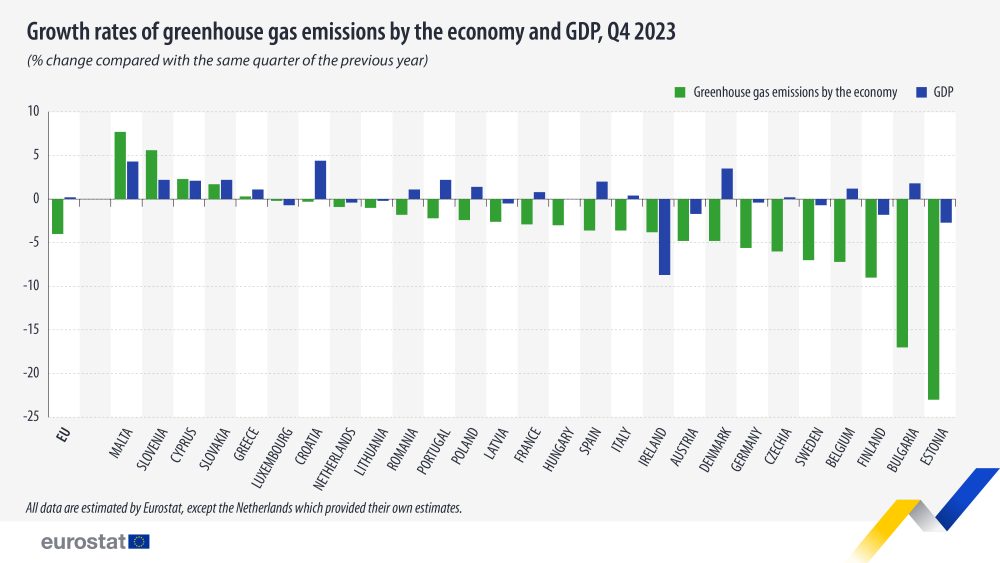
Some 22 EU member states saw a reduction in greenhouse gas emissions in the period, with the largest declines estimated in Estonia (-23.0%), Bulgaria (-17.0%) and Finland (-9.0%).
A number of countries also saw an increase in greenhouse gas emissions, however, with increases estimated in Malta (+7.7%), Slovenia (+5.6%), Cyprus (+2.3%), Slovakia (1.7%) and Greece (+0.3%).
Emissions reduction and GDP
The data also explores the correlation between emissions reduction and GDP – of the EU members that are estimated to have reduced their emissions, 10 also experienced a decline in their GDP (Estonia, Finland, Sweden, Germany, Austria, Ireland, Latvia, Lithuania, The Netherlands, and Luxembourg).
Hungary maintained its GDP at the same level while also reducing emissions.
The remaining 11 EU countries (Bulgaria, Belgium, Czechia, Denmark, Italy, Spain, France, Poland, Portugal, Romania, and Croatia) are estimated to have decreased emissions while simultaneously growing their GDP.
Overall, the EU’s GDP remained stable in the fourth quarter of the year, seeing a 0.2% increase compared with the same period in 2022.

Looking for information about why sustainability is important in business? Make www.sustainabilityonline.net your first choice.