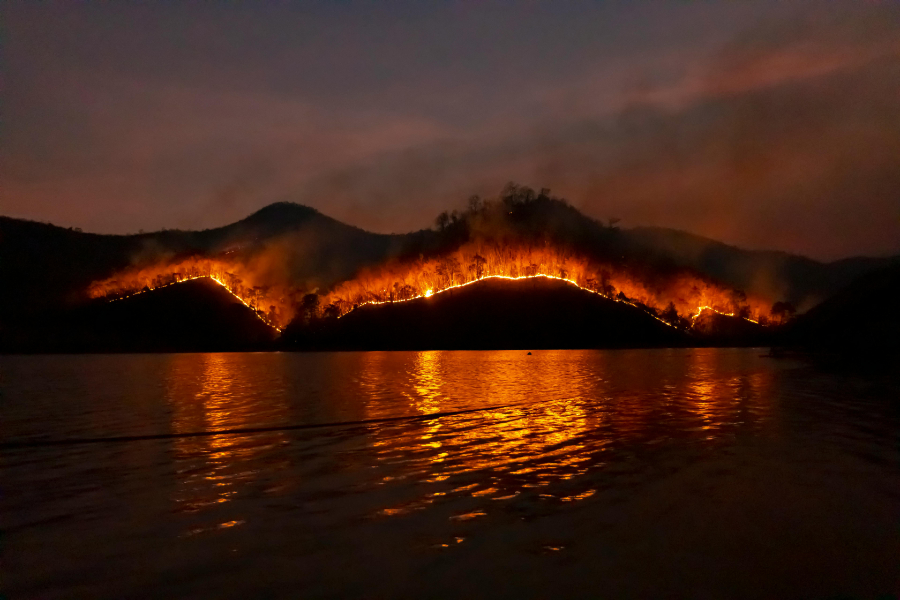
Europe reported the highest annual wildfire carbon emissions on record in 2025, due to significant wildfire activity across the Northern Hemisphere, the Copernicus Atmosphere Monitoring Service (CAMS) has said.
According to CAMS, European wildfire emissions were at their highest level since records began in 2003, while Canada reported its second-highest yearly emissions.
The European Union and the UK emitted just under 13 megatonnes of carbon from wildfires this year, according to the data.
While carbon emissions from wildfires contribute only a small share to global CO₂ totals, the numbers can be used as a proxy for many pollutants that affect air quality, such as PM2.5 and nitrogen oxides (NOx).
Wildfire activity
The Iberian Peninsula was particularly affected by wildfires, driven by ‘persistent heatwaves, extremely dry conditions and strong winds’, CAMS noted, with Spain reporting its highest annual wildfire emissions in 23 years.
Smoke from these fires reached the UK and northwestern Europe, with surface concentrations of fine particulate matter air pollution (PM2.5), far exceeding the World Health Organization’s 24-hour guidelines.
The UK also reported its highest annual total wildfire emissions in more than two decades, due to significant wildfires in Northern Scotland in late June and early July.
In North America, around 250 megatonnes of carbon were released from wildfires in Canada at the start of October, while California was struck by a major wildfire outbreak in January, triggered by a convergence of exceptionally dry vegetation and powerful Santa Ana winds.
Elsewhere, significant wildfire activity was recorded in Russia, Syria and Australia, however wildfire activity was lower than normal in Brazil and Bolivia.
Daily fire locations, intensity and smoke plumes around the world between 1 January and 30 November 2025 based on CAMS GFAS and organic matter aerosol optical depth forecasts.
Global monitoring
“What we have seen in 2025 is extreme wildfires in North America and Europe and impacts on atmospheric composition far from where the fires are burning,” commented Mark Parrington, senior scientist at the Copernicus Atmosphere Monitoring Service (CAMS). “Our global fire emissions monitoring shows extreme wildfire intensity and emissions occurring when dry conditions and high temperatures converge around the world.
“The global perspective of CAMS highlights the local and larger-scales that smoke emitted from these wildfires can have in significantly degrading air quality and potentially affecting human health. This underlines the vital importance of sustained monitoring and coordinated action to better anticipate, manage and reduce the impacts of wildfires on people, ecosystems and air quality.” Read more here.