Google has entered into a global commercial partnership with Energy Dome, a Milan-based firm seeking to redefine long-duration energy storage with its ‘CO2 Battery’ innovation.
With the tech sector increasingly turning to renewable energy sources such as solar and wind to support their growing operations, the inherent intermittency of such solutions can be a challenge, with long-duration energy storage necessary to resolve this flexibility constraint.
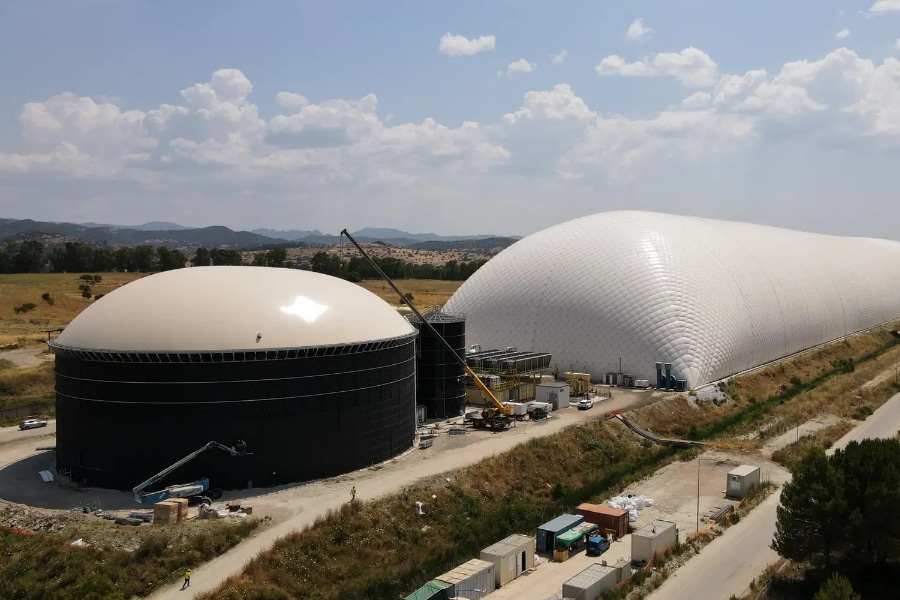
Energy Dome’s CO2 Battery utilises carbon dioxide to store energy efficiently and cost-effectively through a thermo-mechanical process, hence representing a greener alternative to lithium-ion batteries or pumped-hydro solutions.
It is capable of continuously dispatching energy for periods of eight to 24 hours, unlocking enough firm electricity to meet both the baseload and flexibility requirements of large energy users, such as Google.
‘Industry-first agreement’
“The programmatic and strategic deployment of our technology at scale to help Google reach carbon-free energy represents the core of our industry-first agreement,” commented Claudio Spadacini, founder and CEO of Energy Dome. “We’re proving that a 24/7 cost-effective and carbon-free energy supply is achievable with the right technology and partnership model.
“We are also pleased to welcome Google as an investor in Energy Dome, underlining our joint commitment to a shared vision.”
The commercial agreement will lead to the development of CO2 Battery projects in key geographical strategic areas, including Europe, America, and the Asia-Pacific region, with the goal of scaling up deployment at a rapid pace to meet Google’s 2030 carbon-free energy goals.
Alongside the agreement, Google has also made a strategic investment in Energy Dome, following on from recent investments in Alliant Energy in the US, Engie in Italy, and NTPC in India.
‘Unlocking rapid progress’
“Google is committed to powering our operations with clean energy, and Energy Dome’s technologically proven and scalable long-duration energy storage solution can help us unlock rapid progress,” added Maud Texier, director of EMEA Energy at Google.
“But this isn’t just about Google. By helping to scale this first-of-a-kind LDES technology, we hope to help communities everywhere gain greater access to reliable, affordable electricity and support grid resilience as we integrate more renewable energy sources.” Read more here.