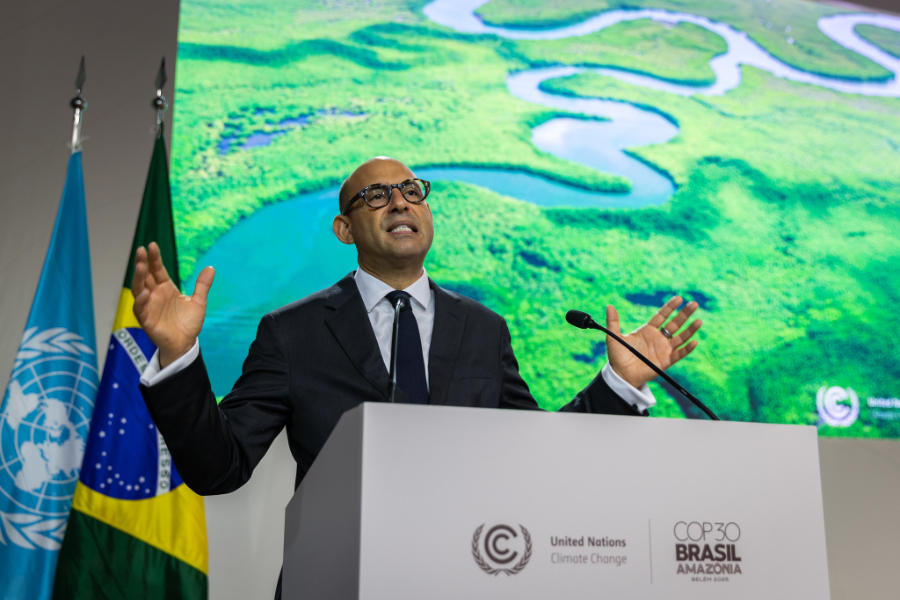
UN Climate Change executive secretary Simon Stiell has told the opening plenary of COP30 that no country can afford to avoid tackling climate change, as “climate disasters rip double-digits off GDP”.
Commenting on the opening day of the Belém conference, which runs until 21 November, Stiell noted that inaction at a time when “mega-droughts wreck national harvests, sending food prices soaring, makes zero sense, economically or politically”.
Energy transition
Noting that the world needs to move “much, much faster” on both reducing emissions and strengthening climate resilience, Stiell pointed to the positive business case for the energy transition.
Clean energy investment is at record levels, he noted, with renewable investments outpacing fossil fuels two to one, while renewables overtook coal this year as the world’s largest energy source.
“The economics of this transition are as indisputable as the costs of inaction,” he added.
COP30 priorities
In terms of the key priorities for COP30, Stiell highlighted the need to operationalise a just and orderly transition away from fossil fuels; tripling renewable energy capacity and doubling energy efficiency; to finalise indicators for global adaptation targets; to advance the Work Programme on Just Transition and the Technology Implementation Programme; and to unlock $1.3 trillion annually for climate action in developing countries.
“In Belém, we’ve got to marry the world of negotiations to the actions needed in the real economy,” he commented. “The Action Agenda is not a ‘nice-to-have’ – it is mission-critical. More than that, it is entirely in every nation’s enlightened self-interest to do so.”
Stiell closed by quoting former US president Theodore Roosevelt, adding, “It is not the critic who counts or the one who points out where the doer of deeds could have done better. The credit belongs to those who are actually in the arena, with their faces marred by dust and sweat and blood, who strive valiantly.” Read more here. [Photo: © UN Climate Change – Kiara Worth]