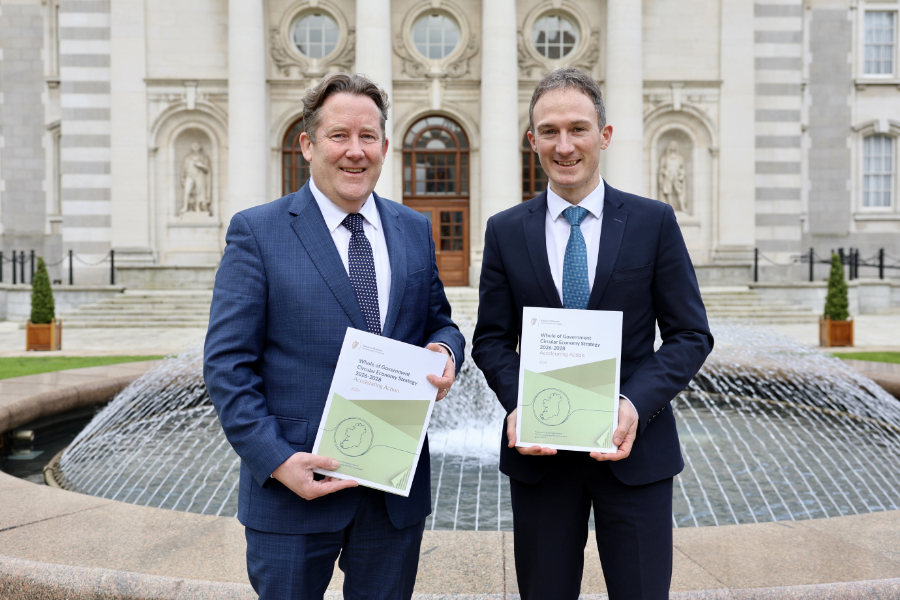
Ireland has launched a new national plan to accelerate the country’s transition from a linear ‘take-make-waste’ model to a circular, sustainable economy.
Ireland’s Circular Economy Strategy 2026-2028, launched by Minister for Climate, Energy and the Environment Darragh O’Brien and Minister of State with responsibility for the Circular Economy Alan Dillon, is a ‘whole-of-government’ approach to circular economy development that places statutory targets on key sectors.
‘Embedding circularity’
“Nearly half of global greenhouse gas emissions come from how we make and use goods, food and materials,” Minister O’Brien commented. “By embedding circularity across our economy, we can cut those emissions at the source – long before they reach our atmosphere.
“This is not simply an environmental project; it is a cornerstone of our climate action agenda. Every tonne of material that’s reused, every product that’s repaired rather than replaced, represents carbon that never needs to be emitted. That is the power of the circular economy. This Strategy sets out how we will harness that power – through innovation, investment, and collaboration.”
The strategy seeks to increase Ireland’s Circular Material Use Rate (CMUR) by two percentage points annually, reaching 12% by 2030, as well as strengthen the country’s position as a hub for sustainable design, advanced manufacturing, and innovative circular business models.
The launch of a National Pilot Repair Voucher Scheme, which is set to be launched by 2027 and funded through the Circular Economy Fund, will seek to narrow the cost gap between product repair and replacement, encouraging consumers to extend the life of products.
The strategy will also introduce a Digital Product Passport (DPP) under the EU Ecodesign for Sustainable Products Regulation, which will inform consumer purchasing decisions by providing data on a product’s sustainability and regulatory compliance.
The Circular Economy Strategy 2026-2028 will focus on six priority sectors for targeted action, including construction, bioeconomy (including agriculture), retail, packaging, textiles and electronics.
‘Cleaner, smarter, and more self-reliant’
“The circular economy is central to how Ireland will grow cleaner, smarter, and more self-reliant,” Minister Dillon added. “Through innovation, design and enterprise we can transform how we use materials and resources, cut waste, boost productivity, and create sustainable jobs in every part of our country.
“Implementation of this strategy will show that circularity is not an abstract idea but a practical, economic, and achievable way forward – one that helps families and businesses get better value, while strengthening Ireland’s competitiveness and resilience. My ambition is to make circular thinking the new normal and secure a more prosperous, resilient, and sustainable Ireland.”
The strategy builds on existing policy foundations already in place, including the Circular Economy Act 2022, the Waste Action Plan for a Circular Economy, the Green Public Procurement Strategy & Action Plan, the Climate Action Plan, and the National Waste Management Plan for a Circular Economy. Read more here.