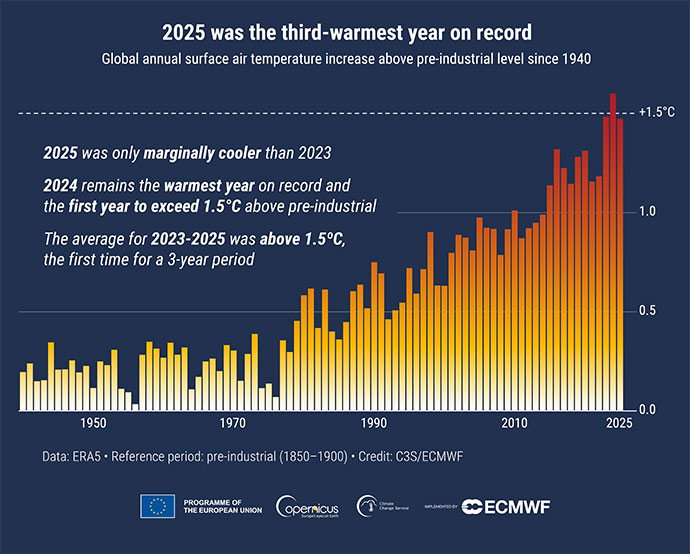
2025 was the third-warmest year on record, with global temperatures from the past three years (2023–2025) averaging more than 1.5°C above pre-industrial levels, new data from the Copernicus Climate Change Service (C3S) has found.
According to the data, global temperatures in 2025 were only marginally (0.01°C) cooler than 2023, while they were 0.13°C cooler than 2024, which was the warmest year on record.
“This report confirms that Europe and the world are in the warmest decade on record and that the European Commission’s investment in Copernicus continues to be critical,” commented ECMWF director general Florian Pappenberger.
“Preparedness and prevention remain possible but only when action is guided by robust, scientific evidence.”
Surface air temperatures
The global average surface air temperature stood at 14.97°C in 2025, which was 1.47°C above the pre-industrial level, compared to an average temperature 1.60°C above the pre-industrial level in 2024.
January 2025 was the warmest January on record, with March, April and May the second-warmest on record, the data showed. In fact, every month apart from February and December was warmer than the corresponding month in any year prior to 2023.
In Europe, 2025 was the third-warmest year on record, with an average temperature of 10.41°C, which was 0.30°C cooler than the warmest year (2024).
Record-high annual temperatures were also observed in regions such as the northwestern and southwestern Pacific, the northeastern Atlantic, far eastern and northwestern Europe, and central Asia. However, air and sea-surface temperatures in the tropics were lower than in 2023 and 2024.
‘Exceptional warmth’
Copernicus noted that the ‘exceptional warmth’ of the last three years has largely been driven by two factors – rising concentrations of greenhouse gases, driven by human activities, and high sea-surface temperatures associated with an El Niño event and other ocean variability factors.
“Atmospheric data from 2025 paints a clear picture: human activity remains the dominant driver of the exceptional temperatures we are observing,” commented Laurence Rouil, director of CAMS at ECMWF.
“Atmospheric greenhouse gases have steadily increased over the last ten years. We will continue to track greenhouse gases, aerosols, and other atmospheric indicators to help decision makers understand the risks of continuing emissions and respond effectively, reinforcing synergies between air quality and climate policies. The atmosphere is sending us a message, and we must listen.”
‘Stalling the transition’
Commenting on the findings, Savio Carvalho, managing director for campaigns and networks at 350.org, said, “Another year in the top three hottest on record, and communities everywhere are feeling it. Extreme weather isn’t rare anymore – it’s driving up food prices, insurance premiums, water shortages, and upending daily life across the globe.
“Governments know fossil fuels are the cause of climate breakdown, yet they keep stalling on the transition. We don’t have the luxury of wasting time or taking side paths – we are running out of time. We need to do what’s right now: a global phase out of fossil fuels is urgent. We already have the renewable energy solutions we need–what’s missing is the political will. We can prevent the worst if we act now.”
Read more here.