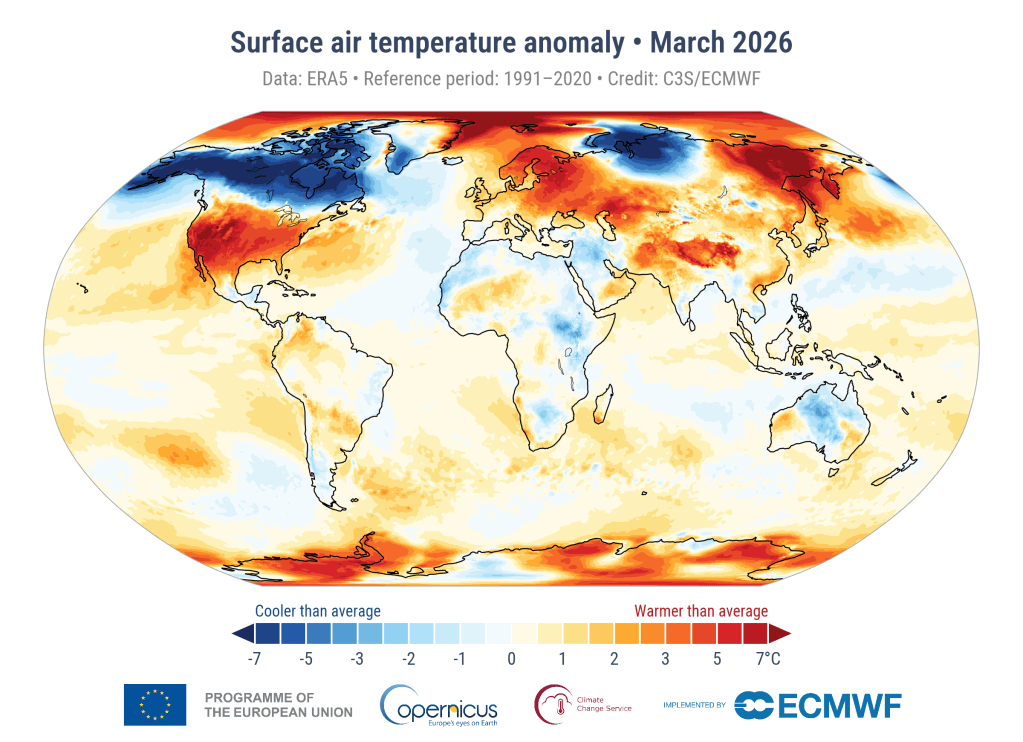
March 2026 was the fourth-warmest on record on a global level, according to new data from the Copernicus Climate Change Service (C3S), implemented by the European Centre for Medium-Range Weather Forecasts (ECMWF).
March saw temperatures at 1.48°C above pre-industrial levels globally, almost on a par with the critical 1.5°C climate threshold, while sea surface temperatures for the month were at their second-highest level on record.
While March was slightly below the record-breaking temperature set in March 2024, several parts of the world experienced severe heat and drier-than-average conditions, particularly in the US and Mexico. Europe, meanwhile, experienced its second-warmest March on record, with much of the continent seeing dry conditions, after a wet February.
The ECMWF, along with other climate centres, are forecasting a transition towards El Niño conditions in the second half of 2026, which could intensify global heat and weather extremes.
‘A sobering story’
“Copernicus data for March 2026 tells a sobering story: 1.48°C above pre-industrial levels, the lowest Arctic sea ice extent on record for March, and sea surface temperatures again approaching historic highs,” commented Carlo Buontempo, director, Copernicus Climate Change Service at ECMWF.
“Each figure is striking on its own — together, they paint a picture of a climate system under sustained and accelerating pressure. Reliable data, produced operationally from billions of measurements across satellites, ships, aircraft and weather stations, is no longer a scientific luxury. It is the essential foundation for any serious climate adaptation and policy response.”
European picture
Copernicus’ data showed that average land temperatures in March were 2.27°C above the 1991–2020 average, with northwest Russia, northern Fennoscandia and the Baltic States reporting warmer-than-average conditions. Türkiye, southern Europe, and most of Iceland were slightly cooler than average.
Much of continental Europe experienced a dry month, however conditions were wetter-than-average in northern UK, Scandinavia, Iceland and parts of the Mediterranean, which experienced heavy rainfall and flooding. Read more here.