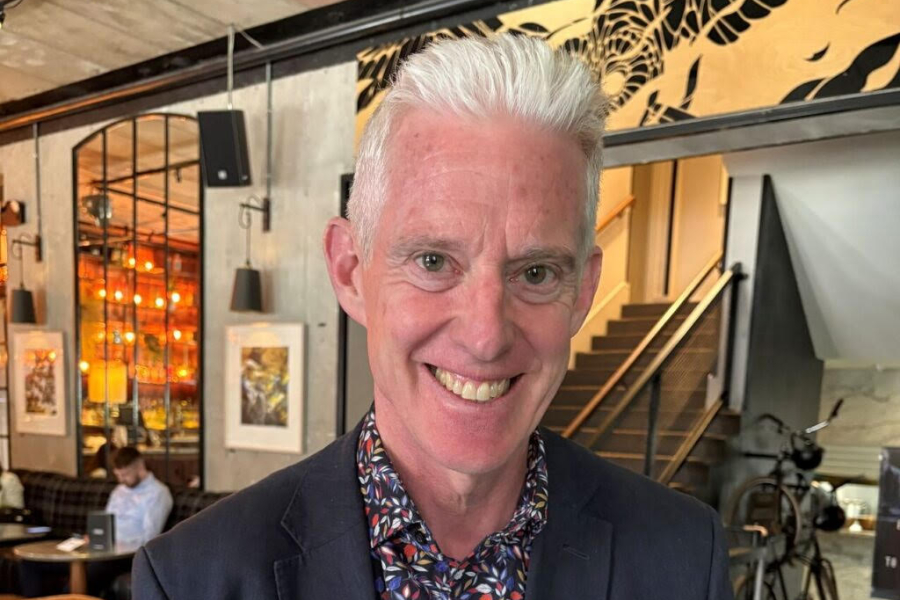
Transitioning the food industry to a more sustainable agenda will be a lot more challenging than other sectors, given the “much broader waterfront of issues” at stake, Planeatry Alliance‘s Mike Barry has told SustainabilityOnline.
Barry was speaking to SustainabilityOnline ahead of his appearance at Sustainable Foods 2026, which takes place in London on 28 and 29 January.
A different proposition
“We all understand that the energy sector and the automotive sector are undergoing forms of sustainability-driven transition,” he said. “Diesel to electric. Fossil to renewable. I can say those transitions in a few seconds. Diesel to electric – I get it. It’s tough and complicated, but we broadly know what we’re trying to control.
“The food system is different. If you and I had two hours, we still wouldn’t get to the bottom of all its problems or all the places it needs to go. I fundamentally believe the food system needs to transition just as completely as the car industry – the equivalent of diesel to electric – but across a much broader range of issues: social, environmental, and human health, and towards a destination that doesn’t necessarily have a neat end point.
“There is no single end point for the food system. How do we benchmark where Tesco or Nestlé needs to be, compared with where a local farm shop or a café needs to be?”
Yet time is of the essence, with Barry citing recent data that indicates that the global food industry generates more societal and environmental damage than economic value.
“We turn over $10 trillion a year collectively in the global food system. In doing so, we create $15 trillion in damage to society, human health, and the planet. That is literally unsustainable. And no government is going to sit there too much longer and say, ‘Yeah, we’ll keep picking up the tab for ill health’.”
The business case
However, a business case is emerging for tackling these issues. As well as stronger regulation of food and efforts to make supply chains more resilient, Barry sees an opportunity to close the gap between consumer intentions and behaviour by making food choices simpler.
“There’s a massive opportunity out there for retailers or manufacturers to ‘crack the code’ and make this accessible to all,” he added.
Mike Barry will moderate a discussion on the topic ‘Future-Proof Your Products: Reformulation for F&D’ at Sustainable Foods 2026, as well as hosting a fireside chat with Nicholas Mazzei, vice president sustainability Europe – DP World. Other high-profile speakers at the event include Ken Murphy, CEO, Tesco; Cécile Beliot‑Zind, CEO, Groupe Bel; Mike Barry, co‑founder, Planeatry Alliance; Karen Betts, OBE, chief executive, Food & Drink Federation (FDF); Rami Baitiéh, CEO, Morrisons; and Sarah Bradbury, CEO, IGD. More details can be found here.
The full interview with Mike Barry will be published on SustainabilityOnline in the coming weeks.