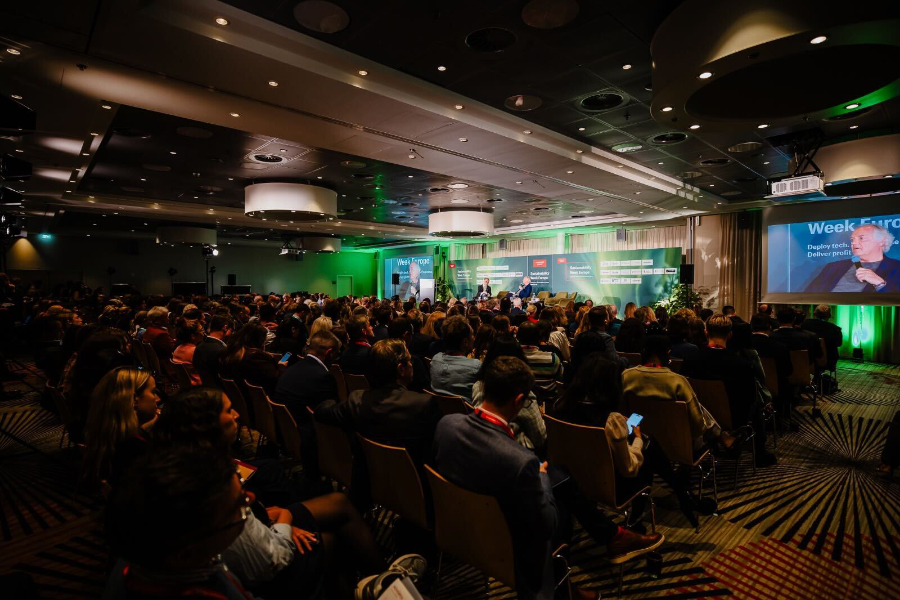
Politicians – and society at large – need to do more to communicate the positive aspects of the sustainable transition, or risk being drowned out by a populist narrative, former Unilever CEO and author Paul Polman has told a conference in Amsterdam.
As Polman told the Economist Impact Sustainability Week Europe conference, which took place in the Dutch capital recently, global inequality and delayed climate action have fuelled populism, with inflation used as a political tool.
Underlying issues
“We’re not addressing the underlying issues of inequality,” he said. “You can see how populists have seized on that – especially around inflation. But the reality is, much of that inflation stems from our failure to move fast enough. Take food, for example: we’re already paying far more for the effects of climate change than we would if we had embraced regenerative agriculture.
“It’s easy for populists to jump on that, and that’s what’s happening in countries around the world now. Trump is not the issue. Trump is a symptom of an issue that is happening everywhere now.”
Reframing sustainability
Populist narratives have framed sustainability as a burden, gaining influence among an electorate that is feeling increasingly under pressure, he added.
“The right has a little bit more of that share of voice in Europe,” Polman explained. “They see this as a cost. They see this as a burden. They see this as a risk. And they’ve put that story out there. Electorates that are pressured, seem to have, in the short term at least, bought into that story.
“We’ve talked about climate change as ‘parts per million’ in the air, as a big threat that will destroy our lives, or as a cost that we need to bear now for future children’s benefit. […] But if you can make the transition, you get clean air, forests you can walk in, healthier and cheaper food, and farmers with a stable income.
“We need to start talking much more about that, especially given the narrative that’s out there. Politicians haven’t done a good enough job.”
He added that the business community continues progressing on sustainability while political and media narratives remain disconnected from realities on the ground. “The business community is moving, despite Europe backtracking a little bit,” he said.
Polman, the co-author of Net Positive and a respected voice in the global business community for his work at Unilever, was in conversation with Matt Steinglass, Europe correspondent for The Economist, at the event, which took place on 7 October. The theme of the interview was ‘Being net-positive in an era of climate negativity’. Read more here.