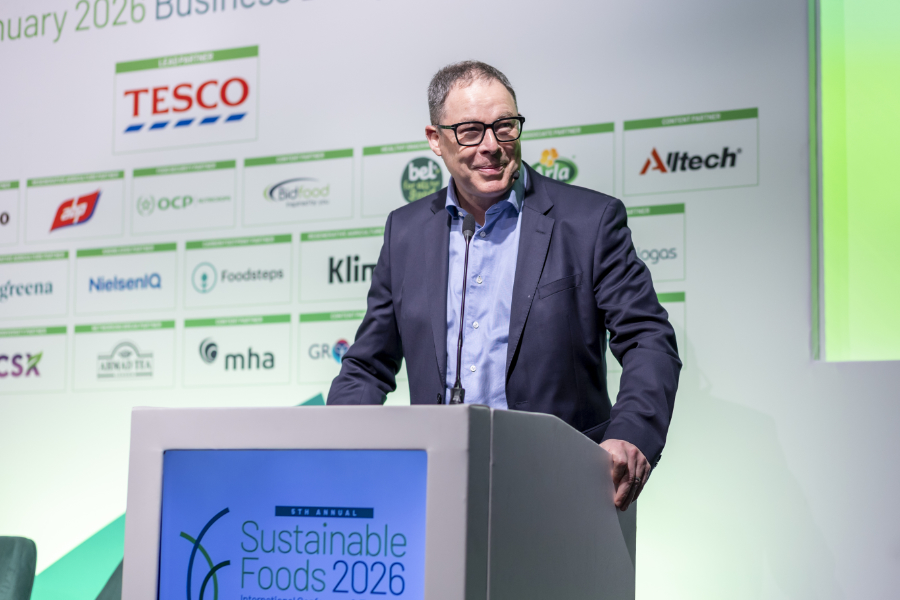
Sustainability needs to be viewed as the “cornerstone of business resilience” in the food industry, rather than a burden or compliance exercise, Tesco chief executive Ken Murphy has told the Sustainable Foods 2026 event in London.
As Murphy noted, resilient food production and supply chains are increasingly critical, with farmers and suppliers facing barriers including limited access to innovation funding, and inconsistent environmental data systems. At the same time, rising obesity and diet-related illness are putting emphasis on the link between sustainable supply chains and public health.
‘Further and faster’
“Our challenge as an industry is to deliver these two things at the same time and in short order,” he commented, adding that the food industry – Tesco included – needs to go “further and faster” in the coming years to deliver on these interlinked challenges.
“Too often as an industry, however, we let the 20% we disagree on act as a barrier to making progress on the 80% where we have achieved consensus,” he added. “This cannot continue. We must treat this year as a wake-up call rather than sleepwalking into what could become a national emergency.”
More collaboration
To drive progress, more emphasis needs to be placed on collaboration between all actors of the supply chain, including farmers, retailers, charities, and government.
“Broad industry collaboration must be our goal,” Murphy explained. “We’ve learned the biggest progress we can make is by working together. And we’re proud of the progress we’ve made so far alongside our partners.”
He also called for greater supports for farmers to enable them to scale workable on-farm innovation, and accelerate the transition to a sustainable future.
“Farmers and suppliers need flexibility to build infrastructure, renewable energy, storage and processing, to boost domestic production and to be able to meet the jump in demand we are seeing for fresh food,” said Murphy.
Murphy concluded by calling for government action on funding access, planning reform and standardised data to support long-term food security and health outcomes.
“In many ways, we’re at a crossroads as an industry: continue with the status quo or drive transformational change in the two areas where we’re needed most — supply chain resilience and the production of healthy food,” he said.
Sustainable Foods 2026 is taking place at the Business Design Centre in London on 28 and 29 January. More information can be found here.