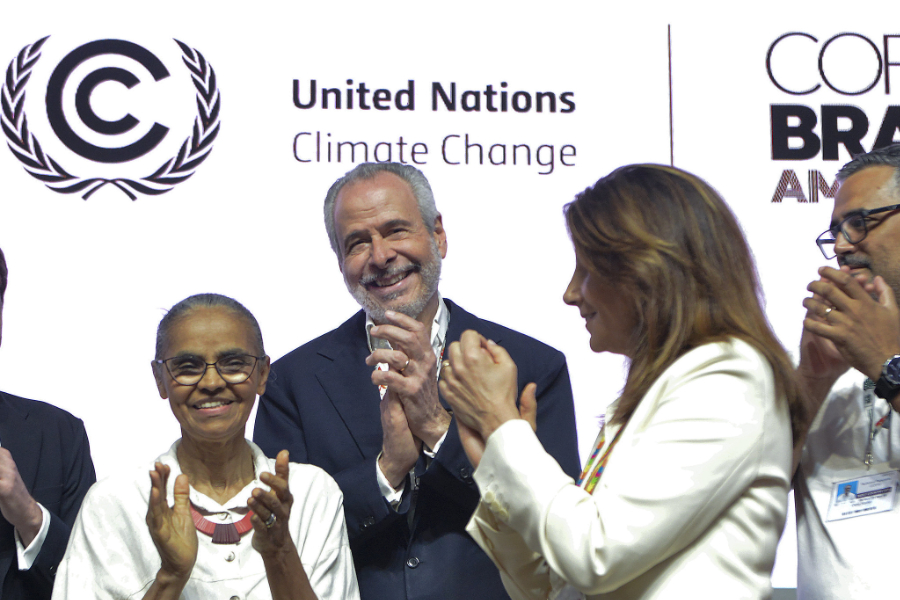
COP30 has come to an end in Belém, with progress made on adaptation finance, however the failure to agree on a roadmap to transition away from fossil fuels left a sour taste in the mouth.
Among the achievements of this year’s COP was an agreement to triple adaptation finance; the launch of the Tropical Forest Forever Facility; pledges to support finance and land rights for Indigenous People and local communities; and a pledge to quadruple sustainable fuels.
In his closing address, UN Climate Change executive secretary Simon Stiell, said, “COP30 showed that climate cooperation is alive and kicking, keeping humanity in the fight for a livable planet. […] I’m not saying we’re winning the climate fight. But we are undeniably still in it, and we are fighting back.”
#COP30 showed that climate cooperation is alive and kicking. Keeping humanity in the fight for a livable planet.
— Simon Stiell (@simonstiell) November 22, 2025
194 countries have said in one voice that ‘the Paris Agreement is working’, and resolved to make it go further and faster. pic.twitter.com/UoznsP76Ag
Here’s how representative groups, business leaders and other leading voices reacted to the closing of COP30.
Ani Dasgupta, president and CEO, World Resources Institute
“COP30 focused more than ever before on the economic transition. Countries recognised by accelerating climate action they will be rewarded through growth, investment, security, competitiveness and good-paying jobs. Those who sit on the sidelines will be left behind.
“The just transition outcome underscored that decarbonising our economies and advancing social and economic development are mutually reinforcing. For the first time in UN climate negotiations, countries agreed to discuss how trade can become a bridge rather than a barrier to climate progress.
“Despite setbacks in the negotiating halls, many of us will remember Belém as the COP of action. Cities and states stepped up, with 14,000 local governments committing to slash emissions and protect communities from deadly heat. More countries committed to phase-out coal, restore forests, transform food systems and sustainably manage the ocean.
“Thirteen nations and one region launched ‘country platforms’ to mobilise public and private finance at scale for their climate and development priorities. Utilities serving millions of customers pledged nearly $150 billion for new grids and storage. Major new initiatives were elevated to create green jobs and harmonise carbon accounting, and nearly 120 acceleration plans were unveiled under the COP30 Action Agenda.
“Adaptation rightly came to the forefront in the climate talks. In addition to agreeing to triple adaptation finance, negotiators agreed to indicators under the Global Goal on Adaptation, though there are concerns that some aren’t measurable. More work is needed to ensure they are fit for purpose and can help build the evidence base to bolster resilience efforts.”
Former U.S. vice president Al Gore
“Petrostates and their political allies are doing everything they can to try to stop the world from making progress on solving the climate crisis. They fiercely opposed what would have been the most important step forward at COP30: the development of a roadmap away from fossil fuels, wanting nothing more than for the world to kick the oil can down the road.
“When it comes to global climate action, the COP30 consensus is the floor – the bare minimum of what the world must do – not the ceiling that limits what is possible. Despite petrostates’ attempt to veto the development of a roadmap away from fossil fuels, the Brazilian COP30 Presidency will lead an effort to develop this roadmap, bolstered by the more than 80 countries that already support the effort.
“Ultimately, petrostates, the fossil fuel industry, and their allies are losing power. Just as we have passed Peak Trump, I believe we have also passed Peak Petrostate. They may be able to veto diplomatic language, but they can’t veto real-world action. Countries, companies, cities, and states worldwide are moving forward to adopt the clean energy solutions that will create jobs, grow economies, and prevent the health catastrophes associated with burning fossil fuels.
“The rest of the world is fed up with delay and denial. Now is the time to forge global partnerships among all levels of government, the private sector, finance, and civil society to cultivate and achieve the level of action necessary to fulfill the promise the world made to future generations under the Paris Agreement.”
Viviana Santiago, executive director, Oxfam Brasil
“COP30 offered a spark of hope but far more heartbreak, as the ambition of global leaders continues to fall short of what is needed for a livable planet. People from the Global South arrived in Belém with hope, seeking real progress on adaptation and finance, but rich nations refused to provide crucial adaptation finance. This failure leaves the communities at the frontlines of the climate crisis exposed to the worst impacts and with few options for their survival.
“The stark hypocrisy of the richest nations is heartbreaking: wealthy countries speak of phasing out fossil fuels even as they plan major oil and gas expansion. A truly just transition requires those who built their fortunes on fossil fuels to move first and fastest – and provide finance in the form of grants, not loans, so frontline communities can do the same. Instead, the poorest countries already in debt are being told to transition faster, with fewer funds.
“The spark of hope lies in the proposed Belém Action Mechanism, which puts workers’ rights and justice at the centre of the shift away fossil fuels. But without financing from rich countries, the just energy transition risks becoming stalled in many countries.”
Andreas Sieber, associate director, policy and campaigns, 350.org
“Belém didn’t stumble. COP30 was steered into a shortfall. President Lula and Minister Marina Silva showed real leadership on confronting fossil fuels. But the Presidency negotiating team retreated behind closed doors, smothering the multilateral spirit needed for higher ambition, while wealthy countries refused to put real finance on the table.
“Yet momentum was unmistakable: nearly 90 countries demanded a roadmap to transition away from fossil fuels, and the Just Transition Mechanism proved multilateralism can still deliver. Those roadmaps now need institutional backing. Brazil must work transparently with Colombia and Pacific hosts ahead of Pre-COP to turn momentum into substance. The world was ready to turn the page on fossil fuels; a few parties were not.”
Kirtana Chandrasekaran, international program coordinator, Friends of the Earth International
“Multilateralism means nothing so long as corporations are rolled out the red carpet and invited to write the rules in the conference halls. 1.5 stands no chance whilst these corporations and rich governments work hand in hand to block progress on any meaningful action whilst promoting false solutions.
“We stand on the door of the Amazon and yet the response we are given to the climate and biodiversity crises is more schemes that commodify nature like the Tropical Forest Forever Facility. Instead, we need to protect forests for their intrinsic value, and centre the rights of the Indigenous Peoples and local communities that are its guardians.”
Tasneem Essop, executive director, Climate Action Network International
“We came here to get the Belém Action Mechanism – for families, for workers, for communities. The adoption of a Just Transition mechanism was a win shaped by years of pressure from civil society. This outcome didn’t fall from the sky; it was carved out through struggle, persistence, and the moral clarity of those living on the frontlines of climate breakdown. Governments must now honour this Just Transition mechanism with real action. Anything less is a betrayal of people – and of the Paris promise.
“Civil society held steady at this COP – together with frontline countries and movements who refused to let justice be pushed aside, even as some developed countries dug in their heels and tried to block agreement.
“We will continue to fight for Adaptation – that is essential for protecting people by investing in their resilience to climate impacts, securing the resources they need to withstand rising risks, and ensuring no community is left exposed. Without Adaptation finance and a just, equitable, and fully funded plan to transition away from fossil fuels, governments are not confronting the root cause of the crisis. We have a win for justice from COP30, but we keep fighting.”
Manuel Pulgar-Vidal, global climate and energy lead, WWF
“As COP30 ends, the reality is clear: bold titles and grand promises have not translated into meaningful action. The so-called ‘COP of Truth’ delivered neither a roadmap nor real solutions for the urgent challenges we face.
“Instead, we were taken for a ride on a carousel of illusions – distracted by colourful promises but left with a document that is weak and lacking in substance due to games played by the forces against climate ambition and implementation.
“Hope was offered but not delivered. The absence of a credible plan to address the climate crisis and the failure to recognise core drivers of the climate crisis, like fossil fuels, speaks volumes. These countries lack the political will to take bold action. They are letting down the people they serve, the science they know and the Paris commitments they made in 2015.
“Yet, the energy and commitment shown by so many in civil society, science, and frontline communities remind us that real change is still possible. We cannot afford more empty gestures. The world needs concrete, implementable action—now more than ever. Anything less is a disservice to people, nature, and future generations. But if we act with determination and unity, we can still turn the tide and keep hope alive for a safer, more resilient future for all.”
Jana Uemura, climate campaigner, Global Forest Coalition
“Different COP, same old story. The UNFCCC needs to be fundamentally reformed for it to retain even an illusion of legitimacy.
“There is no way that this process is even capable of ending deforestation, much less steering the world away from catastrophic climate change, equitably or otherwise. The corporate lobbyists must be kicked out immediately, and big polluters face up to their moral responsibilities now.”
Mar Zepeda Salazar, legislative director, Climate Justice Alliance
“COP30 has been captured by carbon markets and corporate lobbyists, turning what should have been a breakthrough for climate justice into a playground for carbon traders and geoengineering profiteers. Geoengineering, carbon offsets, and techno-fixes are nothing more than profit-driven scams that sacrifice Indigenous Peoples, frontline communities, and Mother Earth.
“We reject these dangerous and unproven experiments on our lands and insist on real climate and community-led solutions that are rooted in justice not corporate manipulation.”
Sol Oyuela, executive director, Global Policy and Campaigns, Water Aid
“This year, we’ve seen some critical progress at COP30, including progress on the landmark Global Goal on Adaptation (GGA), with strong water and sanitation indicators, and new targets for implementation support for those most vulnerable to climate change.
“This lays a foundation for delivering support to those who need it most, and in a time of global political upheaval, COP30 is also a powerful reminder that multilateral climate diplomacy must still deliver.
“Yet, far more needs to be done, and it is deeply frustrating, and frankly dangerous, that wider package agreed fails those most impacted by climate change. Progress cannot stall here: we need clear increases in finance, tangible adaptation actions and a step-change in ambition on mitigation. The climate crisis won’t pause for geopolitics.”
Erika Lennon, senior attorney, Center for International Environmental Law (CIEL)
“The truth at COP30, dubbed the ‘COP of Truth,’ is that countries are failing their legal duties. The International Court of Justice confirmed that keeping the temperature rise to below 1.5 °C is a legal benchmark. It’s not a slogan or words on paper, but a necessity for billions, and failure is measured in lives.
“Without a commitment to a full and equitable fossil fuel phaseout and adequate public climate finance, this COP30 deal disregards the law. Petrostates and industry lobbyists use the consensus rule to block action and ambition. We now need to reform the UNFCCC so the global majority can act, starting with conflict of interest rules and allowing majority voting.”
Bruce Douglas, CEO, Global Renewables Alliance
“COP30 missed an opportunity to agree a formal roadmap to manage the inevitable transition away from fossil fuel – the elephant in the (burning) room.
“85 countries made it clear they want a roadmap – that signal should not be underestimated. The Presidency’s decision to take this forward outside the negotiations keeps momentum alive.
“The action agenda, especially the strong grids and storage package, shows countries and companies are already implementing the next phase. The renewables industry stands ready to translate that political intent into delivery.”
Mauricio Voivodic, executive director, WWF Brazil
“COP30 delivered important results beyond the official negotiation texts, and this must be considered. Climate action is not – and should not be – restricted to formal talks. The Presidency restructured the Action Agenda and mobilized 117 plans to accelerate large-scale solutions, engaging sectors across Brazil and around the world in a COP marked by the strong inclusion of social groups such as Indigenous peoples and local communities. The launch of the Tropical Forest Forever Facility, aimed at financing the reduction of deforestation in tropical countries, was one of the highlights in Belém.
“This was likely the first COP in which fossil fuels and forests were at the center of the debate, which is also an important step forward. However, the Global Mutirão lacks ambition and more effective processes to end dependence on fossil fuels and to halt and reverse deforestation. These so-called roadmaps are critically important and should remain in the climate talks over the next year.”
Teresa Anderson, global lead on climate justice, ActionAid International
“COP30 in Belém has gifted the world with a major legacy, a new mechanism on Just Transition. It’s a huge win for the workers, women, and civil society groups who came to COP pleading for a framework to ensure climate action also protects jobs and makes lives better. It can offer real support to countries so that they can better tackle knotty issues such as the transition away from fossil fuels. Amid growing economic insecurity and climate scepticism, this is exactly the signal needed to get the planet back on track to addressing this global crisis.
“This has been a really challenging COP to negotiate, however. A lack of climate finance is throwing a spanner in the works of climate progress. Global South countries are already carrying the costs of the climate crisis they have not caused, and desperately need support from rich countries if they are to take on any more commitments. Nowhere was this more stark than on the issue of fossil fuels, where specific text once again ended up unfunded and on the cutting room floor.”
Rudelmar Bueno De Faria, secretary general, ACT Alliance
“COP30 has shown once again that the path to climate justice is neither straightforward nor guaranteed. While the outcomes reflect some progress, they also remind us how far we still have to go to protect the communities most affected by climate change. ACT Alliance remains steadfast in its commitment to justice-centred action, from advocating for adequate adaptation and loss and damage finance, to promoting inclusive decision-making that uplifts Indigenous peoples, women, and vulnerable groups.
“The work does not end in Belém; it continues in every community where our members work and every negotiation where the voices of the frontline are too often unheard. Justice must guide the implementation of these decisions if the promises of COP30 are to translate into real change for those who need it most.”
Vula Tsetsi, co-chair, European Green Party
‘Nobody expected Belém to solve the climate crisis. We dared to hope for a clear global commitment to leave fossil fuels behind. But countries failed to agree to this. COP30 made small steps on adaptation and justice, but it avoided the core of the problem: coal, oil and gas.
“As long as fossil fuels keep polluting and heating up the planet, people and the planet remain unprotected. Now we need a real global plan to phase out fossil fuels, and Europe must help build it, instead of waiting for others to lead.”
Gina McCarthy, managing co-chair, America Is All In
“The role of cities and states has never been more elevated and embraced than it was at COP30. The international community heard loud and clear that local leaders in the U.S. and around the world are driving implementation, creating a pipeline of bankable local projects, and advancing multilevel action. At COP30 and the Local Leaders Forum, parties recognised the central role subnational actors play in leading on implementation to keep 1.5°C within reach.
“I welcome the announcement that Türkiye will be the host and President of COP31 with Australia as the COP31 President of Negotiations. The spotlight on Pacific Island nations at the pre-COP will be an opportunity to highlight the lived experience and leadership that island nations bring to resilience and innovation. I also applaud the announcement of Ethiopia as the host of COP32 – a country with a track record of catalyzing renewable energy and building resilience.
“America Is All In stands ready to work in close collaboration with the COP31 and COP32 teams to activate and strengthen networks of local leaders to advance the Action Agenda, non-federal sectoral initiatives, and facilitate cooperation between U.S. local actors and international partners across sectors and regions.”
Rachel Cleetus, senior policy director of Climate and Energy, Union of Concerned Scientists
“The barely adequate outcome salvaged in the final hours of COP30 keeps the Paris Agreement alive but exposes the monumental failures of rich countries—including the United States and European Union nations—to live up to their commitments.
“Despite many wealthy countries claiming to uphold the 1.5 C climate goal, their hypocrisy was on full display as they refused to follow through on necessary actions and funding to transform those words into reality. Adaptation finance was also lowballed and a roadmap to transition away from fossil fuels did not make it into the text. People deserve much more from their leaders to confront the climate crisis and build a thriving clean energy economy.”
Kumi Naidoo, president, Fossil Fuel Treaty Initiative
“The COP30 outcome fell far short of what the world needs in this time of multiple crises. The UNFCCC rules of procedure are clearly broken. We cannot afford to wait another year for another weak political signal while communities burn and drown.
“That’s precisely why Colombia and the Netherlands launched a parallel conference next April for those willing to tackle these issues head on and help meet the goals of the Paris Agreement, including by discussing pathways to a Fossil Fuel Treaty.
“The Treaty proposal is the highest-ambition roadmap available – one that centres justice, equity, finance and urgency. Any nation serious about upholding the 1.5°C limit and supporting a just transition away from fossil fuels should join this courageous group.”
Asad Rehman, chief executive, Friends of the Earth England, Wales and Northern Ireland
“After two weeks of fraught negotiations, rich countries had to be dragged to the table kicking and screaming to reach the outcome we have today. They tried to bully developing countries into accepting crumbs and the weakening of language in the text to serve their interests. But for once, we can at least say we have taken a small step forward. This will be welcomed by the millions for who these talks are life or death. However, the scale of the crisis we face requires giant leaps forward.
“This eleventh hour deal finally puts forward two of the key outcomes the countries on the front lines of climate breakdown have long been demanding – a meaningful pathway to a fair and just transition and real finance to help them adapt to the escalating effects of climate breakdown.
“While the tripling of cash for adaptation is only the tip of the iceberg of what’s needed, it’s a start and signals that rich countries are being forced to recognise how critical this is to global cooperation on climate.”
Signe Norberg, director of policy and public affairs, Institute of Sustainability and Environmental Professionals (ISEP)
“Efforts to agree a timeline to phase-out of fossil fuels have fallen short, but that doesn’t mean 1.5 degrees is off the table.
“However it is disappointing that the parallel debate around tripling adaptation finance, has been pushed back by five years to 2035. Based on new research ISEP on the latest Nationally Determined Contributions, some the most vulnerable countries are making the biggest efforts to equip their communities with the skills to adapt the impacts of climate change – yet they are not be backed up by support from the most able countries.
“This year’s climate summit was held at a critical junction, 10 years on from the Paris Agreement, and while a lot has been achieved in the past decade, this was a vital moment for the international community to come together.
“While it is disappointing that the decision reached at COP30 fails to give a timeframe for the phase-out of fossil fuels, something which is required by scientific evidence to limit global temperature rises and prevent irreversible tipping points, it highlights continued international consensus that we need to urgently tackle climate change. The failure to explicitly reference it in the final text is unfortunate and needs to be addressed at upcoming COP31.”
Photo by Antonio Scorza/COP30.