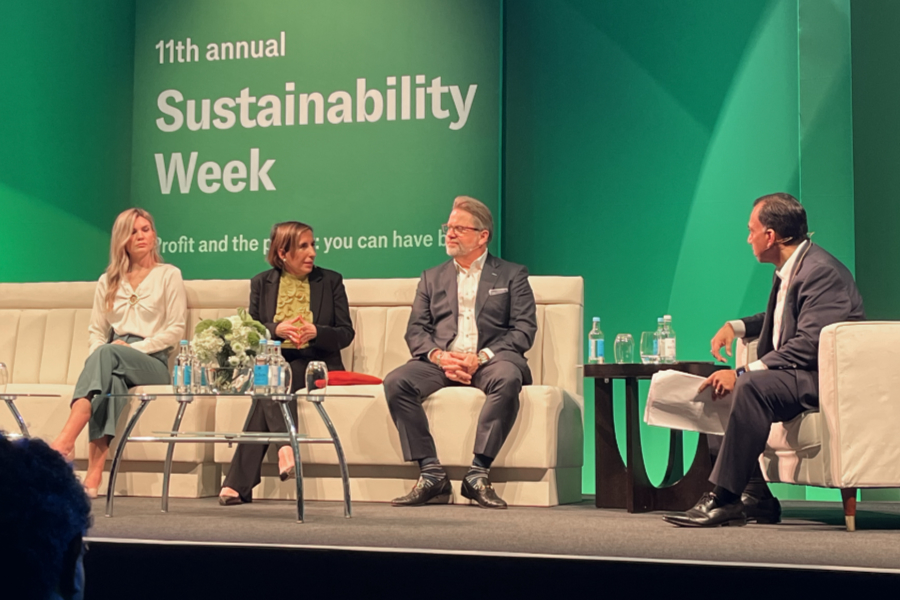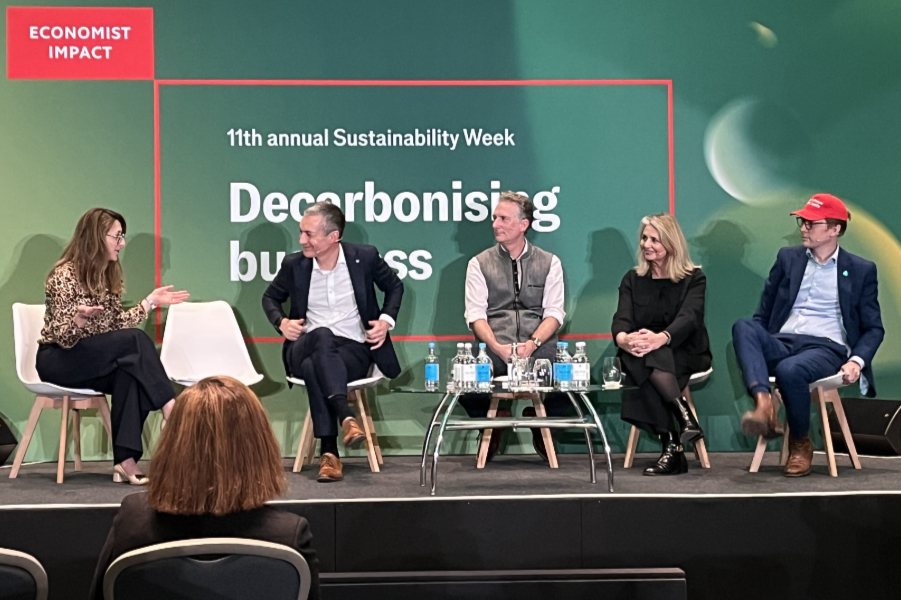
Business voices can play a key role in shaping climate policy and competitiveness, as a discussion panel at the Economist Impact Sustainability Week summit in London has explored.
Entitled Marketing with meaning: being a company that communicates ‘good’, the panel saw Peter Bragg, EMEA sustainability and government affairs director, Canon EMEA; Ingmar Rentzhog, chief executive, We Don’t Have Time; Arlo Brady, chief executive, Freuds Group; and Annette Stube, chief sustainability officer, The Lego Group, discuss how brands can talk about purpose, impact and sustainability without veering into greenwashing, and how communication is shifting in a world where trust is hard-won and easily lost.
Clear positioning
Bragg opened the discussion by noting how expectations have shifted in recent years – while in the past, sponsorships dominated brand activity, consumers now want to understand what a company stands for. By aligning commercial messaging with sustainability commitments, he noted, brands can make their positioning clearer and more competitive.
“It’s about giving a deeper awareness of what our products can do. It’s about linking it to a sustainability purpose,” he commented. “Also, for our employees, it’s about engagement, so that they understand why you’re getting involved in a particular campaign.
“There are all sorts of dynamics and angles to it. But certainly for us, I think that by linking what you’re doing – your marketing campaigns – to sustainability, it helps you to achieve sustainability progress in a more meaningful way.”
Taking stock
Freuds Group’s Brady echoed this sentiment, pointing to the obstacles facing sustainability from a marketing perspective at present, with companies cautious about how they communicate in certain markets. This is an opportunity to take stock, he added, noting that listening more closely to stakeholders is essential to understanding which messages connect and which fall flat.
“Given what we’ve been doing for the last 20 years, as we’ve built up enough momentum in terms of public engagement or investor engagement, I think it’s a good moment to pause and look at what’s been done,” he said. “Maybe there’s a different way of engaging around some of these issues.”
Consistent communication
Stube pointed to the direct link between The Lego Group’s social mission and sustainability work, noting that children sit at the centre of the company’s strategy – thus, communication is framed in a tone consistent with the brand’s identity.
“Coming to the Lego Group a few years ago,” she explained, “I had to get used to this different mindset of talking about what we can do about it in a fun and playful way – on how we mitigate climate change, for instance. […] That’s about focusing on the proof points rather than just the aspirations. I think it’s something that everyone, including children, can understand.”
Stay the course
Decked out in a red ‘Make Science Great Again’ hat, Rentzhog of We Don’t Have Time offered the most impassioned contribution to the panel, calling on corporate leaders to stay the course and maintain their commitment to sustainability, even in challenging political environments.
“Not everything is about making money,” he said. “It’s about fighting and standing up for what’s right. […] You don’t need to do everything right, you just need to take the right steps.”
As the panelists noted, sustainability communication increasingly involves clarity of purpose, transparency and an understanding of audience concerns – or, to put it another way, for sustainability to resonate, it needs to be relevant.
The Economist Impact Sustainability Week summit continues on 4 March. More information can be found here.