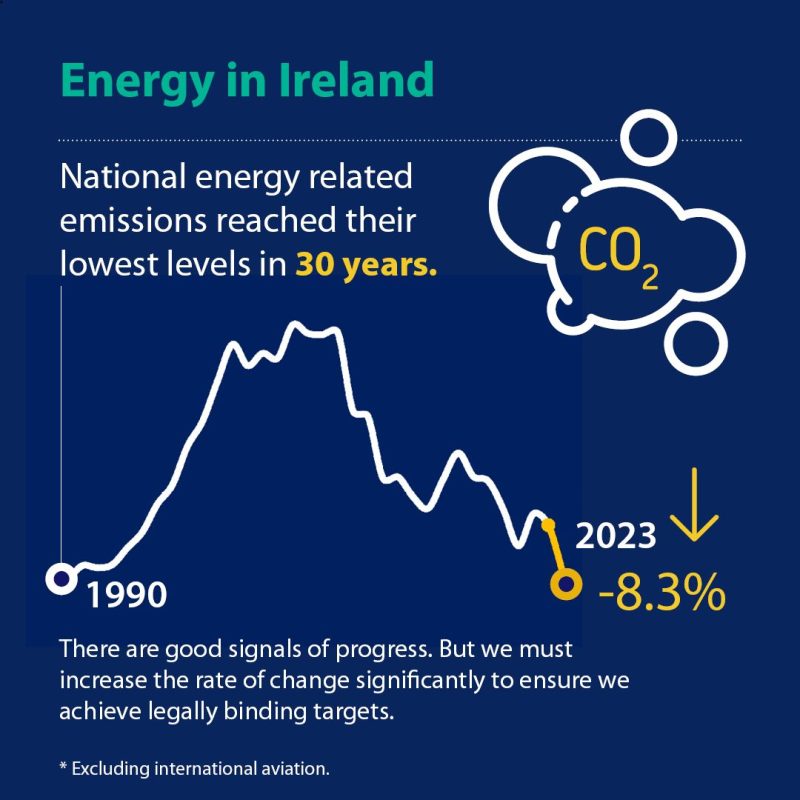
Ireland‘s energy-related emissions reached their lowest level for 30 years in 2023, falling by 8.3%, new data from the Sustainable Energy Authority of Ireland (SEAI) has found.
According to the data, Ireland’s energy demand increased by 0.8% last year, due to increased energy demand from transport (+4.5%), particularly private car use and aviation) and commercial services, including data centres (6.9%).
The year 2023 was also a ‘record’ one for renewables, while demand for gas, coal, peat, electricity, and oil all dropped in the residential sector.
Strong dependance on fossil fuels
However, despite the reduction in energy-related emissions, Ireland still remains ‘highly dependant’ on fossil fuels, the SEAI said, accounting for 82.7% of the country’s energy needs.
‘The data shows good signals of progress, but Ireland will have to increase the rate of change significantly to deliver on its legally binding targets,’ it noted, adding that strategic management of energy demand growth will be needed to ensure progress in the transition to green energy.
Early 2024 data indicates that residential demand for gas and heating oil increased this year, while it is also likely that Ireland’s transport and electricity emissions will exceed the sectoral emission ceiling established in the first carbon budget (2021-2025).
In turn, there is also a growing concern that Ireland could face fines for falling short of its climate commitments. To address this, the SEAI has called for intensified efforts, including faster deployment of offshore wind, solar energy, district heating, heat pumps, and electric vehicles.
‘Critical mass action’
“This year’s data includes a number of welcome achievements in terms of renewables and emissions reductions,” commented William Walsh, CEO SEAI. “The question now is do these signals mark the start of a tipping point for critical mass action in our national energy transition. We need bold, courageous and committed leadership nationally and across all sectors to avoid missing our non-negotiable carbon budgets and EU targets.
“Acting immediately is essential; we can see already that concerted effort and actions deliver results. It’s not just the end goal of emission reductions by 2030 or 2050 that matter, but reducing our emissions each and every year, to comply with science-based carbon budgets and sectoral ceilings. These are our non-negotiables.” Read more here.