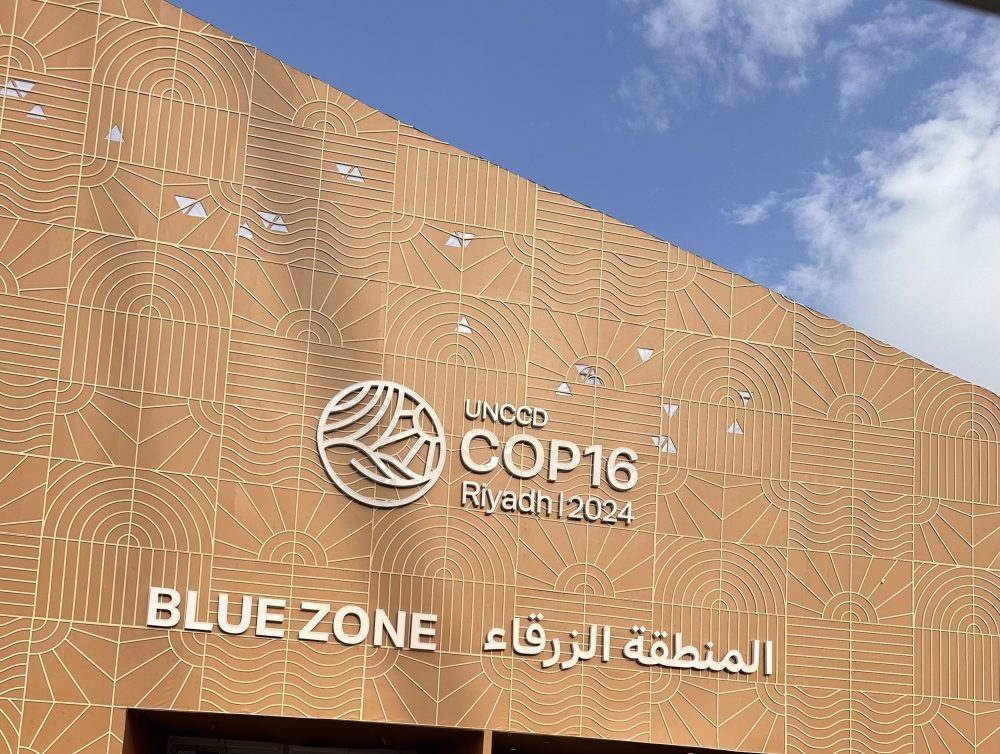
The United Nations Convention to Combat Desertification (UNCCD) COP16 is drawing to a close in Riyadh, Saudi Arabia, with the organisers describing the event as a ‘landmark moment for the fight against land degradation, desertification and drought’.
COP16 welcomed more than 24,000 registered participants – including a total of 57,000 visitors to the Green and Blue zones – as well as thousands of events, dialogues, and panel discussions. It was the third ‘Conference of the Parties’ event of the year, following the biodiversity COP16 in Colombia earlier this year, and the COP29 climate change conference in Baku in November.
SustainabilityOnline looks at five key takeaways from the event.
1 – The Riyadh Action Agenda
The organisers of COP16 have trumpeted the Riyadh Action Agenda as a driver of ‘lasting contributions, engagement and action on global drought resilience and land restoration’. The agenda, which has already begun collaboration with over 100 new and existing initiatives, aims to mobilise countries, NGOs, financial institutions, and the private sector to bolster global action.
“The Riyadh Action Agenda has already helped galvanise state and non-state actors around the world,” commented Dr. Osama Faqeeha, deputy minister for environment, Saudi Arabia, and Advisor to the UNCCD COP16 Presidency. “However, COP16 in Riyadh is just the beginning of its impact, and Saudi Arabia’s UNCCD COP16 Presidency will continue to engage with everyone from the investment community, NGOs and scientists to Indigenous Peoples and farmers, to maximise its lasting global legacy.”
2 – Drought resilience commitment
COP16 secured over $12 billion in funding pledges for land restoration and drought resilience, a key part of which was the Riyadh Global Drought Resilience Partnership, which mobilised $2 billion to support drought-prone nations. The initiative will incorporate early warning systems, financing, vulnerability assessments, and drought risk mitigation strategies in the 80 countries most vulnerable to drought.
“The Riyadh Global Drought Resilience Partnership will work to deliver a transformative shift in how drought is tackled around the world,” Faqeeha added. “This stands to be a landmark moment for combatting international drought, and we are calling on countries, companies, organisations, scientists, NGOs, financial institutions and communities to join this pivotal partnership.”
3 – Technological innovation
Technological solutions came to the fore at COP16, with Saudi Arabia in particular using the event to showcase AI- and tech-driven solutions to combatting desertification and drought. These include the REMDY project, an AI-driven platform for assessing land health.
Additionally, the launch of the Sand and Dust Storm Warning Advisory and Assessment System (SDS-WAS) in Jeddah expands global early warning systems, enhancing resilience in regions impacted by dust storms. This initiative, which increases the number of global World Meteorological Organization-affiliated nodes to four, received an initial pledge of $10 million to support under-resourced countries.
“Innovation is a huge enabler,” as Faqeeha noted during the event.
4 – Unlocking economic growth
Can tackling drought and desertification be good for business? Yes it can, according to a report launched at COP16, Economics of Drought: Investing in Nature-Based Solutions for Drought Resilience – Proaction Pays.
As the report noted, droughts, exacerbated by environmental degradation, cost the global economy over $307 billion annually, however, nature-based solutions, such as reforestation, grazing management and watershed restoration can not only build resilience, but also reap economic rewards. For every dollar invested, up to $27 in economic benefits can be generated.
Sustainable practices could generate up to $10.1 trillion annually in business value and create nearly 395 million jobs by 2030, the report states.
5 – Funding shortfall
Despite the proactive measures announced at COP16, there is still a significant funding gap when it comes to land restoration and drought resilience – the UNCCD’s financial risk assessment highlighted a $278 billion annual shortfall.
COP16 emphasised the critical role of the private sector in bridging this gap, calling for increased investment in sustainable land management.
“”We do not need to reinvent the wheel to deliver urgent solutions to the crises gripping our land and soils,” Faqeeha noted during the conference. Read more here.