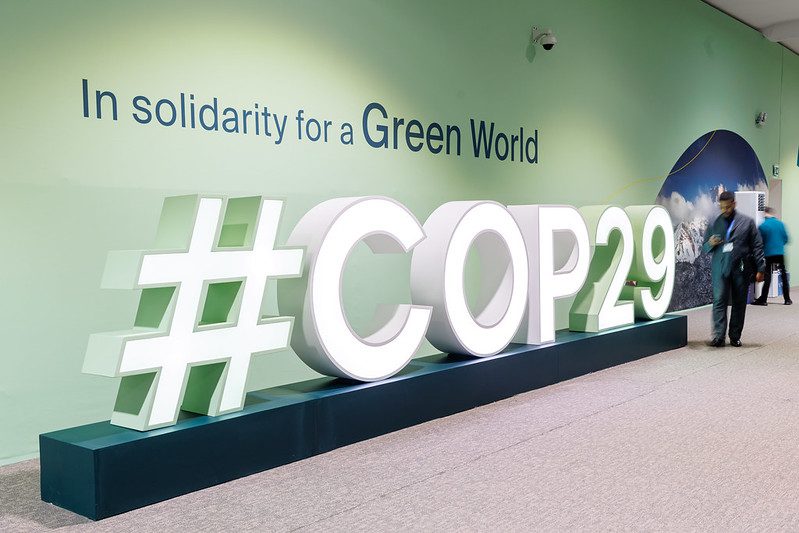
As COP29 kicks off, Luis Costa, Climate Research Lead, and Yann Rosetti, Research Specialist, at the World Benchmarking Alliance (WBA), examine why it still makes sense to assess companies against the 1.5°C climate change ambition, and how other climate narratives would risk downplaying the urgency of business action.
Is the Paris Agreement’s 1.5°C climate target dead in the water? That’s irrelevant, says the World Benchmarking Alliance (WBA). Aligning transition planning efforts in pursuit of the 1.5°C target will remain the only meaningful goal for both corporate accountability and the planet.
The 1.5°C window is closing. It’s been nearly 10 years since COP21 in Paris, where in a rare feat of global diplomacy world leaders agreed on the critical importance of keeping global warming well below 2°C. Yet insufficient action has put success in jeopardy. As of January 2023, there was an estimated 250 Gt CO2 left in the carbon budget to achieve this goal – equivalent to just six years’ worth of current-level emissions.
This gloomy outlook has prompted debate from both scientific and corporate communities. Is there any hope of reaching the 1.5°C goal? What’s the point of working towards a “dead” target? Some have argued that we should just call it quits altogether and write a new narrative. Yet no discussion offers a tractable way forward in a way that matters: speedy climate action.
Worse still, this narrative risks casting shadows on those holding corporations accountable for their climate efforts. If the target is unattainable, does it still make sense to assess companies against a 1.5°C ambition?
‘No other climate target’
The answer is yes, absolutely. Firstly, there is no other ethically defensible climate target. The 1.5°C target exists because it reflects a political willingness to protect all nations, particularly vulnerable ones, against climate change impacts. Science affirms this insight as we see climate impact rise significantly beyond 1.5°C levels of warming.
Shifting the goal essentially says that as a global community we are content with putting a third of humanity in perilous climate conditions if it takes the pressure off richer countries.
Secondly, there is no evidence that an alternative target will speed up climate action. Since the 1.5°C signing in 2016, current policy projections of global warming have been systematically revised downwards. In 2016, the world was on track for global warming of up to 3.4°C. In 2023 the continuation of current policies places locked warming at 2.7°C (a 50% chance). Should all parties’ emissions reduction pledges be realised, that figure drops to 2.3°C. Clearly, aiming for 1.5°C had a mobilising effect on pledges and investments whose effect is steering the planet away from insurmountable levels of warming.
While it is true that the levels of warming embedded in current policies are unacceptable under the 1.5°C target, an alternative needs to demonstrate that it can plausibly achieve a higher rate of avoided warming. Without proof that a different narrative would do a better job than the current arrangement, such discussions are entirely hypothetical and, we argue, a waste of valuable time.
Thirdly, and perhaps most importantly, revising the 1.5°C target to the next lowest level of warming possible does not provide an objective way of measuring progress. It may even fuel social tensions and misconstrue the nature of the climate system itself.
Let’s imagine, under the attractive narrative that “every fraction of a degree matters”, the target is shifted to 1.7°C. This more than doubles the allowed carbon budget for 1.5°C. The only practical effect would be a flood of corporate and country climate targets becoming ultra-ambitious overnight without a single extra gram of CO2 being avoided.
It would also likely delay critical required investments and public policies that are so important to connect the dots between nationally determined contributions (NDCs) and companies transition plans. By relaxing the sense of urgency, we fail to understand how this scenario would unlock the type of action needed to reach the alternative targets.
In addition, a new global consensus would need to be forged on what warming level ‘matters’ most and for whom.
The importance of 1.5°C
For island states no warming level above 1.5°C ‘matters’ given the near-certain collapse of the Greenland ice sheet. The same goes for the communities depending on coral reefs, which virtually disappear with warming above 1.5°C.
Forging a new global consensus would become an unnecessary distraction, creating a playground for more greenwashing and resentment from those making genuine progress towards 1.5°C, and turbocharging social divisions between climate activist groups and governments.
Need for clear targets
At WBA, we fully recognise the importance of having clear targets, which are essential for guiding corporations in transitioning away from carbon-intensive activities and measuring their progress. The 1.5°C target appears increasingly difficult to achieve, but instead of altering this aim we need to reassess how countries and corporations are held accountable for missed opportunities that could get us closer to this goal.
Our benchmarks indicate that, nearly a decade after the Paris Agreement, a significant number of global companies have failed to report their emissions, set short- or long-term targets, or provide evidence of a credible and robust transition plan. These foundational steps are within reach for any company and, at least in the short term, require neither substantial investments nor actions that would harm shareholder interests or public opinion.
As we’ve noted, even an ambitious target that seems unattainable can drive meaningful progress, so if these companies had made even minimal efforts over the last decade, the outlook now would be brighter. The consequences of this being the case again in a further 10 years’ time will be devastating.
A determinant of business success
We need to catalyse action among those that are still dragging their heels. It’s time to hold countries and companies to account for their role in downplaying the 1.5°C ambition. We should use this opportunity to make climate action a determinant of business success and establish a UN convention that clearly defines the private sector’s role in achieving the Paris Agreement.
It’s time to push the transition into the mainstream with concrete plans and climate finance, and it’s time to do away with distracting, shackling narratives, and focus on the challenge at hand. [Photo: UN Climate Change – Habib Samadov]